
Sunday, September 20, 2026

Kenyan Presidential Elections Null and Void, Supreme Court Declares

Ronnie Evans

September 1, 2017
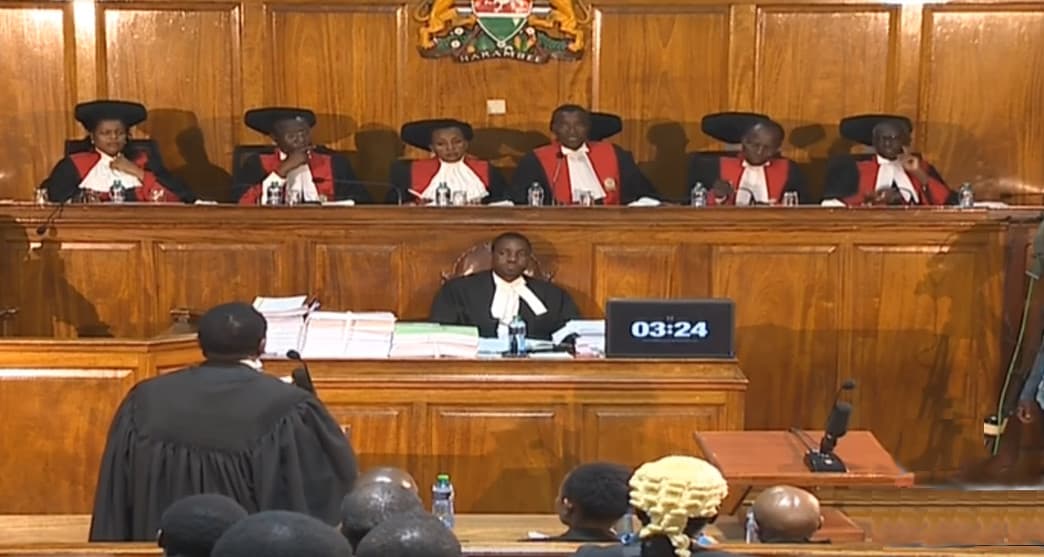
Kenya Presidential election result annulled by Supreme Court decision.
Nairobi, Kenya (ViaNews) - The Supreme Court of Kenya added a new twist to the election conundrum after nullifying the Kenyan presidential elections held on August 8 during an announcement made on Friday morning in Nairobi. Four judges led by Chief Justice David Maraga, his deputy Philomena Mwilu, Smokin Wanjala and Isaac Lenaola were on the view that the electoral process conducted by Independent Electoral and Boundaries Commission (IEBC) was flawed. On the other hand judges, Njoki Nd’ungu and Jackton Ojwang dissented as they believed the elections as fair in accordance with the international observers. In his ruling on the matter, he said that it was not humanly possible to go through the huge chunks of paperwork presented before them given the short timelines. He highlighted the following prime factors in the determination of the court’s decision:
  • a) Whether the 2017 presidential elections were conducted within the principles laid down in the Constitution of Kenya.
  • b) Whether there were irregularities in the conduct of the 2017 presidential elections.
  • c) If there were irregularities and illegalities and if so what was their impact on the integrity of the election.
  • d) What consequential orders and declaration the court should grant in this case.
In his response to these factors, he said, “the court was satisfied that the first respondent (IEBC) committed irregularities in the transmission of results and its particulars. The decision of the court is banning of the presidential elections 2017.” The country’s top judge then went on to order the IEBC to conduct fresh elections within the stipulated 60 days as dictated by the Constitution. Maraga closed the lid on an anxious two weeks for supporters. This ruling is the first of its kind in not only in Kenya’s but also Africa’s history that has undergone significant changes in its constitutional and electoral reforms. According to the IEBC database, 19 million people were in their registered voters’ database with 15 million taking part in voting. Two weeks ago, the National Super Alliance (NASA) filed a petition against the President Uhuru Kenyatta’s Jubilee Party and IEBC challenging the election results that had Kenyatta declared as the winner. There were claims by NASA that the IEBC servers were hacked and results manipulated.

Shot in the arm for Odinga

This development has been a shot in the arm for a veteran politician and opposition leader Raila Odinga who has been viewed to be in his sunset years politically and at 72, he now has to shift his focus to a re-run of the presidential elections against President Kenyatta. The court’s directive has drawn excitement in Odinga’s strongholds in Western Kenya while President Kenyatta has publicly told his rival to be ready for the terms as a ‘rematch’ despite not agreeing with the court. “I personally do not agree with the decision by the Supreme Court judges but I respect it,” Kenyatta said in response. On his part, Odinga was pleased with the outcome. “I am happy as this is historic for Kenya and Africa as it is the first time that a ruling of this kind has been made,” he said after the court session. Maraga concluded by stating that a comprehensive judgment will be made later. Pressure is now on IEBC to go back to the drawing board and plan for elections again. In 2013, a similar petition was presented before the court and the ruling was in favour of Kenyatta as Odinga’s team failed to convince the court that the election malpractice was sufficient enough to change the complexion of the result. In two months or less, Kenyans will once again have the chance to exercise their democratic right as they select their preferred candidate for the country’s top job.

Categories

Tags

What we know · the intelligence behind this page
Live from the substrate
What we're seeing
AI Boom Hits a Fork: Slowdown Calls Clash with Capex Confidence as Markets Get Nervous
Dario Amodei's repeated calls for a global slowdown in frontier AI development, echoed by Microsoft's new humanist AI code of conduct and FTC antitrust caution, are being publicly rejected by Nvidia and Meta leadership even as hyperscaler spending draws fresh skeptical scrutiny (Wachter's analysis, Burry-style overbuilding worries) and weak guidance from Adobe and a post-slowdown-comment selloff in GE Vernova signal investor jitters. Meanwhile wealth and security effects of the AI race keep compounding — Zhang Yiming's fortune surging on AI-driven ByteDance value, a Chinese hacking firm weaponizing AI against stolen government secrets, and low-quality AI-generated products (an AI sitcom, a spam-flooding agent platform) fueling backlash even as adoption races ahead.
Our read on the data ›
Signals we're tracking
EPKINLY Regulatory-Clinical Success Cascade
High probability of expanded label indications, additional combination approvals, and competitive positioning strength in follicular lymphoma market. Predicts positive commercial uptake and potential accelerated review for related indications.
Patterns we're watching ›
Where sources disagree
Berkshire Hathaway
Both facts report Berkshire Hathaway's cash position on 2026-01-01 with identical observation timestamps, but claim vastly different values: 380 billion USD vs 400 USD. These cannot both be true for the same entity at the same point in time. The magnitude of the discrepancy (a factor of ~10^9) rules out rounding, unit conversion, or methodological differences.
We flag conflicts openly ›
Recently verified
Checked against the original source
4,982
facts traced to their source — and we flag the ones that don't hold up.
101 entities tracked4,982 facts checked against source5,299 source documents archived
Query this data → isubstrate.com