
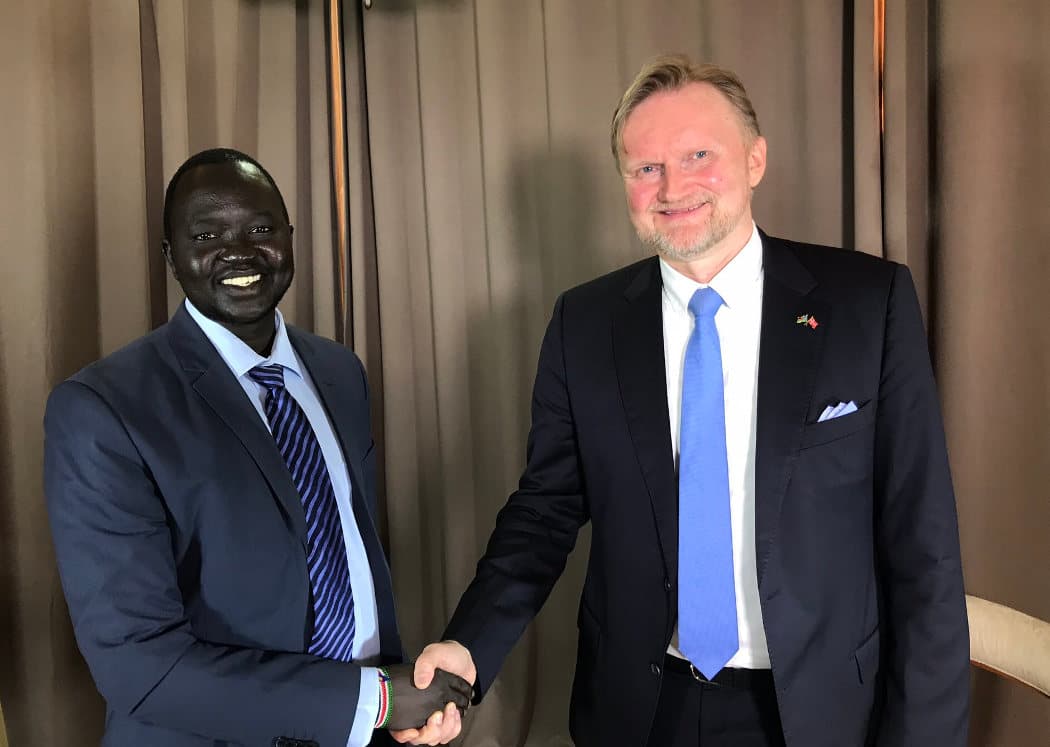
JUBA, South Sudan (Via News) - "We are worried about developments in South Sudan. We see journalists being persecuted, as is anybody else that criticizes the government. This does not bode well for the country's civil society – or for its peace process," states Lars Andersen, Norway's ambassador to South Sudan.
Andersen continues: "South Sudan's journalists and activities require effective protection from government-issued harassment, as this is the way to ensure freedom of the press and speech."
Norway & South Sudan Relations https://t.co/rfkYWb1Qnj via @YouTube
Good talk with @madingngor on «Fixing South Sudan» on Norway & South Sudan Relations and the work to support peace in South Sudan. Mading has done his research.— Lars Andersen (@LarsandeLars) January 30, 2019
Andersen's remarks were made at a workshop held on February 4, 2019, in Juba. The workshop was organized by the Inter-governmental Authority on Development (IGAD) with the objective of developing the capabilities of women leaders in South Sudan.
As Andersen pointed out: "A free exchange of opinion and voicing of criticisms are elements required for the development of a society. If you stifle criticism and dissent, you won't make the best decisions for your country. And you certainly won't get a handle on corruption and other crimes," Andersen noted.
"Freedom of speech and media are key values of humankind and key indicators of a country's political health. This also applies to each organization. Each of them has to promote and protect these freedoms in its internal dealings," Anderson concluded.
Talking to @madingngor and «Fixing South Sudan» this morning on Norway’s enduring engagement in South Sudan, on lost opportunities of the past, and the present chance for a sustainable peace. pic.twitter.com/B39vkva3nG
— Lars Andersen (@LarsandeLars) December 18, 2018
Andersen's remarks were occasioned by further reports of the South Sudanese government's crackdown's causing journalists to leave their professions, or to resort to strict self-censorship.
South Sudanese journalists join call for the release of Sudanese colleagues
The journalists in South Sudan are reportedly dealing with a harsh crackdown perpetrated by the country's media authorities. Its objective is to stop reports on the unrest sweeping Sudan, the neighbor country to the north.
The authorities' fear is that the unrest could spread to South Sudan.
Harsh though this reportedly crackdown is, it pales in comparison to what our colleagues in Sudan are experiencing.
Their dire fates have led the renowned Committee to Protect Journalists organization to call upon Sudanese authorities to release the journalists detained for the "crime" of covering the widespread protests against the Bashir regime.
"President Bashir's attempt to deflect the public's anger by smearing Sudan's brave journalists is both futile and shameful," says Sheriff Mansour, the CPJ's Middle East and North Africa program coordinator.
"Rounding up more journalists won't help authorities find a solution to the country's ongoing unrest," he added.
The reportedly arrested journalists are Tariq Ali, Iman Osman, Musab Mohamed, Osama Hassan, Adam Mahdi, and Amin Sanada.
These imprisonments have reportedly been accompanied by a revocation of the credentials of journalists working for international news outlets, and by a curtailing of access to the Internet and social media.