
Monday, August 24, 2026
What we know · the intelligence behind this page
Live from the substrate
What we're seeing
AI Leadership Exodus Rattles Investor Confidence Amid Capex Boom
High-profile departures at top AI labs — Brad Lightcap's exit from OpenAI and an unnamed researcher's departure from Alphabet/Google that triggered a share-price drop — are surfacing talent retention as a market risk factor even as hyperscalers pour record capital into AI infrastructure. The reaction shows investors treating key-person risk at frontier AI labs as material to valuation, a new fragility layered onto an otherwise bullish AI-driven capex cycle.
Our read on the data ›
Signals we're tracking
EPKINLY Regulatory-Clinical Success Cascade
High probability of expanded label indications, additional combination approvals, and competitive positioning strength in follicular lymphoma market. Predicts positive commercial uptake and potential accelerated review for related indications.
Patterns we're watching ›
Where sources disagree
Broadcom Inc.
Both facts report EPS for Broadcom Inc. for the same fiscal period (Q1 2026) observed on the same date (2026-02-01). However, they report conflicting values: 1.5 USD per share vs 2.05 USD per share. This is a 37% difference for the identical metric and time period, not a value change over time.
We flag conflicts openly ›
Recently verified
Checked against the original source
4,978
facts traced to their source — and we flag the ones that don't hold up.
101 entities tracked4,978 facts checked against source5,251 source documents archived
Work with this data → vianewsagency.com

Flow Traders and BitMart Deploy Neural Networks for Crypto Trading as Bitcoin Volatility Exposes Algorithmic Limits

Amsterdam-based Flow Traders and Singapore exchange BitMart are deploying deep learning trading systems as Bitcoin's recent volatility—all-time highs followed by sharp corrections—overwhelmed traditional algorithmic strategies. BitMart's multi-tier architecture tests experimental models with limited capital while stable systems handle core execution. Regulatory pressure from China's crypto ban and USDT's credit downgrade is driving platforms to replace static risk engines with real-time ML monit

ViaNews Editorial Team

February 24, 2026

Source Trace Score3 source documents3 with a live linkVerifiability: Strong
Flow Traders and BitMart Deploy Neural Networks for Crypto Trading as Bitcoin Volatility Exposes Algorithmic Limits
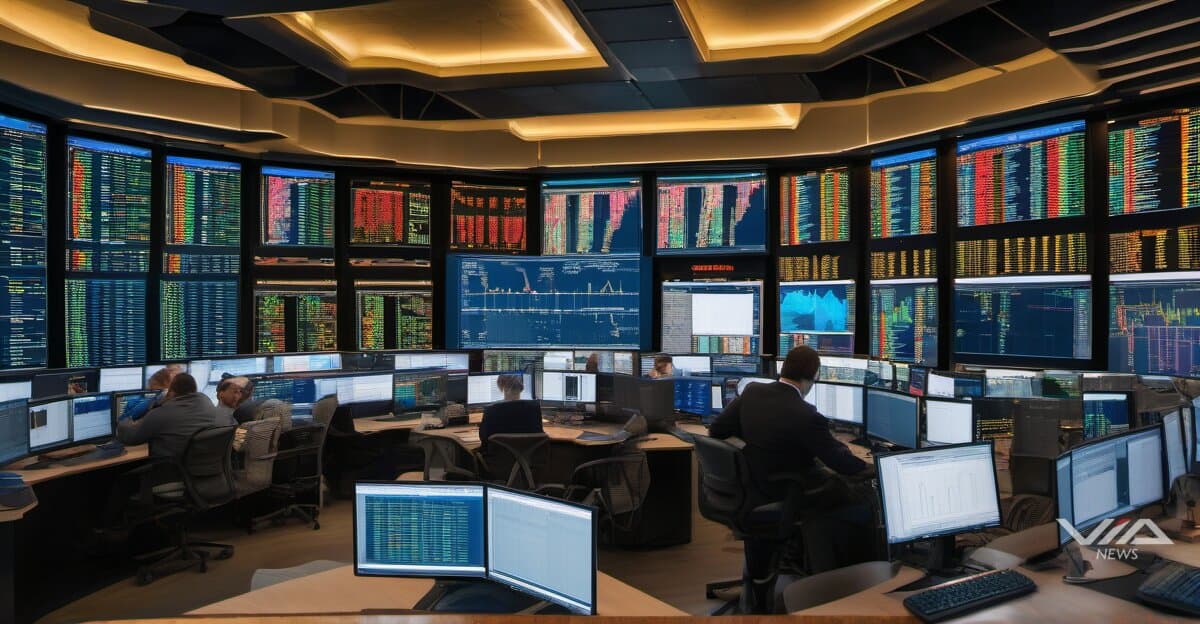
Image generated by AI for illustrative purposes. Not actual footage or photography from the reported events.

Flow Traders, the Amsterdam market maker, is integrating deep learning into live trading operations while Singapore-based BitMart launched multi-generation AI systems, marking two distinct approaches as crypto volatility tests algorithmic infrastructure globally. Bitcoin's swing from all-time highs to sharp corrections exposed the limits of rule-based trading systems.

BitMart's staged deployment uses older stable models for baseline execution while experimental architectures test strategies with restricted capital allocation. This reduces catastrophic failure risk that hit earlier AI trading attempts. Flow Traders' approach focuses on neural networks that adapt to regime changes, a shift from static algorithms.

Meta's transition to TPUs and Google's Gemini 3 Pro release changed ML inference economics for trading firms. Lower latency and compute costs make production deep learning viable for real-time execution, not just backtesting. NVIDIA's earnings beat reflects demand from financial services building private GPU clusters—Flow Traders likely uses in-house infrastructure for sensitive trading data.

Regulatory pressure is accelerating the infrastructure overhaul. USDT's credit downgrade and China's reaffirmed crypto ban forced platforms to embed smarter risk management. ML models now monitor counterparty exposure and liquidity in real-time, replacing static rule engines that failed during volatility spikes.

Traditional finance firms in New York, London, and Tokyo are watching these deployments as proof ML systems can handle production trading loads. The crypto volatility stress test provides real-world validation beyond controlled lab environments. Enterprise adoption depends on model explainability—regulators require firms to demonstrate how AI systems make decisions, shaping architecture choices toward interpretable models over black-box deep learning.

Source documents

Via News is a conduit. We point to the source documents behind this report — we don't replace them. Trace any claim to its source and decide what to trust. How we source

Source Trace Score3 source documents3 with a live linkVerifiability: Strong
  1. [1]Press releaseGlobeNewswire· January 13, 2026
    BitMart 2025 Annual Review: Building a More Complete Financial Infrastructure to Drive Long-Term Sustainable Growth
  2. [2]Press releaseGlobeNewswire· December 5, 2025
    CoinEx Research November 2025 Report: Painvember's Brutal Reality Check
  3. [3]News articleYahoo Finance· February 12, 2026
    Flow Traders 4Q and FY 2025 Results

In this story · Knowledge Files