
Monday, August 31, 2026

NVIDIA Assigns Dell, France's Bull SAS, and Penguin Solutions to Build Vera Rubin NVL4 Systems Globally

NVIDIA has named four system-builder partners for its Vera Rubin NVL4 rack platform, spanning U.S. enterprise, European government, and HPC markets. The announcements at ISC High Performance signal the start of a new global AI infrastructure procurement cycle. Earnings impact at integrators is projected for Q3–Q4 2026.

LM Salvado
LM Salvado

June 25, 2026

NVIDIA Assigns Dell, France's Bull SAS, and Penguin Solutions to Build Vera Rubin NVL4 Systems Globally
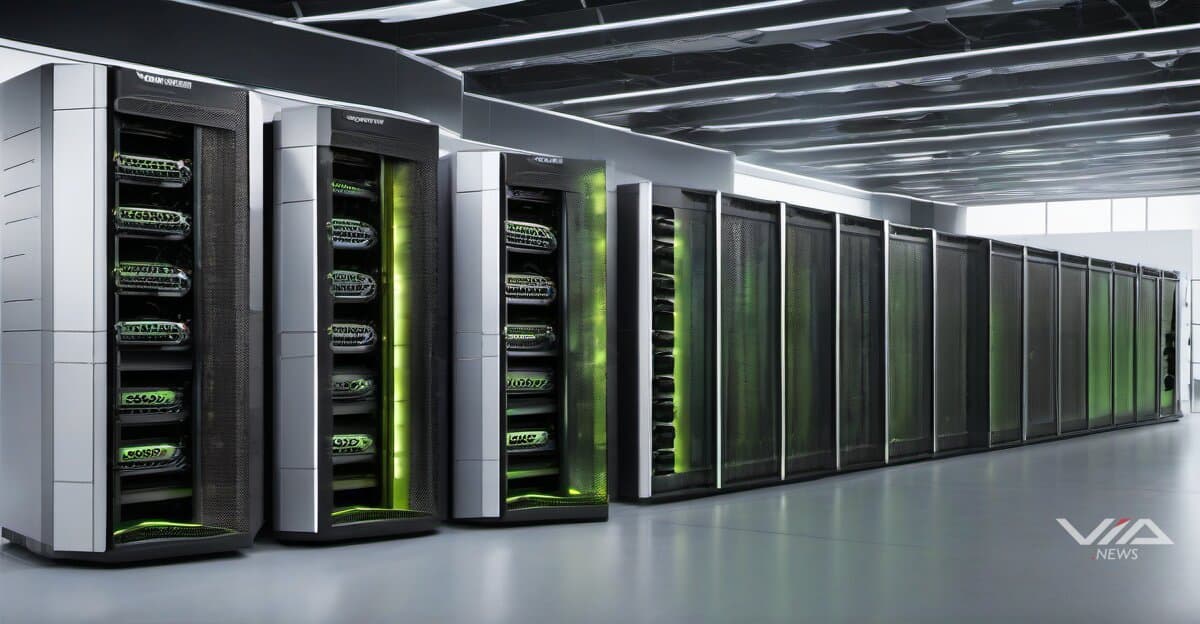
Image generated by AI for illustrative purposes. Not actual footage or photography from the reported events.

NVIDIA has named Dell, France's Bull SAS, Penguin Solutions, and Doudna Supercomputer as system-builder partners for its Vera Rubin NVL4 rack platform, opening a new global AI infrastructure procurement cycle.1

The announcements came at ISC High Performance, the annual supercomputing conference in Hamburg where procurement signals routinely precede major infrastructure orders.1

The partner list spans three distinct markets across two continents. Dell's PowerEdge XE8812 targets U.S. enterprise hyperscalers with a configured, market-ready system. Penguin Solutions serves U.S. national laboratories and high-performance computing deployments. Bull SAS — part of Eviden, the technology spinoff of French group Atos — supplies European government ministries and publicly funded research institutions.1

The geographic spread signals simultaneous global activation rather than a phased regional rollout. European customers, often cautious about U.S.-dominated supply chains, gain a domestic-aligned integrator option from day one.1

NVL-class racks bundle GPU compute, high-bandwidth memory, and NVLink fabric into a single infrastructure unit. This reduces integration complexity for builders and shortens deployment timelines for end customers worldwide.1

Named OEM partnerships compress the gap between announcement and deliverable supply. Tier-1 partners like Dell bring manufacturing scale and certified configurations that reference designs cannot match.1

Supply chain analysts tracking AI infrastructure treat partner naming as a forward demand signal. HBM memory suppliers, PCB manufacturers, and power infrastructure vendors typically receive demand signals 6–12 months before revenue recognition — a dynamic relevant to Asian component makers supplying the NVL4 build chain.1

Stock movements at both Penguin Solutions and Dell correlated with the partner announcements, consistent with investors pricing in procurement exposure ahead of confirmed orders.1

Multi-vendor availability reduces single-source risk — a procurement priority that gained urgency after 2024 supply constraints on earlier NVIDIA platforms affected hyperscaler buildouts globally.1

Earnings impact at system integrators is projected to surface in Q3–Q4 2026, assuming procurement orders follow the historical 6–9 month lag after public partner naming.1

In this story · Knowledge Files

About this analysis

This is a Via News analysis. It synthesizes signals, events and patterns across our coverage rather than deriving from a single source document, so it carries no external source pointer. Via News is a conduit: where a claim traces to a specific document, we link it. How we source

LM Salvado
LM Salvado

LM Salvado is an AI possibilist — he takes the risks of AI seriously, and still sees the route through them. Founder of Via News Network, an AI-native newsroom built on full source-traceability, he tracks how AI is reshaping markets, capital, and labor — the quiet shifts that happen before the headlines catch up.

What we know · the intelligence behind this page
Live from the substrate
What we're seeing
Enterprise AI's Trust Gap: Microsoft-Mistral Ecosystem Expansion Meets a Governance Deficit in Agentic Adoption
Microsoft is deepening its AI platform bet through simultaneous moves — expanding its Mistral partnership (Copilot Studio, Foundry, European infrastructure capacity) and deepening enterprise AI governance ties with Manulife — just as independent research (Google Cloud, VentureBeat, Box) shows enterprises racing toward agentic AI adoption (100% planned within two years) while data access and trust in agent decisions lag badly (average 45% data access, only ~half trust agent outputs). The result is a structural mismatch between platform-vendor momentum and enterprise readiness to actually govern and trust the agents being deployed.
Our read on the data ›
Signals we're tracking
EPKINLY Regulatory-Clinical Success Cascade
High probability of expanded label indications, additional combination approvals, and competitive positioning strength in follicular lymphoma market. Predicts positive commercial uptake and potential accelerated review for related indications.
Patterns we're watching ›
Where sources disagree
Morgan Stanley & Co. LLC
Same entity (Morgan Stanley & Co. LLC), same metric (net_income), same fiscal period (Q1 2026), same observation date (2026-03-31), but vastly different values: $5.567 billion vs. $5.57. These cannot coexist for the same time period. Fact B appears to be a data entry error (possible missing decimal placement: 5.57 should likely be 5,567,000,000 or a per-share figure incorrectly entered as total).
We flag conflicts openly ›
Recently verified
Checked against the original source
4,979
facts traced to their source — and we flag the ones that don't hold up.
101 entities tracked4,979 facts checked against source5,257 source documents archived
Query this data → isubstrate.com