

Monday, September 21, 2026

Is Distributed Teams the Future of Work?

Photo by Ali Yahya on Unsplash

The last three months of the COVID-19 crisis have resulted in the biggest remote work experiment that Landing.Jobs, a Lisbon-based tech company, has ever experienced.

Landing.Jobs is a candidate-driven marketplace dedicated to matching the best tech professionals to the best companies all around Europe.

The COVID-19 crisis has changed the way people work, forcing some teams to move to a fully remote work setup.

According to an official statement by Landing.Jobs, remote work and distributed teams have become the standard for many companies and may even become the new normal after the pandemic.

Right now, to get tech talent, companies need to spend growing sums in tech recruiters (one of the fastest-growing job categories in the last two years), ATSs, and all types of external recruiting services.

After finding the right talent, companies put them in payroll, and assign them to a team or project, managed internally—creating a heavy structure.
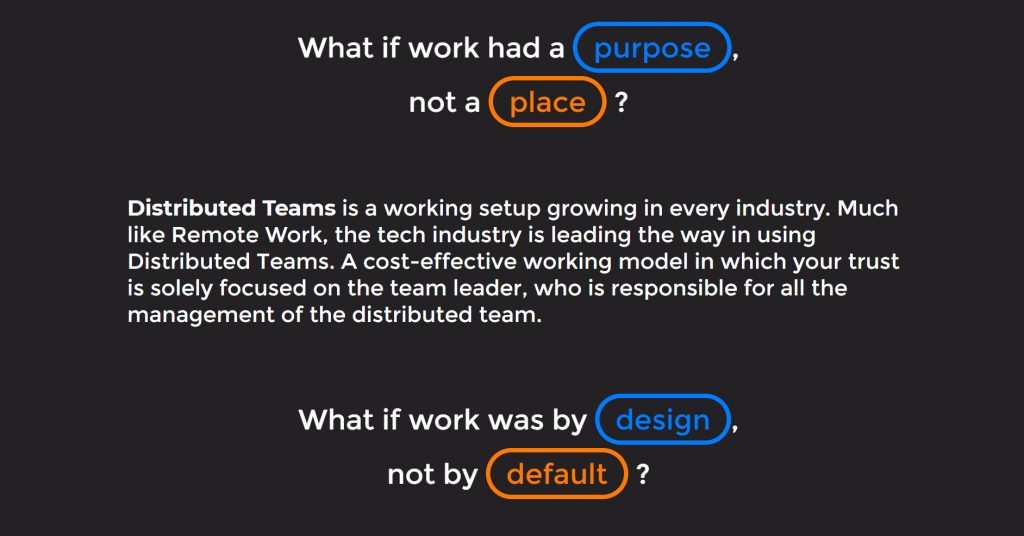
Photo credit: Future.Works

How can companies become more agile and adapt to the future of work?

For Pedro Moura, head of talent at Landing.Jobs, the answer is in the reconceptualization of the workforce with the idea of distributed teams.

He explains: “A Distributed Team is composed of 4 to 7 tech talents working remotely for a client company in a local office setup. For example, a Portuguese network team working in an office in Porto for a British company."

Read more: Distributed Teams Feasible, Need to Invest in Upskilling Low-Skilled Workers

According to Pedro, a distributed team starts by the company selecting a team leader and defining the charter for the team (turn-key projects, time, materials, goals, functions, projects, team profiles, company work, communication procedures, standards, etc).
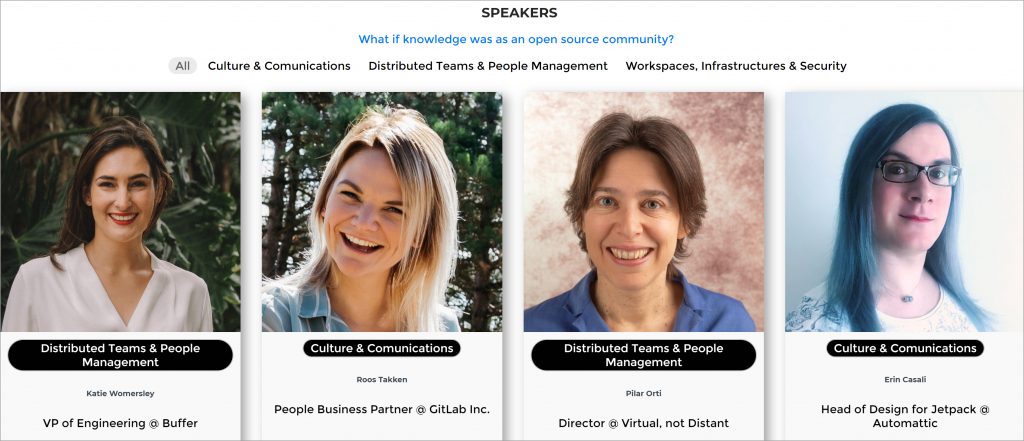
Future.Works is holding the Distributed Teams Conference from June 15 to 17. (Photo credit: Future.Works)

"The team leader staffs the team members and assures work is being done and delivered. The distributed team members don’t need to have any formal contract with the client company," Pedro added.

For tech talent in these teams, this means working together in an office close to their homes (not necessarily in big cities), or even remote in some cases, improving their motivation, sense of belonging, and commitment.

Believing in the power of distributed teams, Future.Works is holding the Distributed Teams Conference, a free online event.
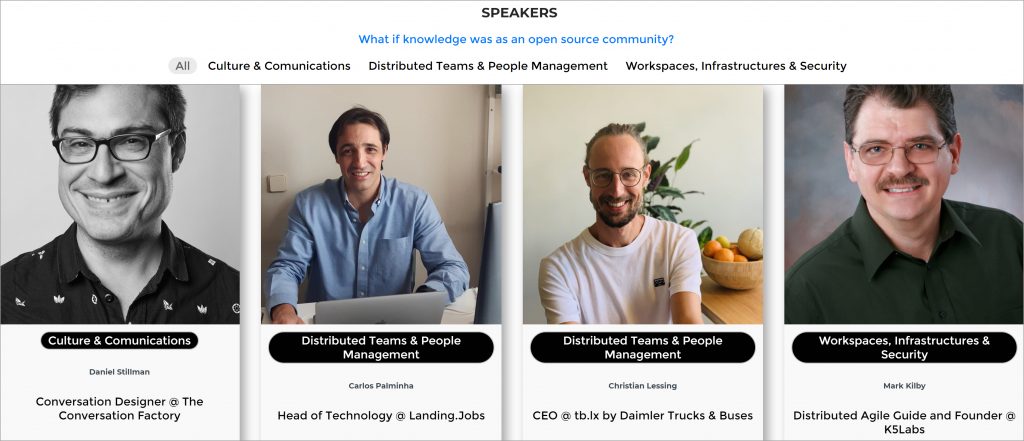
The Distributed Teams Conference is a free online event. (Photo credit: Future.Works)

The event, which began on June 15 and runs until 17, is focused on topics like distributed teams, people management, culture and communication, and a new workspace.
Photo credit: Future.Works

Future.Works is the umbrella brand of Landing.Jobs. The brand focuses on revolutionizing how people think and manage careers and creating products, services, and projects to prepare companies and tech talent for the future of work.

ViaNews Editorial Team

Via News Editorial Team delivers comprehensive financial news coverage and market analysis from journalists around the world. Our team specializes in data journalism and in-depth reporting on stock markets, business developments, and economic trends.

What we know · the intelligence behind this page
Live from the substrate
What we're seeing
Frontier AI Slowdown Call Splits Industry, Rattles Capex-Sensitive Markets
Anthropic's Dario Amodei publicly called for a coordinated global slowdown in frontier AI development, a stance Microsoft echoed with a 'humanist' AI code of conduct, but Nvidia and Meta's CEOs rejected any coordinated pause days later, exposing a widening rift between safety-focused and growth-focused AI leaders. The dispute landed amid growing financial scrutiny of AI infrastructure spending — a hyperscaler capex analysis, FTC warnings against antitrust waivers for AI firms, and an 8.6% single-day stock drop in GE Vernova tied directly to the slowdown remarks — signaling investors are newly nervous about whether the AI capex boom (including Alphabet's projected $701B revenue narrative) can be justified if the pace of development itself becomes contested.
Our read on the data ›
Signals we're tracking
Satellite-Terrestrial Network Integration Acceleration
Increased investment and launches in hybrid satellite-cellular networks across telecom industry; competitive responses from other carriers; regulatory activity around satellite spectrum; expansion of emergency/rural connectivity use cases
Patterns we're watching ›
Where sources disagree
ING Group
Both facts record the same metric (shares_outstanding) for ING Group at the identical observation date (2025-12-31). FACT A states 2,902,437,688 shares; FACT B states 2,902 million shares (2,902,000,000). The difference is 437,688 shares (~0.015%). This is a genuine value conflict, though the discrepancy appears to result from FACT B rounding to the nearest million while FACT A provides the precise count.
We flag conflicts openly ›
Recently verified
Checked against the original source
4,983
facts traced to their source — and we flag the ones that don't hold up.
101 entities tracked4,983 facts checked against source5,304 source documents archived
Query this data → isubstrate.com