

The Office Administrative Services industry facilitates the day-to-day operations and smooth business functioning of small to big enterprises alike.
Besides office administrative personnel, companies in this industry offer financial planning, accounting, billing, and logistics services.
In 2017 the Office Administrative Services industry was worth $71 billion worldwide. Fast forward to 2019, it has grown to more than half a trillion US dollars. The accounting services sector is the largest with a market value of $505 billion, as of December 2019.
Countries in which the industry is flourishing
As of 2017, the North American region claimed the largest share of the industry at 35.43%. In particular, the US accounted for much of this value hence making it the country where the industry is more robust worldwide. The industry has amounted to around $35 billion in value in the US as of 2017. Better economic conditions in the US are behind the exponential growth of the Office Administrative Services industry. By 2023, Statista estimates that the US office administrative services industry will be worth $54.1 billion.
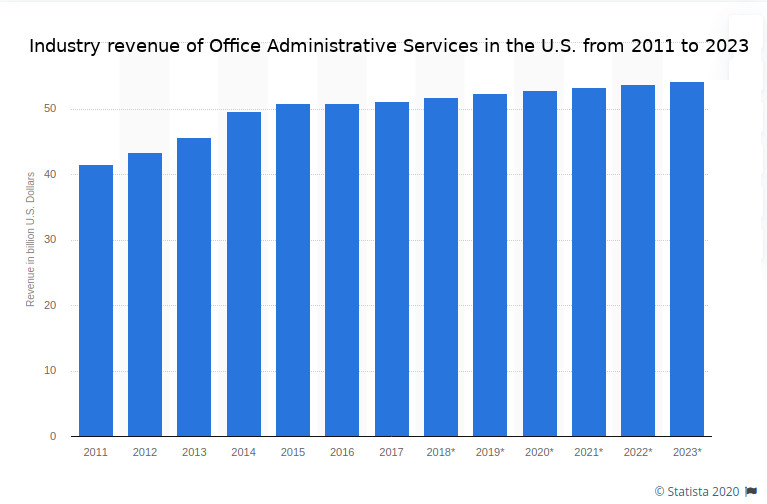
This growth comes on the back of technological advancement and the increased automation of service delivery.
The United Kingdom is another country where the Office Administrative Services industry is vibrant. Notably, a single sector like the call center industry in the UK is experiencing unceasing expansion. In 2019, the sector recorded £2 billion ($2.58 billion) in revenues, which justifies the 0.5% CAGR (Compound annual growth rate) between 2014 and 2019.
From the other end of the world, Australia’s office administrative services industry was about AUD 14 billion ($9.34 billion) as of December 2019.
The Major areas of application
The main products and services that players in this industry offer are record keeping, billing, facilities management, payroll processing, administrative services (like call center service), and others. Specifically, the accounting services (billing, payroll processing, and record-keeping) sector is the largest.
In 2019 alone, the total revenue that the sector earned exceeds $505 billion. The major companies in this sector include PricewaterhouseCoopers (PWC), Ernst & Young, Deloitte, and KPMG.
Other areas of application for this industry include clerical, reception, business administrative services, and more. Interestingly, this sector is not known for having world-renowned providers. Instead, every country has it's major players providing the services. In Australia, for instance, the major players in the industry are the Spotless Group and Ferrovial Services Australia Pty Ltd.
Industry short-term and long-term expectations
A lot is happening in the industry. For the short term, legacy business structures are likely to hold their turf. For example, legacy companies like The Big Four, i.e., Ernst & Young, PwC, KPMG, and Deloitte will continue to rake in huge sums in revenues.
Nonetheless, the long-term view of the industry is exciting for tech-savvy enterprises that focus on lean management and process automation. Administrative tasks like record keeping and billing are being taken over by software like QuickBooks and Zoho Invoice.
This change will provide the fuel for future growth. On this account, The Business Research Company expects the value of the industry to hit $654.55 billion come 2022. In the five years to 2022, the research estimates that the industry will grow at 20.9% CAGR.
Only time will tell how the Office Administrative Services Industry will react to the recession caused by the 2020 crisis.