
Cancer medicine has a crowded calendar this autumn. On 9 October 2026 the US Food and Drug Administration approved Tecentriq, with a standard chemotherapy pairing, for stage III colon cancer in patients whose tumours have a particular genetic fault called dMMR. It is the twelfth US use for the drug.1 Five weeks later comes a bigger test for a much smaller company. Summit Therapeutics' application for ivonescimab, built on the HARMONi trial, has an FDA decision deadline of 14 November 2026.2
That deadline is the clearest dated event in this story, and Summit's audited accounts show what is riding on it. This piece sets out what the checked numbers say, what the industry's AI ambitions rest on, and where our own verification found weak spots.
The price of waiting: Summit's verified accounts
Summit has booked no revenue in the years our data covers. Revenue was zero in both 2023 and 2024.3 What it has done is spend. Its net loss was $221.3 million in 2024 and $1,079.6 million in 2025, nearly five times larger.3 That is roughly $3 million lost for every day of 2025, a figure we derived from the reported total. Loss per share went from $0.31 to $1.44 over the same two years.3
Cash leaving the business through day-to-day operations tells the same story. Operating cash flow was negative $76.8 million in 2023, negative $142.1 million in 2024 and negative $322.9 million in 2025.3 Capital spending on equipment and facilities, still small, rose from $139,000 in 2024 to $657,000 in 2025.3
The cash balance moved sharply, and the pattern matters for anyone judging how much room Summit has. It held $211.5 million in the first quarter of 2025 and $297.9 million in the second.3 It ended 2025 at $225.3 million, then fell to $106.5 million in the first quarter of 2026.3 By the second quarter of 2026 it had jumped to $419.4 million.3 Our verified data records those balances but not where the new money came from, so we do not speculate. The pattern is still instructive: a company with no product revenue, losing about $1.08 billion a year, depends on regularly topping up its cash. A positive FDA decision would change that picture. A delay or refusal would raise the stakes for the next round of funding.
Many readers may not hold Summit directly. Our dossier gives no index-fund weightings for it or for any company here, so we cannot say whether it sits in your fund. Large drugmakers named in the sector, such as AstraZeneca, are listed in the FTSE 100 according to our entity records, which may matter to UK-based fund holders.3
Other catalysts on the calendar
Moderna and Merck plan to present detailed results for intismeran, their personalised mRNA cancer vaccine, at the ESMO cancer congress on 24 October, and to engage with regulators about possible filings.4 That is a plan, not a result, and we have no outcome data to report.
Other recent news shows how the field is widening. In Europe, the regulator's expert committee (the CHMP) has recommended Gilead's Trodelvy plus Keytruda as a first treatment for metastatic triple-negative breast cancer. This is a recommendation, not a final authorisation. Evandro de Azambuja said: "People with metastatic triple-negative breast cancer need effective treatment options as early as possible in the course of their disease, particularly when their tumors express PD-L1."5
In rarer blood-related skin cancers, Kyowa Kirin's final German MINT study covered 109 patients at 18 centres treated with mogamulizumab in routine care. Median time to next treatment, the main measure, was 14.9 months. The best overall response rate was 62.4%, and median progression-free survival was 20.2 months.6 These are real-world results from a company announcement, not a controlled trial.
The AI promise, in its makers' own words
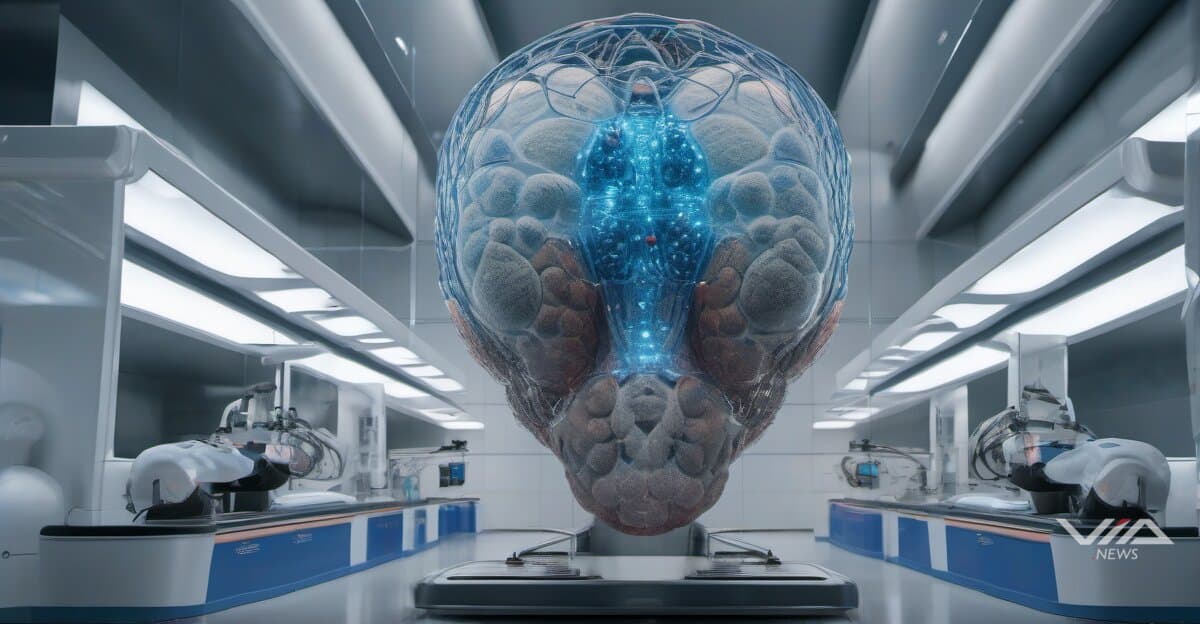
A recurring theme is that artificial intelligence could speed up drug design. Puja Sapra, in an MIT Technology Review piece, describes a 'lab of the future' that works like a self-driving car: "Where a self-driving car uses sensors and models to navigate its environment, this system uses AI to make predictions, robotic systems to execute experiments, and instruments to generate data."7
She also frames data as AstraZeneca's edge: "Data is our differentiator."7 Just as important is her candour about the limits. She says: "One of the hardest problems in de novo design is predicting whether a computationally generated molecule will be safe in the human body."7 And she stresses that "human oversight remains at the heart of this approach—ensuring explainable and ethical AI for the benefit of patients."7
For an investor, the useful reading is that AI is presented as a way to propose better candidates faster and to cut early testing bottlenecks, not as a replacement for clinical trials. Summit's accounts show what the later stage costs. Faster design does not remove a $1.08 billion-a-year bill for late-stage development.
Where capital is going: delivery and commercial success
Money is also flowing toward the business of delivering cancer care. Novocure reported second-quarter 2026 net revenues of $184 million, up 16% on a year earlier, with global active patient numbers up 18%. It also received a European CE Mark for Optune Pax in locally advanced pancreatic cancer, with Germany the first market to launch and more than 280 active patients as of 30 June.8 Frank Leonard said: "This was our strongest quarter to date, with record net revenues and active patients on therapy."8
Our topic framing also points to McKesson and CD&R's acquisition of Option Care Health, a company headquartered in Bannockburn, Illinois.3 Our sources contain no deal terms or prices, so we cannot size it. Talent is moving as well: Everest Medicines has hired two former Moderna cancer-research leaders, according to the October announcements in our event records, which fits the personalised-vaccine race.
How much to trust the sources
The seams matter here. The company announcements above come from a newswire feed in which, by our measurement, 56% of 4,960 checked claims held up. That is a middling record, so treat headline performance figures as company claims until independently confirmed.5,6,8 The MIT Technology Review article is weaker still. Of 11 claims we checked from it, none held up against our source-of-truth checks.7 That does not mean the speaker is wrong. It means the AI-discovery claims are aspirations and descriptions, not verified outcomes. By contrast, the Summit figures are canonical numbers taken directly from SEC filings.3
What to watch
- 14 November 2026: the FDA's decision date on ivonescimab, and any news on Summit's funding afterwards.2
- 24 October 2026: the ESMO presentation of detailed intismeran results and any regulator discussions.4
- The Trodelvy plus Keytruda decision: whether the European Commission follows the committee's recommendation.5
- Summit's next filing: whether cash and the rate of loss move in line with the pattern above.3
The honest summary is that oncology has many catalysts but few settled outcomes. The approvals so far are real. The AI-driven productivity gain is, for now, a stated ambition with no verified track record in our data.