
Biotechnology is a new concept from a scientific point of view. The first serious developments in the industry began to be noticeable in the 1970s. A few years later, it seems biotechnology holds the answers to all problems facing this planet and its inhabitants.
Fast forward, the industry is massive. Growth of the industry in 2019 in terms of revenue and value creation is higher than all the years. Interestingly, the industry has recorded $301 billion in total revenues so far in 2019. Between 2014 and 2019, the average annual growth rate of the industry is at 2%. This is to say that the net trajectory of the industry for the last five years in positive.
In 2017, the global biotechnology industry was worth $218 billion in terms of revenue. However, many companies are spending much more money on R&D, hence creating the right environment for the fast expansion of the market. Faster growth was experienced in 2018 and 2019 so far due to increased investment in R&D.
Tissue engineering and regeneration are the fastest-growing segments of the biotechnology industry. This is because there is a huge demand for tissue engineering and biomedical engineering products and services. Here, the technology helps to replace human cells or to help human organs to restore their natural biological functioning.
Countries that are aggressively pursuing biotechnology
Biotechnology is an advanced technology and it requires an advanced understanding of science. As such, most of the countries leading the pursuit of technology are advanced both economically and academically.
Generally, North America is the leader in this industry. Particularly, the United States tops the industry in terms of revenue from biotech generated.
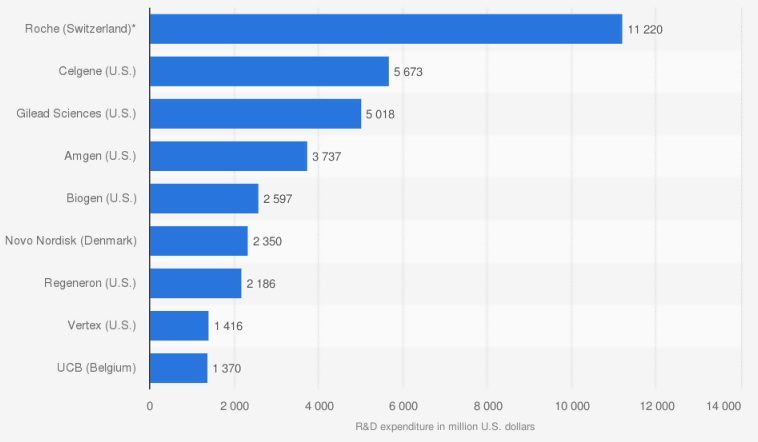
In the US, the biotechnology industry has expanded massively over the last five years. Interestingly, the industry expanded by 3.5% to $112.4 billion in 2019 alone. Between 2014 and 2019, the annualized market size growth of the US biotech market is 1.7%. Further, the US has the largest number of companies that are investing in biotech-focused R&D. In 2018 alone, six US-based biotech companies spend more than $1 billion in R&D. According to Statista data, Celgene spent $5.67 billion in R&D while Gilead Sciences, Amgen, and Biogen spent $5.02 billion, $3.74 billion, and $2.60 billion respectively.
In the 13th Five-Year Plan (FYP, 2016-2020) on National Economic and Social Development, the Chinese government is setting its eyes on innovation. One of the areas that this plan cover is biotechnology. The country intends to take the lead role when it comes to new and revolutionary technologies like biotechnology. Already, the country is making huge strides towards that goal. In 2017, the biotech industry in China was worth$18.66 billion.
Sectors where biotech is applied the most and industry outlook
The global biopharmaceutical industry is the largest application area for biotechnology. In 2018, the biopharmaceutical sector generated $237 billion in revenue. By 2024, the revenues the sector generates should hit $388 billion. This implies a CAGR of 8.59% between 2018 and 2024.
The driver of the growth of the sector lies in the ability of biopharmaceuticals to help treat previously untreatable diseases. Notably, biotechnology is at the center of efforts to control problems like cancer and diabetes. Further, technology has helped to make drugs safer for human use hence increasing chances of improved conditions of patients. Some of the companies that are leading the utilization of biotech in pharmaceuticals include Amgen and Gilead, both US-based, and Novo Nordisk, based in Switzerland.
The outlook of the industry is great. By 2025, the industry should clock $727.1 billion in terms of revenue. Notably, the increased demand for regenerative medicine and increased funding for R&D by governments are driving the growth of the industry. Further, new technologies like artificial intelligence have made it possible to pursue more advanced research in biotech.