
Friday, October 23, 2026

Fed Rate Freeze Through Mid-2026 Squeezes Global Credit Markets as $3.2 Trillion Debt Wall Looms

The Federal Reserve will hold rates steady through June 2026 as U.S. services inflation persists above 3.5%, creating ripple effects across global credit markets. Corporate treasurers worldwide face $3.2 trillion in maturing debt with refinancing costs 150-200 basis points higher than expiring obligations. The prolonged pause mirrors cautious stances from the Bank of Canada and pressures international investors to shift from rate-cut strategies to yield extraction.

Fed Rate Freeze Through Mid-2026 Squeezes Global Credit Markets as $3.2 Trillion Debt Wall Looms
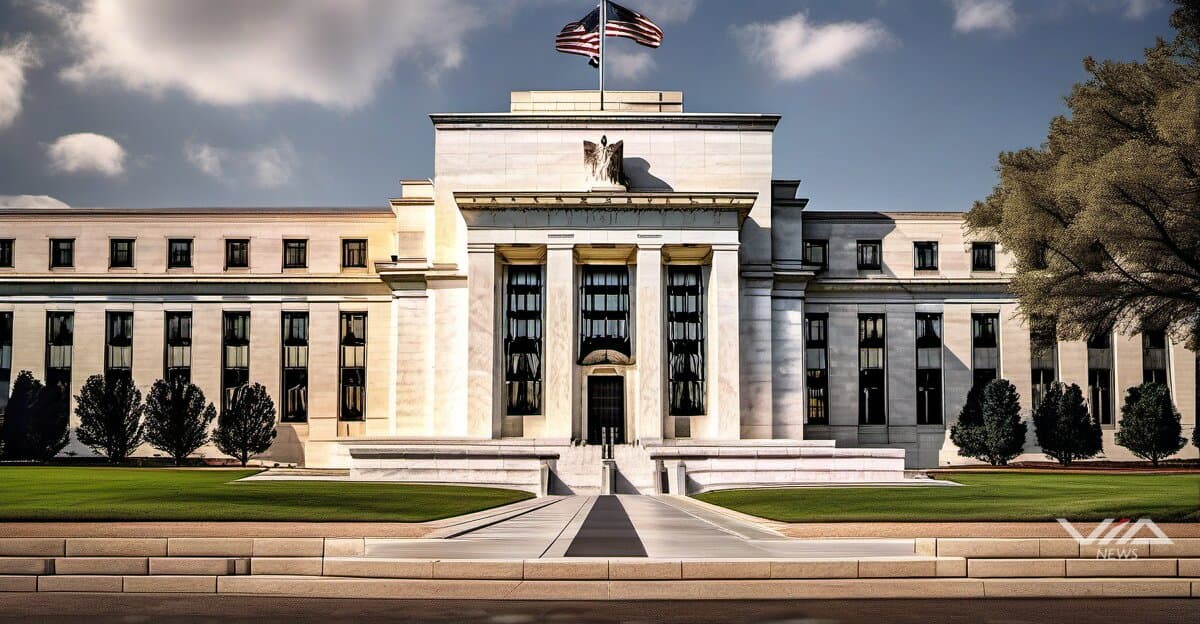
Image generated by AI for illustrative purposes. Not actual footage or photography from the reported events.

The Federal Reserve's rate-cutting cycle halts through June 2026 as services inflation holds above 3.5% annualized, triggering global credit market adjustments. Chicago Fed President Austan Goolsbee confirmed further cuts require clear inflation moderation. Standard Chartered analyst Geoffrey Kendrick puts May 2026 cut odds below 1%.

Corporate treasurers managing $3.2 trillion in maturing debt through 2026 now face refinancing costs 150-200 basis points above expiring obligations. Investment-grade spreads widened 45 basis points since January as firms delay bond issuance. S&P 500 companies cut capital expenditure budgets 8% quarter-over-quarter.

U.S. regional banks with commercial real estate exposure see compressed net interest margins as deposit costs stay elevated while loan pricing stagnates. Default risk rises as borrowers struggle to refinance at current rates. The Bank of Canada flagged highly indebted households as a key vulnerability, a concern shared across North American markets where adjustable-rate mortgages reset higher.

Rate-sensitive equities including REITs and utilities underperformed broader indexes by 12% since expectations shifted. Growth technology stocks dependent on low discount rates for valuations posted similar declines. Credit markets price Fed funds above 4.25% through year-end 2026.

International portfolio managers adopt defensive positioning: short-duration bonds, value stocks over growth, and cash reserves near 15% of allocations. The shift from anticipating cuts to extracting yield in the current environment favors floating-rate securities and senior bank loans, which benefit from sustained higher rates.

Consumer credit stress typically precedes banking sector losses by 6-9 months, creating ripple effects across interconnected global financial systems. The prolonged policy pause forces corporations worldwide to preserve cash and delay expansion projects, slowing cross-border investment flows.


Sources:
1 Yahoo Finance, "Dollar poised for rally as escalating Middle East conflict spurs haven demand" (March 23, 2026)
2 News Report, "Crypto Market Review: Did Shiba Inu (SHIB) Finally Hit Price Top? Bitcoin's Catastrophic Tumbling Mi" (March 23, 2026)
3 Globe Newswire, "XRP News: CACrypto Launches Ripple-Based “Green Mobility Challenge” as Price Outlook Targets $5" (March 21, 2026)
4 Yahoo Finance, "XRP Price Prediction: One Analyst Predicts XRP Price at $27 After Hitting Fibonacci Targets" (March 21, 2026)
5 Yahoo Finance, "CNOOC Names Huang Yongzhang as Chief Executive Officer" (March 23, 2026)

In this story · Knowledge Files

What we know · the intelligence behind this page
Live from the substrate
What we're seeing
Enterprise Software Races to Govern and Consolidate Around Agentic AI
Enterprise software vendors are repositioning around autonomous AI agents. Salesforce is acquiring Braze, ServiceNow is launching agent governance tools (AI Passport, Super Intelligence Control Tower), SAP is pushing its 'Autonomous Enterprise', and Zeta is launching AthenaOS and its own inference model. Palantir is embedding itself in banking, aviation and sovereign AI infrastructure through partnerships with Customers Bank, Surf Air, Ondas and Armada. Governance, data sovereignty and enforced policy are emerging as preconditions for regulated sectors like finance. Investors such as Norwest see room to disrupt ERP and finance software, and they caution that AI should not be trusted with financial calculations. Consolidation and shareholder disputes (Salesforce/Braze, Tiny/Oso Cloud, ZenaTech/Boardwalktech) show the market reshaping.
Our read on the data ›
Signals we're tracking
EPKINLY Regulatory-Clinical Success Cascade
High probability of expanded label indications, additional combination approvals, and competitive positioning strength in follicular lymphoma market. Predicts positive commercial uptake and potential accelerated review for related indications.
Patterns we're watching ›
Where sources disagree
ING Group
Both facts record the same metric (shares_outstanding) for ING Group at the identical observation date (2025-12-31). FACT A states 2,902,437,688 shares; FACT B states 2,902 million shares (2,902,000,000). The difference is 437,688 shares (~0.015%). This is a genuine value conflict, though the discrepancy appears to result from FACT B rounding to the nearest million while FACT A provides the precise count.
We flag conflicts openly ›
Recently verified
✓ Checked against the original source
4,994
facts traced to their source — and we flag the ones that don't hold up.
101 entities tracked4,994 facts checked against source5,475 source documents archived
Query this data → isubstrate.com