
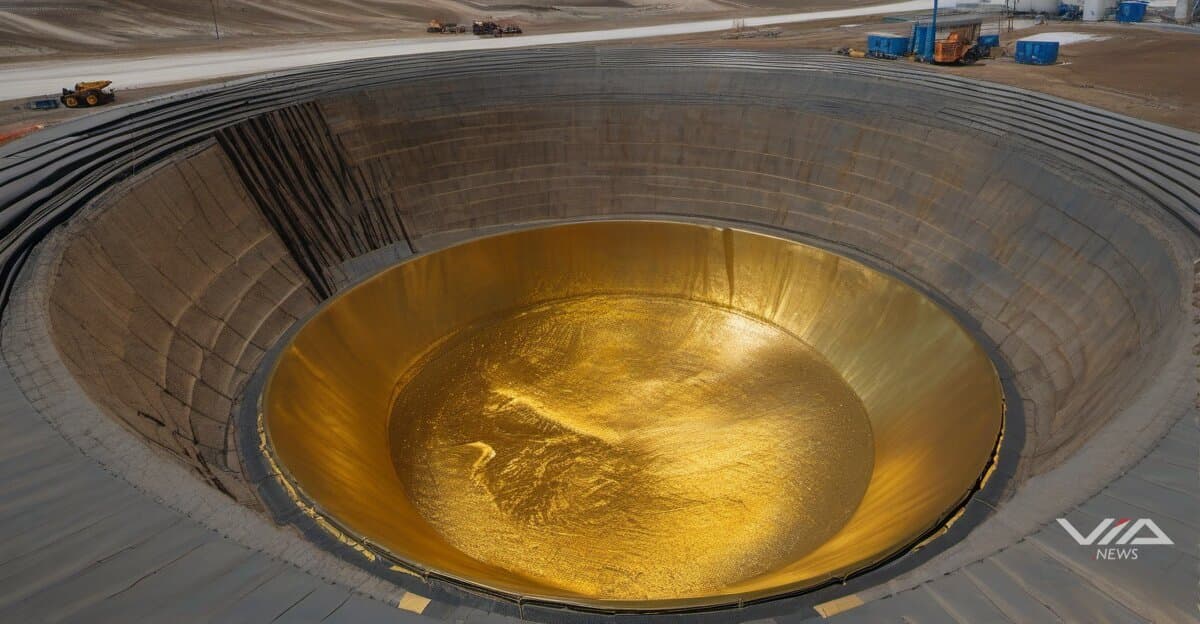
In an era when major new gold discoveries in politically secure territories have become vanishingly rare, Canada's Artemis Gold Inc. (TSXV: ARTG, OTCQX: ARGTF) is moving to fill a conspicuous gap. The company's board has approved a $1.44 billion CAD Expanded Phase 2 (EP2) development at its Blackwater Mine in central British Columbia — a decision with ramifications that extend well beyond Canada's borders.
Board approval came on December 15, 2025. Early works are set to begin in January 2026, with major construction commencing in Q3 2026 and a first gold pour from the EP2 facility targeted for Q3 2028. Full production is expected by year-end 2028.
A Junior Producer on Track to Join Global Majors
Blackwater's trajectory is exceptional by any international benchmark. The mine poured its first gold in January 2025 and declared commercial production on May 1, 2025, with current annual guidance of 190,000–210,000 ounces of gold. By 2029, EP2 is projected to push that figure to 500,000–525,000 ounces per year — a level that would place Artemis alongside established mid-tier producers such as Kinross or Pan American Silver in terms of output scale, and within reach of the lower tier of global majors.
For context, the world's largest gold producer, Newmont, operates at roughly 6 million ounces annually across multiple continents. A single Canadian mine delivering half a million ounces from one site, within four years of first production, is a rare achievement in the modern mining era.
Silver production scales in parallel, rising from 600,000–1,200,000 ounces currently to 2,000,000–2,500,000 ounces annually in the first decade of full EP2 operation. Gold equivalent production from 2029 to 2034 is forecast at 520,000–550,000 ounces per year.
Economics That Outperform Global Peers
The cost structure is where Blackwater's international significance becomes clear. Artemis reports an All-In Sustaining Cost (AISC) of US$825–875 per ounce in 2025, rising to US$1,000–1,100 per ounce during the mature EP2 phase from 2029 onward. With gold spot prices currently near US$4,200 per ounce — a level sustained by persistent central bank buying, geopolitical uncertainty, and dollar-hedging demand from emerging markets — the operation would generate an AISC margin exceeding US$3,000 per ounce, or roughly 75% of revenue.
That margin compares favourably even against West Africa's celebrated low-cost producers. Operations in Mali, Burkina Faso, and Ghana have historically delivered some of the world's lowest AISCs, but escalating security risks, coup-driven regulatory uncertainty, and logistical constraints have increasingly discounted their appeal to institutional capital. Blackwater, sitting in British Columbia under Canadian rule of law, carries none of those sovereign risk premiums.
Capital intensity for the expansion is pegged at just $110 CAD per tonne of additional annual throughput — a figure management describes as highly competitive within the global industry. Crucially, Artemis intends to fund the expansion primarily from Phase 1 operating cash flows, limiting dilution risk for equity holders at a time when debt markets for junior miners remain expensive.
A Supply Signal for Global Gold Markets
The broader supply context elevates this project beyond a single corporate story. Global gold mine output has struggled to grow meaningfully for over a decade. The World Gold Council and major analysts have repeatedly flagged the depletion of legacy reserves, rising average ore grades below historic norms, and a dearth of world-class new discoveries — particularly in Organisation for Economic Co-operation and Development (OECD) jurisdictions where environmental permitting, community consultation, and infrastructure requirements raise the bar for development.
Blackwater's reserve base of 8.0 million ounces of proven and probable reserves, underpinning a mine life extending to 2043, represents precisely the long-duration, low-sovereign-risk asset that sovereign wealth funds, pension managers, and gold-focused ETFs have been competing to access. The mine's location in British Columbia also positions it favourably relative to growing Asian demand: Vancouver's Pacific logistics corridor offers efficient routes to refinery and bullion markets in Japan, South Korea, and China.
Geopolitical Timing and the Canada Advantage
The approval lands at a moment of heightened attention to supply chain security in critical commodities. Governments across Europe, Japan, and the United States have moved to diversify sourcing of strategic materials away from jurisdictions deemed geopolitically unstable. Gold, while not classified as a critical mineral in most policy frameworks, has re-emerged as a core reserve asset for central banks globally — with institutions in China, India, Poland, Turkey, and several Gulf states aggressively accumulating bullion since 2022.
Against that backdrop, a large, long-life, fully permitted gold mine in a G7 country represents a category of asset that is structurally undersupplied. Artemis's EP2 approval is not simply a corporate capital allocation decision — it is a material addition to the global inventory of investable, politically stable gold production capacity.
For equity investors, the next milestones to watch are the commencement of major construction in Q3 2026 and the EP2 first pour in Q3 2028. For commodity markets, the more consequential date is 2029, when Blackwater's full output is expected to register as one of the largest single-mine contributions to global gold supply added in this decade.