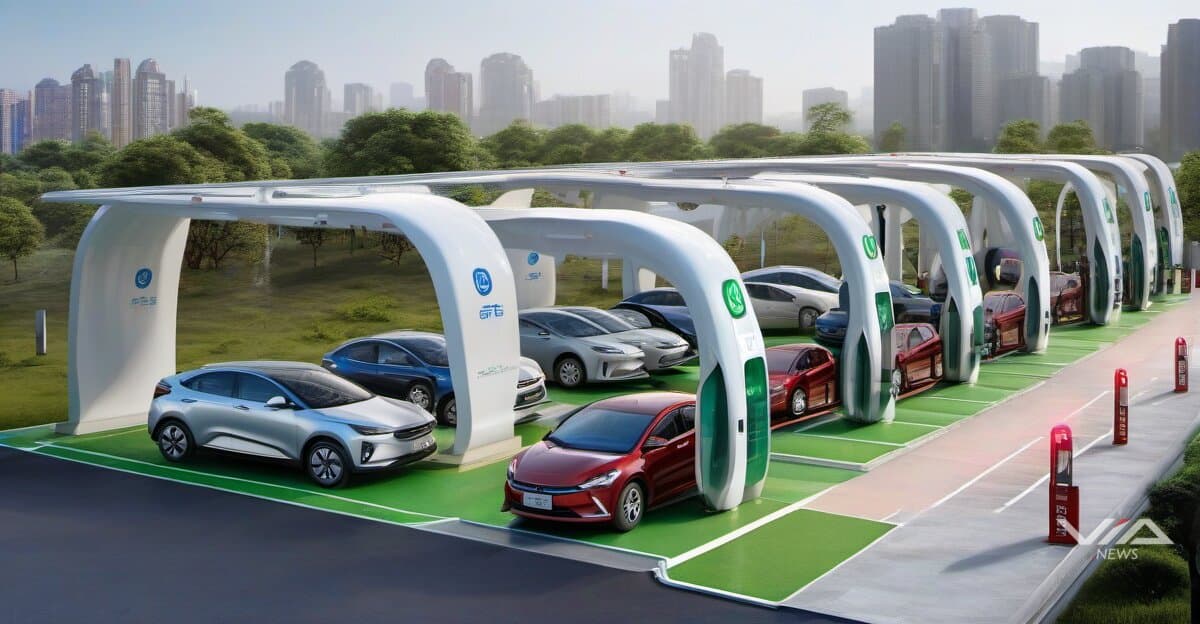
BYD is deploying 20,000 Flash Charging stations across China by end of 2026, each delivering up to 1,500 kW of output.1 Tesla's Supercharger network — the global benchmark for fast charging — peaks at roughly 500 kW, one-third the speed.1
The scale of the gap matters. In the world's largest EV market, charging speed and network density directly influence purchase decisions. BYD is building both advantages simultaneously.
The rollout is anchored by a partnership with Sinopec, China's state-owned petroleum giant.1 Sinopec's 30,000-plus fuel station sites become charging hubs, eliminating land acquisition costs and grid delays that new construction requires. No foreign automaker has equivalent access to that distribution backbone.
BYD overtook Tesla in full-year 2025 global EV sales.1 That was a market share event. A charging network surpassing Tesla on both scale and speed would make that lead structural.
Tesla's China Supercharger network is growing at roughly 18% annually.1 BYD's expansion is outpacing that rate. Analysts project BYD matches Tesla's China station count within the year if current growth holds.1
The competitive pressure extends beyond Tesla. European automakers — Volkswagen, Stellantis, Renault — have invested heavily in China but rely on third-party charging networks. BYD is building its own. That asymmetry raises the switching cost for Chinese EV buyers and widens the gap for rivals attempting to compete on total ownership experience.
Two metrics will confirm or challenge this thesis by end of 2026: BYD's quarterly Flash Charging station count versus Tesla's China Supercharger count, and Tesla's China market share in H2 2026.1 If BYD crosses 15,000 stations by Q4 and Tesla's share falls below 8%, the infrastructure strategy will have delivered its intended moat.1
BYD built the cars first. Now it is building the ecosystem that surrounds them.