
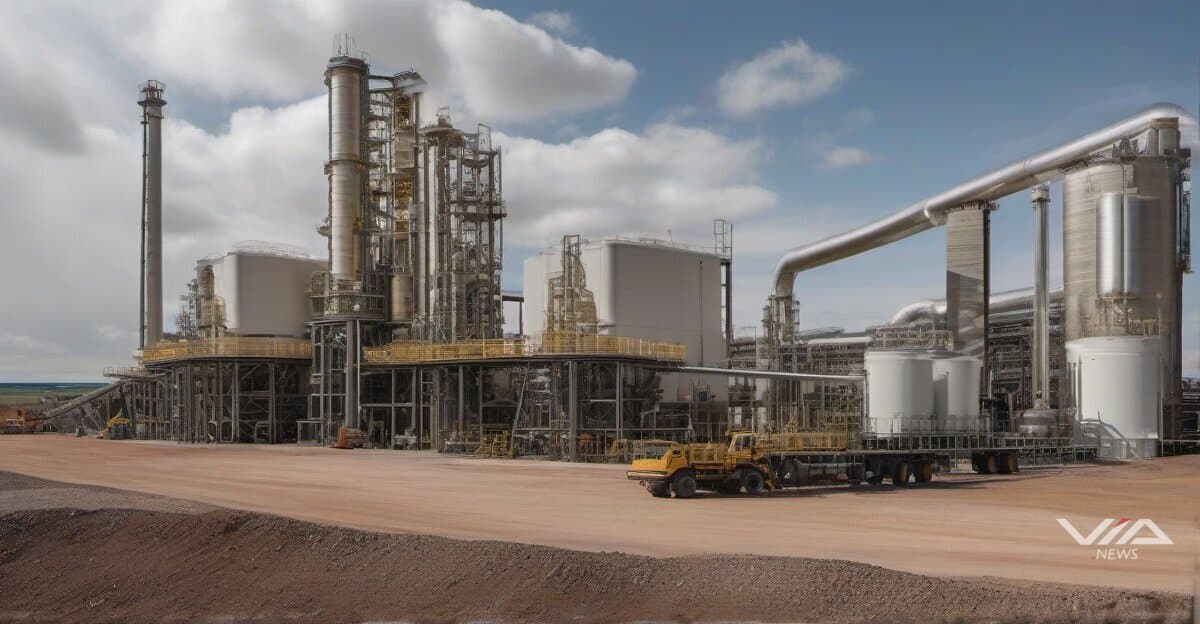
At a moment when much of the global oil industry is hedging its bets — scaling back long-cycle commitments in response to energy transition pressures and price volatility — Canadian Natural Resources Limited (TSX: CNQ, NYSE: CNQ) is doing the opposite. The Alberta-based heavyweight is pressing ahead with one of the most ambitious upstream capital programs in the Western world, anchored by a scheduled 2027 production start at its Kirby Steam-Assisted Gravity Drainage (SAGD) facility and a broader suite of thermal in situ expansions that collectively represent a strategic bet on durable crude demand.
The Kirby SAGD pad expansion, located in Alberta's oil sands heartland, is part of a thermal in situ program that also includes three Cyclic Steam Stimulation (CSS) pads at the Primrose facility — the first slated to come online in Q3 2026 — along with 46 new wells being added to existing mature pads. Canadian Natural has allocated $2.98 billion to its Thermal and Oil Sands Mining & Upgrading segment in 2026 alone, underscoring the scale of its commitment to long-cycle, low-decline production assets.
A $6.4 Billion Capital Commitment in Global Context
Canadian Natural's total 2026 capital budget stands at $6.425 billion — a figure that places it among the most capital-intensive upstream operators globally, rivalling mid-sized national oil companies in its sheer deployment of growth capital. The budget encompasses $6.3 billion in operating capital, $125 million earmarked for carbon capture infrastructure, and $175 million in Front-End Engineering and Design (FEED) capital for medium- and long-term projects.
The company is guiding for total production of 1,590–1,650 thousand barrels of oil equivalent per day (MBOE/d) in 2026 — roughly 3% growth over 2025 at the midpoint, with liquids output projected to rise by approximately 55,000 barrels per day, a 5% year-on-year increase. To put this in perspective, that single year's liquids growth increment is larger than the entire crude output of several OPEC member states.
Heavy crude oil accounts for 25% of Canadian Natural's production mix, making Kirby and similar developments directly consequential for Western Canadian Select (WCS) differentials — a pricing benchmark watched closely by refiners across the United States Gulf Coast, Asia-Pacific, and increasingly, Europe.
What It Means for Global Heavy Crude Markets
The 2027 Kirby SAGD production start represents a meaningful increment of heavy crude supply entering the market at a time when the global oil balance remains contested. OPEC+ has maintained production discipline since 2022, repeatedly extending cuts to support Brent prices — but Canadian oil sands operators operate outside that framework entirely. Once capital is committed and construction is underway, these projects are largely price-resilient: the marginal cost of production from existing SAGD pads is low enough that output curtailment in response to short-term price weakness makes little economic sense.
This structural feature of oil sands production — long lead times, high upfront capital, but very low sustaining costs and extremely long asset lives — distinguishes Canadian supply growth from, say, U.S. shale, which is more price-elastic and quicker to respond to market signals. Where a Permian Basin driller might idle rigs within weeks of a price downturn, a SAGD operator like Canadian Natural will typically maintain or grow output regardless of short-term oil price moves.
International refiners, particularly those configured to process heavy sour crudes — including major complexes in the U.S. Gulf Coast, India, South Korea, and China — should take note. The additional volumes from Kirby, combined with the NRUTT (Naphtha Recovery Unit Tailings Treatment) project at Canadian Natural's Horizon facility targeting an additional 6,300 barrels per day of Synthetic Crude Oil (SCO) by Q3 2027, create a cluster of new Canadian supply entering global markets in the second half of 2027.
A Counterpoint to the Energy Transition Narrative
The Kirby expansion also arrives as a pointed counterargument to those who forecast a rapid decline in oil sands investment. While European majors such as BP and Shell have progressively reduced their oil sands exposure over the past decade — partly under investor pressure tied to ESG frameworks — Canadian domestically-anchored producers like Canadian Natural, Cenovus, and Imperial Oil have moved in the opposite direction, doubling down on assets they consider generationally advantaged.
Canadian Natural's inclusion of $125 million in carbon capture spending within its 2026 budget reflects an attempt to square this circle — investing in emissions reduction technology while simultaneously growing production. Canada's federal carbon pricing regime and the evolving Clean Fuels Standard create regulatory headwinds for oil sands producers, but the economics of low-decline, long-life assets appear, for now, to outweigh those pressures in the company's capital allocation calculus.
Financial Position: Debt Reduction Before Shareholder Returns
Canadian Natural is not without vulnerabilities. The company's net debt stood at $17.155 billion as of September 30, 2025 — above its self-imposed $15 billion threshold. Under its capital allocation framework, this means 40% of free cash flow is currently directed toward balance sheet reduction rather than dividends or buybacks, constraining near-term shareholder returns even as production grows.
Adjusted funds flow reached $3.92 billion in Q3 2025, demonstrating robust cash generation capacity at prevailing crude prices. However, the debt overhang remains a risk factor in a scenario where WCS differentials widen materially — a possibility if U.S. tariff threats targeting Canadian crude imports were to materialise, disrupting the dominant export corridor into the U.S. Gulf Coast and Midwest.
The tariff risk is not theoretical. Ongoing political uncertainty around U.S.-Canada trade relations, combined with the lack of sufficient alternative export infrastructure to reach tidewater at scale, means Canadian producers remain structurally dependent on American refinery demand. Pipeline capacity constraints on routes to Asian markets — long discussed but still unresolved — leave the WCS differential exposed to regional supply-demand imbalances in ways that producers in the Middle East or West Africa simply do not face.
The Broader Signal
For global energy markets, the Kirby SAGD expansion and Canadian Natural's wider 2026–2027 capital program send a clear signal: the world's third-largest proven oil reserve base is not winding down. It is growing, methodically and at scale, backed by producers with decades-long time horizons and balance sheets capable of sustaining investment through cycles.
Whether that supply growth proves a stabilising force for global energy security — or a complicating variable for OPEC+ discipline and climate commitments — will depend on the interplay of demand trajectories, geopolitics, and the pace of the energy transition. What is not in doubt is that Alberta's oil sands will remain a material force in the global crude supply picture well into the 2030s and beyond.