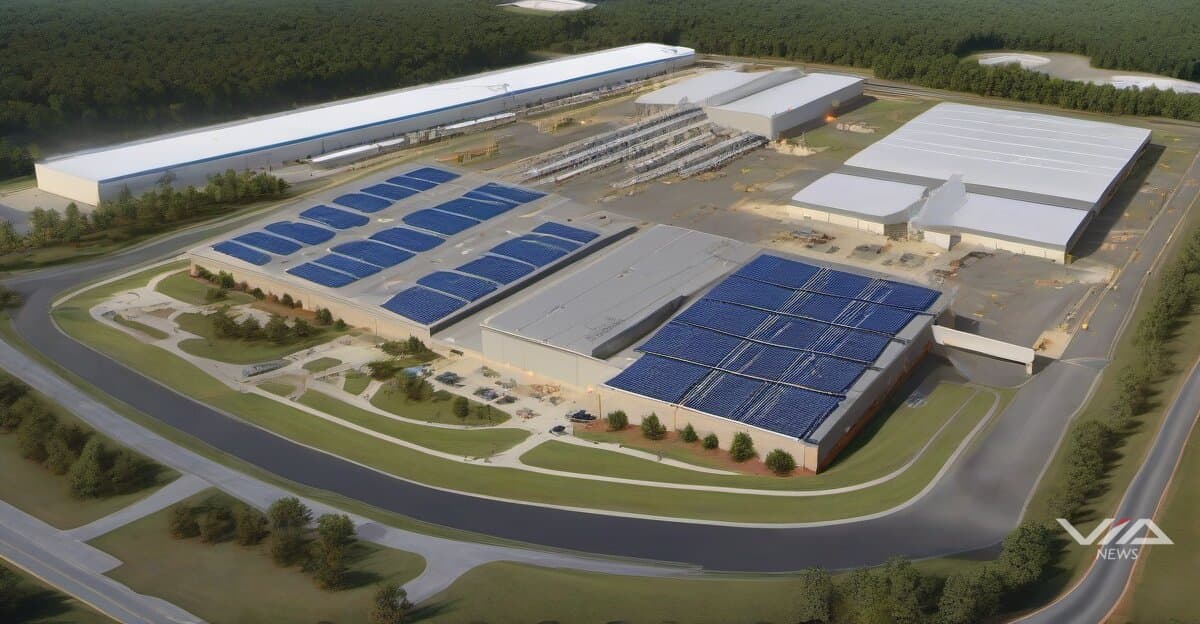
China manufactures roughly 80% of the world's solar cells. Suniva is placing a millions bet that the U.S. can change that — at least for its own market.1 The wager: expand a South Carolina facility from 1 GW to 4.5 GW nameplate capacity, a 4.5x jump that risk assessors rate catastrophic severity and high likelihood of capital failure.1
Suniva holds a singular position: it is the largest and oldest U.S. merchant manufacturer of high-efficiency monocrystalline silicon photovoltaic cells, and the only American-owned, American-operated solar cell producer in the country.1 That status makes it the central domestic alternative to a global supply chain dominated by Chinese producers including LONGi, Jinko Solar, and Tongwei.
A concurrent reverse merger sharpens the financial exposure. The transaction creates an untested combined entity with no operational history under the new structure.1 Lenders have minimal data on which to underwrite a nine-figure construction loan — a structural problem that mirrors difficulties faced by European solar manufacturers including Meyer Burger as they attempted to scale against Asian cost advantages.
Three failure vectors drive the catastrophic rating. Cost overruns on large-scale manufacturing builds routinely exceed projections — a 4.5x capacity expansion is a facility rebuild, not an upgrade. Construction delays would accrue fixed financing costs before revenue generation begins. Most dangerously, the reverse merger could trigger lender covenants or refinancing requirements mid-build, when the company is most exposed.1
The asymmetry is severe. A completed build positions Suniva as the dominant domestic supplier at a moment when U.S. policy — through the Inflation Reduction Act and solar manufacturing tax credits — is explicitly subsidizing onshore clean energy production. A stalled build leaves a partially constructed asset, elevated debt, and a merged entity without the track record to attract rescue financing at viable rates.
For international investors watching U.S. industrial policy play out in clean energy, Suniva is the test case. The strategic rationale for domestic solar manufacturing is sound. Whether a post-merger company can execute a millions construction program without proven capital market access is the unresolved question.1