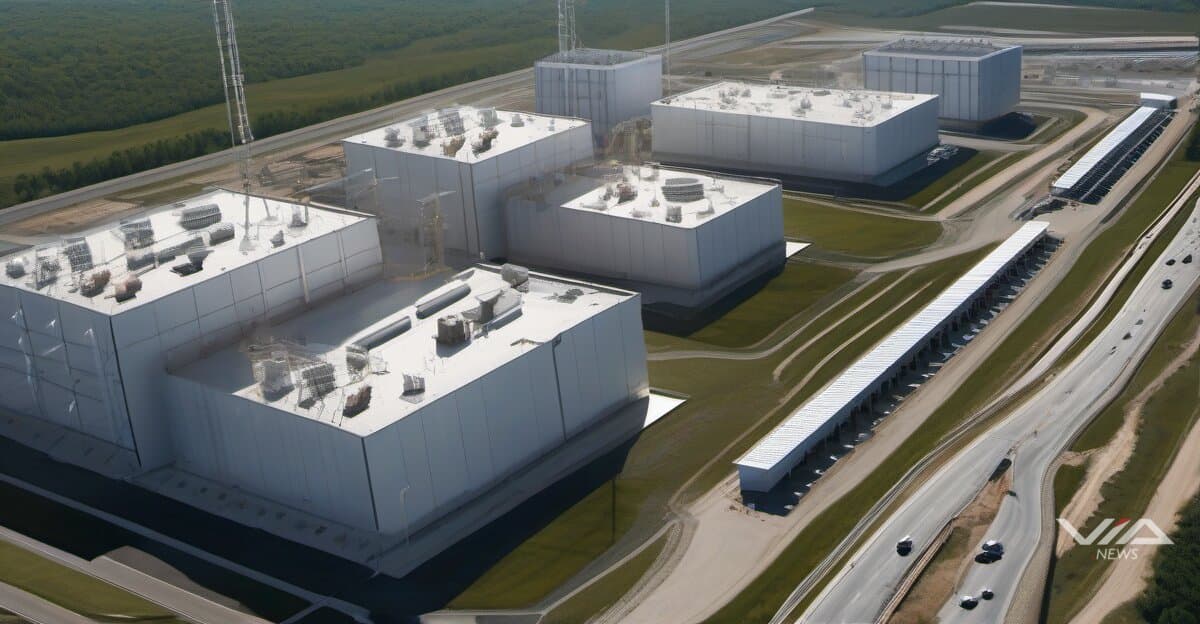
Duke Energy has committed billions in capital expenditure over five years, anchored by electricity supply agreements with hyperscalers expanding AI data center capacity.1 The plan includes next-generation nuclear. Duke's CEO has signaled the total will rise.
The dynamic is not uniquely American. Utilities in the UK, Germany, Japan, and South Korea are under equivalent pressure as hyperscalers accelerate global AI buildouts. In the Middle East, Saudi Arabia and the UAE are constructing dedicated power infrastructure for AI campuses before demand fully materializes. China's state-owned utilities are absorbing AI data center load directly into national grid planning.
The scale of AI power demand explains why. A conventional enterprise data center draws 5–10 megawatts. AI training clusters routinely require 100MW or more per site.1 Dozens of facilities under simultaneous construction push aggregate demand into gigawatts — utility-scale, not IT-scale.
Hyperscalers need continuous, high-density power. Intermittent renewables cannot anchor AI infrastructure alone. That constraint is driving nuclear back into utility planning globally. France has long relied on nuclear baseload. The UK, South Korea, and Canada are advancing small modular reactor programs. Duke's inclusion of next-gen nuclear in its capex plan reflects the same logic: hyperscalers are willing to contract long-term for carbon-free baseload, and utilities that can provide it capture demand before nuclear developers bypass them with direct agreements.1
Duke's service territory in the Carolinas and Midwest has become a concentration point for US AI infrastructure.1 But the investment cycle it is entering — grid upgrades, new generation, expanded transmission — is being replicated across every major economy where AI compute is concentrating.
If Duke's CEO is correct that billions is a floor, the pattern will compound. Utility capex cycles lag demand by years. The AI buildout is still accelerating.1