
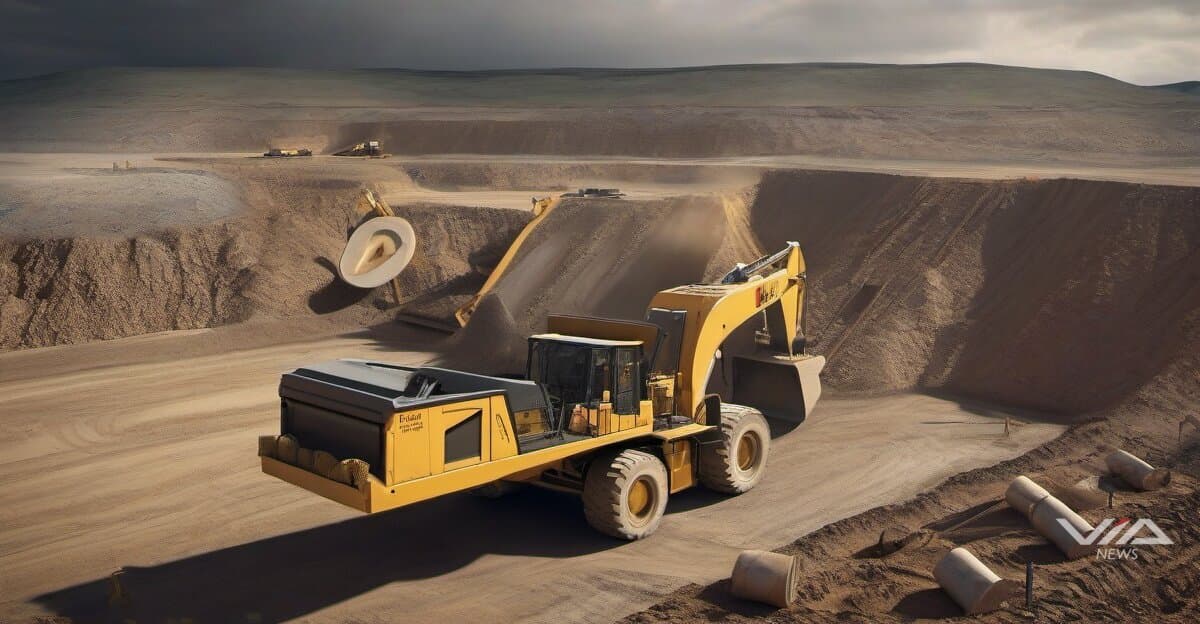
In a world scrambling to secure the raw materials of the clean energy transition, a graphite deposit in upstate New York is drawing serious federal attention — and for good reason. Titan Mining Corporation (TSX: TI, NYSE-A: TII) is advancing its Kilbourne Graphite Project in Gouverneur, New York, toward a 2027 construction start, positioning it as one of the most consequential critical mineral developments in the Western Hemisphere.
The economics are striking. A Preliminary Economic Assessment (PEA) published in December 2025 projects an after-tax net present value of $513 million at a 7% discount rate, a pre-tax NPV of $581 million, and an after-tax internal rate of return of 37%. The payback period is estimated at just 2.7 years — unusually tight for a mining project of this scale. Average annual EBITDA is projected at $125 million, with margins between 58% and 69% over a 13-year mine life.
The China Problem — and Why It Matters Globally
To understand why Kilbourne is attracting federal financing at this scale, the starting point is China. Beijing currently controls an estimated 60–70% of global natural graphite mining and well over 90% of the world's graphite anode processing capacity — the stage at which raw flake is transformed into battery-ready material. For countries betting trillions of dollars on electric vehicle adoption, that concentration is a systemic vulnerability.
The European Union has listed graphite as a critical raw material and is pursuing its own supply diversification under the Critical Raw Materials Act. Japan and South Korea, home to major battery manufacturers, have similarly sought to reduce exposure to single-source supply. But the United States has been particularly aggressive: the Inflation Reduction Act, the CHIPS and Science Act, and a series of executive orders have collectively placed domestic critical mineral production at the centre of U.S. industrial policy.
Kilbourne fits squarely into that framework. At nameplate capacity, the project is designed to produce 40,000 tonnes of graphite concentrate annually — equivalent to roughly half of current U.S. natural graphite demand. That is not an incremental contribution; it is a structural shift in the domestic supply picture.
Federal Money Validates the Case
The U.S. Export-Import Bank has issued a non-binding Letter of Interest for $120 million in construction financing, covering the majority of an initial construction capital expenditure of $156 million. Titan also secured $5.5 million in non-dilutive EXIM Make More in America (MMIA) funding to finance a forthcoming Feasibility Study — marking the first EXIM-funded domestic feasibility study of its kind. The project is further positioned to benefit from Section 45X Advanced Manufacturing Tax Credits, applicable to both anode material and critical mineral production.
Taken together, the federal support package substantially de-risks the project's financing path — a signal that Washington views Kilbourne not merely as a commercial venture, but as infrastructure relevant to national supply chain security.
A Phased Approach to Premium-Grade Output
Total capital expenditure across construction, expansion, and sustaining phases reaches $431.7 million. Titan's production strategy is deliberately phased. Initial output will focus on standard purity flake concentrate and micronized natural flake graphite. From year five onward, the project will add Coated Spherical Purified Graphite (CSPG) — the anode-grade material used directly in lithium-ion battery cells.
The pricing differential between these product types is significant. Standard flake concentrate realises approximately $1,575 per tonne; CSPG commands a weighted average price of $11,193 per tonne — nearly seven times as much. As the product mix shifts toward higher-grade material in the project's later years, the revenue profile improves substantially.
Broader Implications for the Global Battery Race
The Kilbourne project does not exist in isolation. It is one data point in a rapidly evolving global contest for battery supply chain sovereignty. Canada, Australia, Mozambique, and Madagascar are among the countries developing competing graphite assets, while refiners in Europe and North America are investing in processing capacity to reduce dependence on Chinese conversion. Yet most of these projects remain years from meaningful production at scale.
What distinguishes Kilbourne is its combination of resource scale, federal financial backing, and proximity to North American battery manufacturing hubs — particularly as the U.S. and Canadian EV industries deepen integration under trade frameworks designed to preference domestic content. If construction commences on schedule in 2027 and the feasibility study confirms the PEA's projections, Kilbourne could become one of the first significant non-Chinese sources of battery-grade graphite to reach commercial production in this decade.
For a global industry still overwhelmingly dependent on Chinese supply, that would be a notable development — and one with implications well beyond the borders of New York State.