
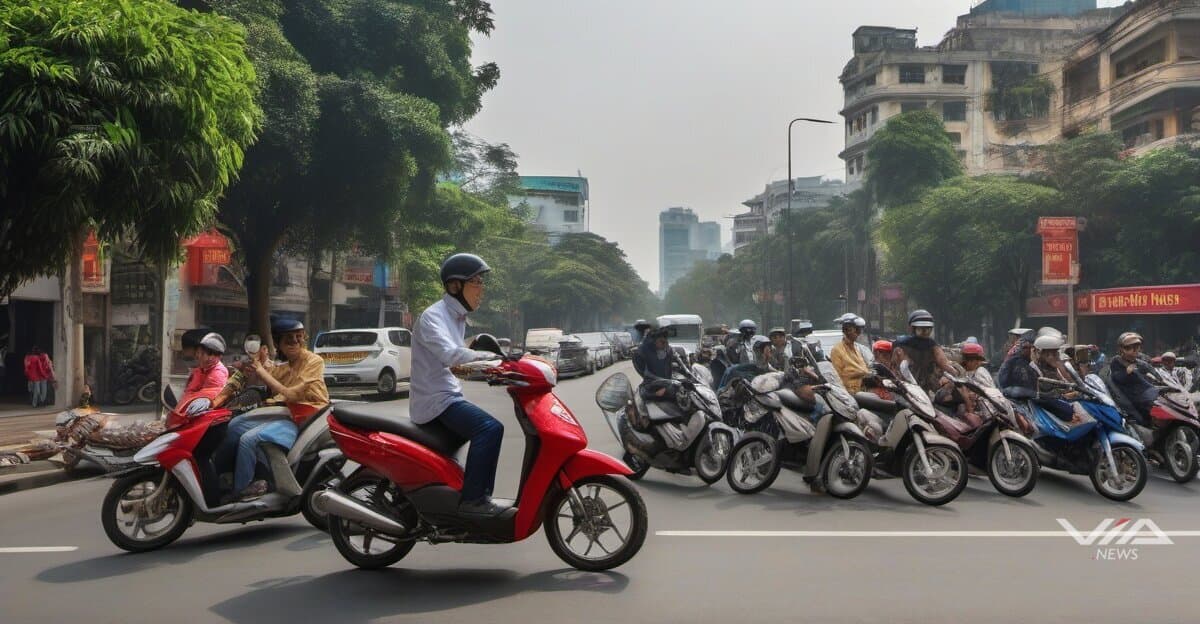
For years, the global conversation about low-emission cities has been dominated by a short list of wealthy European names: Amsterdam, Oslo, Copenhagen, Paris. These cities have made genuine progress, and their policies deserve credit. But a decision taken in Hanoi — a Southeast Asian megacity of more than eight million people, built on the combustion-engine motorbike — may ultimately tell us more about the future of urban transport than anything happening in Scandinavia.
Vietnam's capital has confirmed it will impose a full ban on petrol and diesel motorcycles and scooters within its urban core by 2030. The announcement is, by any measure, audacious. Hanoi is home to an estimated four million registered motorbikes. They are not a lifestyle accessory or a commuter convenience — they are the circulatory system of the city. They carry workers, schoolchildren, street vendors, delivery drivers, and families of four. They are cheaper than cars, faster than buses, and more flexible than any fixed-route transit the city currently offers. Banning them, within six years, is a different order of ambition from anything European capitals have attempted.
The air quality stakes are stark. Hanoi's pollution levels regularly exceed World Health Organisation safe limits by a factor of three or more during peak periods — a figure that places the city among the most polluted in Southeast Asia and far above the levels that have driven emergency regulatory responses in cities like Delhi, Beijing, and Jakarta. The motorbike fleet is a primary contributor. Unlike the particulate problem in Chinese megacities, which has been substantially industrial and coal-driven, Hanoi's crisis is directly linked to the vehicles on its streets.
That context reframes what European observers might otherwise read as a distant regional story. Cities across the Global South — Dhaka, Lagos, Ho Chi Minh City, Manila, Nairobi — share Hanoi's dependence on affordable two-wheel transport. None of them has yet committed to a hard ban on the scale Hanoi is now pursuing. If Hanoi's transition succeeds, it will become the most-cited policy precedent for urban mobility reform in the developing world. If it fails — due to inadequate infrastructure, unaffordable alternatives, or enforcement collapse — that outcome will be equally instructive, and considerably more damaging to the cause.
The infrastructure question is where the comparison with European cities becomes most illuminating. Oslo, Amsterdam, and Brussels have all pursued zero-emission zones anchored by the assumption that residents can charge vehicles overnight at home, at work, or at widely distributed public stations. That assumption does not travel well. In Hanoi, as in most high-density Asian cities, the majority of residents live in apartments or narrow shophouse terraces with no private parking and no realistic prospect of home charging. The European EV model, built around the overnight charge, is structurally incompatible with the way most of the world's urban population actually lives.
This is precisely the gap that battery-swapping networks are designed to fill. Gogoro, the Taiwanese company that pioneered the swappable-battery model for electric scooters, has built an ecosystem in which users exchange a depleted battery for a fully charged one at a kiosk in under a minute — no dwelling, no cable, no waiting required. The model has reached genuine scale in Taiwan and is under active evaluation across Southeast Asia. It represents a meaningful infrastructural alternative for cities where the plug-in paradigm is a non-starter.
European cities are not indifferent to the concept. Battery-swap proposals have been advanced for cargo bikes and last-mile delivery fleets in Hamburg and Rotterdam, where dense urban logistics present similar obstacles to fixed charging. The cross-pollination of ideas between Asian and European urban planners on this question is becoming more direct — a quiet acknowledgement that neither hemisphere has a complete solution.
The socioeconomic dimension of Hanoi's ban is the hardest problem, and the one least amenable to policy borrowing from wealthier cities. Affordable electric two-wheelers remain out of reach for a significant portion of Hanoi's working population. A subsidised scooter replacement programme, a concessional financing scheme, or a phased transition by district are all under discussion, but none has been fully designed or funded. Oslo can ease the transition to EVs with purchase subsidies and toll exemptions because Oslo has a tax base that makes such instruments viable. Hanoi does not.
What it does have is a regulatory commitment that is now a matter of public record, a governance structure capable of enforcement when the political will exists, and a deadline that creates pressure on manufacturers, infrastructure investors, and citizens alike to move. Vietnam's domestic EV industry — anchored by VinFast, which has expanded aggressively into export markets including the United States and Europe — has a commercial interest in the success of the transition. That alignment between industrial policy and urban environmental policy is itself a model worth examining.
The cities that will define the future of urban transport are not the ones that face the easiest transitions. They are the ones with the most to gain and the fewest inherited advantages. Hanoi has placed itself, willingly or not, at the front of that cohort. The world's urban planners are watching.