
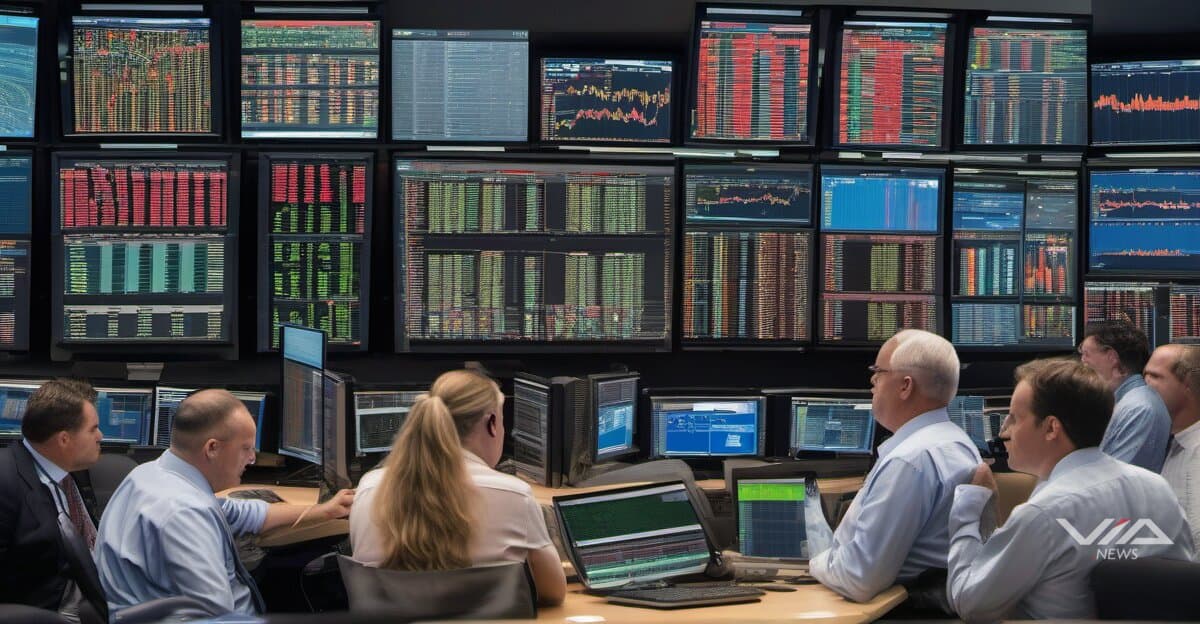
Across the world's major financial centres — New York, London, Amsterdam, Singapore and Hong Kong — a structural fault line is forming inside the algorithmic trading industry. On one side stand a small cohort of elite quantitative institutions with decades of mathematical heritage, deepening AI capabilities, and growing regulatory accountability. On the other, a proliferating class of retail-facing automated trading platforms is flooding global markets with sophisticated-sounding technology and carefully worded disclaimers.
The bifurcation is not merely technical. It reflects a broader asymmetry that is reshaping who captures value from the artificial intelligence revolution in global finance — and who bears the risk.
The Institutional Elite Widens Its Moat
Amsterdam-headquartered Flow Traders and New York-based Virtu Financial headline a cohort of professional market-making firms that have translated early, costly investments in deep learning and high-frequency infrastructure into durable competitive advantages. Both firms posted strong 2025 performance metrics, reinforcing a trend visible across institutional trading globally: those who got in early are pulling decisively ahead.
The lineage of this dominance traces back to Renaissance Technologies, the Long Island-based quantitative pioneer whose Medallion Fund became the most successful investment vehicle in financial history. The mathematical culture Renaissance established has since diffused across global finance, from London's Man Group and Winton to Hong Kong's Quantedge and Singapore's proprietary trading desks that service Asia-Pacific equity and derivatives markets.
What these firms share is not simply access to AI — it is access to production-scale AI. Their models run multi-layer neural network architectures capable of simultaneously processing thousands of real-time data streams across global exchanges: pricing feeds from Tokyo to Frankfurt, volume fluctuations on the London Stock Exchange, macroeconomic triggers from Federal Reserve announcements, and cross-asset correlation signals spanning currencies, commodities and sovereign debt. Critically, these systems train on proprietary datasets accumulated over years — an advantage no newcomer can purchase.
Regulatory frameworks in multiple jurisdictions are now reinforcing this institutional tier's structural position. In the United Kingdom, formal position disclosure requirements are imposing structured reporting on firms that once operated with limited transparency. The European Union's MiFID II framework similarly demands algorithmic documentation and pre-trade risk controls. In the United States, the SEC has intensified scrutiny of automated trading practices. Well-capitalised firms with established compliance infrastructure are best positioned to absorb these obligations — adding yet another barrier to entry for smaller competitors.
A Global Retail AI Boom — and Its Risks
Simultaneously, a parallel ecosystem has emerged across multiple continents, targeting retail investors from Brazil to the United Kingdom, from Southeast Asia to the Gulf states. Platforms including Quantum AI, Vorexlan, Envariax, GPT Invest and Lucren are promoting AI-driven portfolio automation to mainstream audiences, typically requiring minimum deposits around $250 and promising real-time market intelligence at democratised cost.
The pitch has clear global appeal. In emerging markets where access to professional wealth management is limited, and in developed economies where a generation of retail investors was activated by pandemic-era brokerage apps, the promise of AI levelling the financial playing field resonates powerfully. Vorexlan, for example, markets a cloud-based multi-asset system with machine learning layers that analyse historical performance, volatility patterns, and sentiment indicators — connecting users to regulated third-party brokers for execution while earning through partnership arrangements rather than direct trading profits.
The technical specifications cited by such platforms — anomaly detection models, data normalisation frameworks, smart-routing execution systems — are credible on their face. The language mirrors, at least superficially, what genuine institutional systems employ.
But regulators on several continents are growing alarmed. The UK's Financial Conduct Authority, Australia's ASIC, and Canada's provincial securities commissions have each issued warnings about AI trading platforms making unverifiable performance claims. The Financial Stability Board has flagged the systemic risk posed by loosely regulated retail automation tools operating across jurisdictions simultaneously. In markets as diverse as India and the UAE, local regulators have moved to require clearer disclosures from platforms offering algorithmic trading services to retail clients.
The Core Asymmetry
The gap between institutional and retail AI trading ultimately comes down to three compounding advantages that no app subscription can bridge: data, infrastructure and talent. Institutional firms operate on co-located servers measuring latency in microseconds; retail platforms route orders through third-party brokers with execution delays measured in seconds. Institutional models train on decades of proprietary tick data; retail systems reference publicly available datasets that every competitor uses. Institutional teams employ PhD-level researchers in mathematics, physics and computer science; retail platforms often outsource their technology stacks.
This does not mean automated tools offer retail investors no value. Rules-based portfolio rebalancing, systematic risk controls, and algorithm-assisted diversification can genuinely improve outcomes for individual investors — particularly in markets where human advisers are expensive or unavailable. The danger lies in the gap between what these platforms imply and what they can deliver: not the modest utility of systematic automation, but the mythologised edge of institutional-grade AI.
As artificial intelligence reshapes global finance, the critical question for regulators, investors and policymakers alike is whether the technology will compress or compound existing inequalities. Early evidence suggests the latter. The firms with the deepest data, the fastest pipes, and the sharpest mathematicians are using AI to widen their lead — while a generation of retail investors worldwide is being invited to fund their counterparty.