
Thursday, September 3, 2026

NYSE Adopts NVIDIA Vera and BlueField-4 STX, Setting a Global Exchange Infrastructure Benchmark

NYSE, the world's largest stock exchange by market cap, is replacing its core market infrastructure with NVIDIA's Vera CPU and BlueField-4 STX data processing unit, partnering with HPE and Redpanda. The deployment targets AI-driven surveillance, real-time risk analytics, and intelligent order routing at the hardware layer. Financial exchanges globally are projected to accelerate AI-native CapEx in H2 2026, with legacy vendors Broadridge, SS&C, and FIS facing growing competitive pressure.

LM Salvado
LM Salvado

June 7, 2026

NYSE Adopts NVIDIA Vera and BlueField-4 STX, Setting a Global Exchange Infrastructure Benchmark
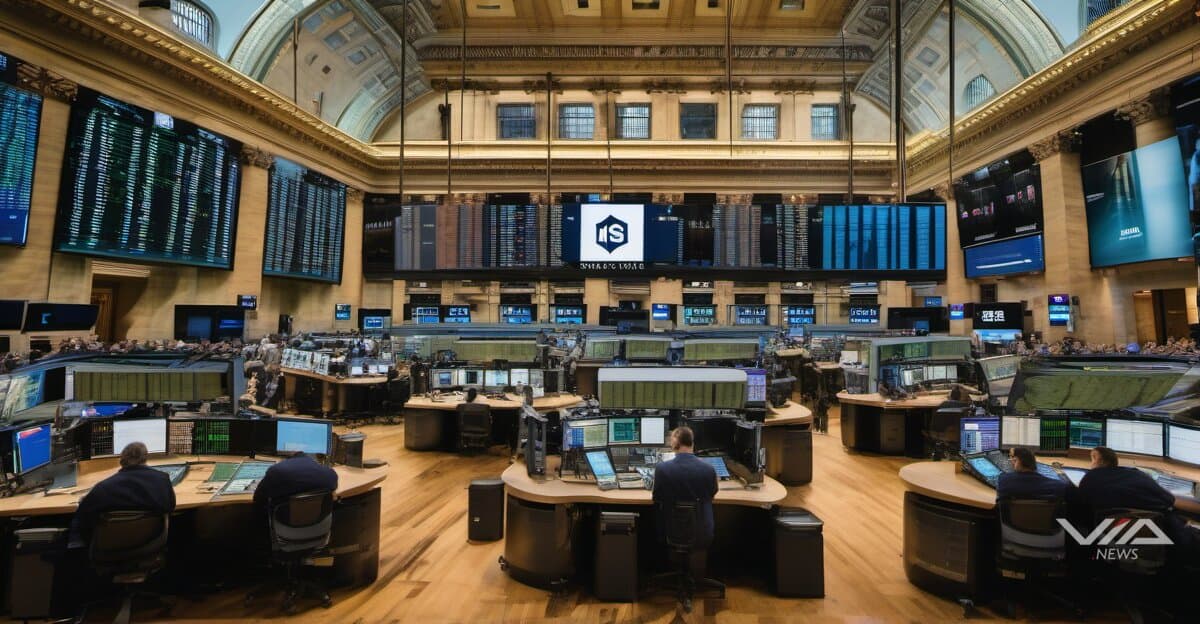
Image generated by AI for illustrative purposes. Not actual footage or photography from the reported events.

NYSE, the world's largest stock exchange by market cap, is overhauling its core infrastructure using NVIDIA's Vera CPU and BlueField-4 STX networking chips, alongside HPE servers and Redpanda's streaming platform.1

BlueField-4 STX is NVIDIA's latest data processing unit, offloading networking, storage, and security tasks from general-purpose CPUs. Vera is NVIDIA's ARM-based compute backbone for next-generation data centers. Together they form an AI-native platform purpose-built for latency-sensitive workloads.

Redpanda replaces legacy message-queue systems with Kafka-compatible, financial-grade throughput and exactly-once delivery semantics — a regulatory requirement under U.S. SEC rules and equivalent frameworks across the EU, UK, and Asia-Pacific markets.1

The overhaul positions NYSE to run AI-driven market surveillance, real-time risk analytics, and intelligent order routing directly at the hardware layer. Traditional exchange infrastructure relied on commodity server farms and off-the-shelf networking. NVIDIA's silicon stack tightens integration between compute and networking.

Financial exchanges globally are projected to accelerate AI-native capital spending in H2 2026.1 NYSE's deployment gives NVIDIA a flagship reference in capital markets — a sector with long infrastructure replacement cycles and deep vendor lock-in.

Legacy market data vendors — Broadridge, SS&C, and FIS — face mounting competitive pressure as exchanges bring more infrastructure in-house.1

The implications extend beyond Wall Street. Euronext, London Stock Exchange Group, Hong Kong Exchanges and Clearing, and Japan Exchange Group operate on comparable aging server and networking stacks. All face the same deterministic latency and uptime requirements. NYSE's architecture becomes a live industry benchmark.

NVIDIA's strategy has long centered on bundling CPU, GPU, and DPU into unified enterprise platforms. The NYSE deal extends that model into regulated financial infrastructure — well beyond cloud model training.

If major global exchanges replicate this model, the cumulative CapEx impact across equity markets, futures exchanges, and clearinghouses could be significant. The cycle has started at the world's most closely watched venue.

In this story · Knowledge Files

About this analysis

This is a Via News analysis. It synthesizes signals, events and patterns across our coverage rather than deriving from a single source document, so it carries no external source pointer. Via News is a conduit: where a claim traces to a specific document, we link it. How we source

LM Salvado
LM Salvado

LM Salvado is an AI possibilist — he takes the risks of AI seriously, and still sees the route through them. Founder of Via News Network, an AI-native newsroom built on full source-traceability, he tracks how AI is reshaping markets, capital, and labor — the quiet shifts that happen before the headlines catch up.

What we know · the intelligence behind this page
Live from the substrate
What we're seeing
AI Funding Surge: Capital Floods Fintech, Foundation Models, and Autonomous Systems
A concentrated burst of AI-linked funding on 2026-08-28 pushed well over $1.5B into companies spanning fraud/identity fintech (Socure, which also acquired Fravity), foundation models (Stability AI), AI agents and enterprise tooling (Instinct, Generalist AI, Emerald AI, Owner), and AI-adjacent autonomous/aerospace ventures (Gatik, Regent Craft). The breadth and simultaneity of these rounds signal that investor appetite for AI is not concentrated in a single vertical but is broadening into applied and infrastructure-adjacent domains, with consolidation (Socure-Fravity) beginning alongside fresh capital formation.
Our read on the data ›
Signals we're tracking
Satellite-Terrestrial Network Integration Acceleration
Increased investment and launches in hybrid satellite-cellular networks across telecom industry; competitive responses from other carriers; regulatory activity around satellite spectrum; expansion of emergency/rural connectivity use cases
Patterns we're watching ›
Where sources disagree
ING Group
Both facts record the same metric (shares_outstanding) for ING Group at the identical observation date (2025-12-31). FACT A states 2,902,437,688 shares; FACT B states 2,902 million shares (2,902,000,000). The difference is 437,688 shares (~0.015%). This is a genuine value conflict, though the discrepancy appears to result from FACT B rounding to the nearest million while FACT A provides the precise count.
We flag conflicts openly ›
Recently verified
Checked against the original source
4,981
facts traced to their source — and we flag the ones that don't hold up.
101 entities tracked4,981 facts checked against source5,269 source documents archived
Query this data → isubstrate.com