
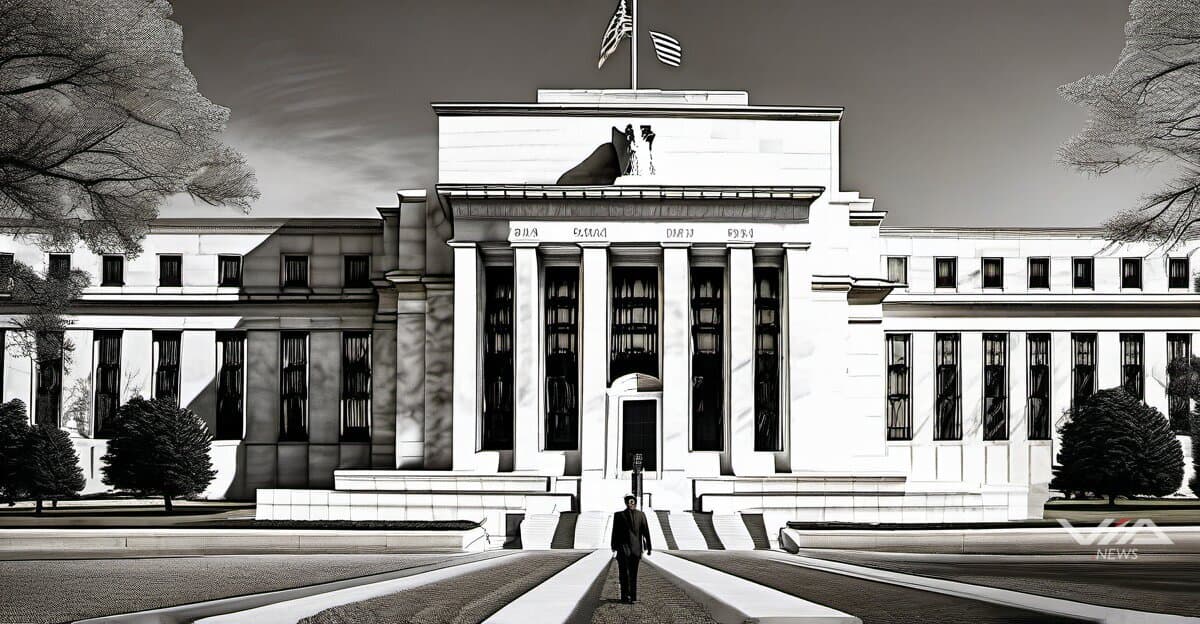
The world's most influential central bank has effectively declared a ceasefire in its rate-cutting campaign. After a series of reductions that began in late 2024 and reverberated through financial markets from São Paulo to Seoul, the US Federal Reserve is now firmly in wait-and-see mode — and the rest of the world is adjusting accordingly.
Fed Chair Jerome Powell made the position plain in recent public remarks: "We're well-positioned to see how the economy evolves." He went further to dismiss any near-term prospect of rate hikes, saying, "I don't think that a rate hike is anybody's base case at this point. I'm not hearing that." The message is one of deliberate stillness — a central bank content to observe rather than act.
That view has been reinforced across the Federal Open Market Committee. Governors Philip Jefferson and Jeff Schmid, along with Chicago Fed President Austan Goolsbee, have each argued that the federal funds rate now sits at or near its neutral level — the theoretical setting that neither accelerates nor restrains economic activity. For global investors, that framing matters enormously: it signals that the era of cheap dollar liquidity, which fuelled asset booms across emerging markets and developed economies alike, is not returning anytime soon.
Global Markets Reprice the Dollar Outlook
Fed funds futures now assign just a 51% probability to a single quarter-point cut by June 2026 — a stark retreat from earlier expectations of multiple reductions. The shift has already been felt in currency and bond markets worldwide. A higher-for-longer Fed typically strengthens the US dollar, tightening financial conditions for countries that borrow in the greenback and squeezing economies whose debt is denominated in dollars.
For emerging markets across Latin America, Sub-Saharan Africa, and South and Southeast Asia, the implications are direct. Nations carrying substantial dollar-denominated debt — from Argentina to Egypt to Indonesia — face higher refinancing costs and downward pressure on their own currencies. Capital that might otherwise flow toward higher-yielding developing-world assets tends to stay closer to the safety of US Treasuries when the Fed signals stability at elevated rates.
A Diverging Path from Other Major Central Banks
The Fed's pause stands in contrast to the trajectory of several peer institutions. The European Central Bank has continued to ease policy as the eurozone grapples with sluggish growth, particularly in Germany and France. The Bank of England faces its own dilemma — stubborn domestic inflation set against a weakening labour market — but has nonetheless moved toward gradual cuts. The Bank of Japan, meanwhile, remains an outlier in the opposite direction, cautiously tightening after decades of ultra-loose policy.
This divergence in central bank cycles creates both opportunity and volatility. Currency traders are already positioning for a stronger dollar relative to the euro and the pound, while carry traders reconsider bets built on the assumption of rapid Fed easing. For multinational corporations managing cross-border revenues and costs, the landscape has become considerably more complex.
Why the Fed Is in No Hurry
The Fed's patience is rooted in an American economy that has proved more durable than many forecasters predicted. Consumer spending remains robust, and a wave of artificial intelligence-related capital investment is driving a new cycle of corporate expenditure. Inflation, while retreating significantly from its 2022 peaks, has not fully surrendered — the last mile of disinflation has proven the hardest in the US, much as it has in the United Kingdom and parts of the eurozone.
Even Austan Goolsbee, among the more dovish voices on the committee, acknowledged the value of restraint: "Waiting to take this matter up in the new year would not have entailed much additional risk and would have come with the added benefit of updated economic data." The remark is telling — it suggests that the bar for resuming cuts is now high, and that patience has become the consensus position across the ideological spectrum of the committee.
Political Currents and the Independence Question
Hovering over the Fed's deliberations is a political dimension with international resonance. Powell has pointedly defended the central bank's independence in recent appearances, pushing back against mounting pressure from the White House. The episode echoes tensions seen in other major economies — from Turkey, where political interference in monetary policy contributed to a currency crisis, to Brazil and Hungary, where governments have clashed with central bankers over the pace of easing.
For global investors and international institutions such as the IMF and World Bank, the robustness of Fed independence is not merely an American domestic matter. A central bank perceived as subject to political direction would undermine confidence in dollar-denominated assets and the broader architecture of the international financial system that has been anchored by US monetary credibility for decades.
What Comes Next
The practical consequences of a prolonged Fed pause will be felt across the global economy in the months ahead. Mortgage markets, corporate credit conditions, and valuations in rate-sensitive sectors — real estate, utilities, infrastructure — are all calibrated against where the Fed is headed. Tighter-for-longer financial conditions in the United States tend to export constraint globally, through the dollar's dominance in trade invoicing, commodity pricing, and international lending.
Whether the Fed ultimately cuts once, twice, or not at all in 2026 will depend on data that does not yet exist — on how inflation evolves, how employment holds up, and how the broader global economy navigates an unusually complex geopolitical and technological transition. For now, the world's central bank has chosen stillness. The world will watch, and wait, alongside it.