
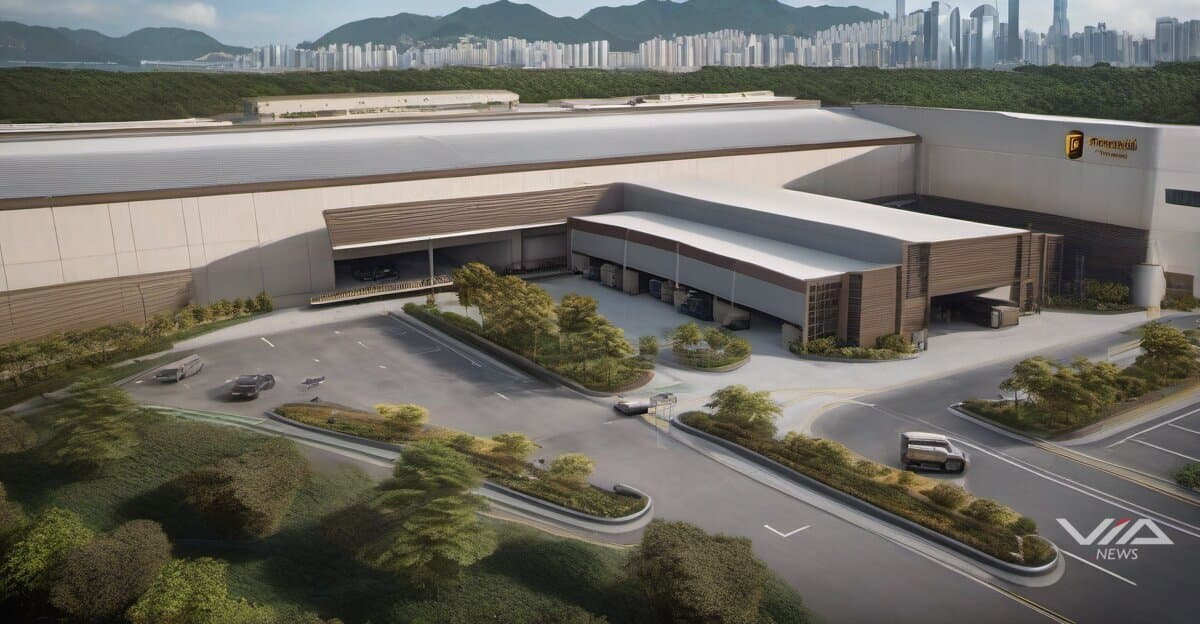
In a signal that cuts against the prevailing narrative of Western corporate retreat from Asia, United Parcel Service is pressing ahead with a capital investment in its Hong Kong gateway facility — committing infrastructure funds to a region that is simultaneously losing volume on legacy routes and gaining strategic weight as the nerve centre of a reconfigured global supply chain.
The expansion, disclosed during UPS's fourth-quarter 2025 earnings call on 27 January 2026, arrives at an inflection point for Asia-Pacific logistics. U.S. import volumes from the region fell sharply in Q4 2025: China-origin shipments declined 20.9% year-on-year, while Canada-Mexico corridor flows dropped 30.5%. Taken in isolation, those numbers might argue for retrenchment. UPS has drawn the opposite conclusion.
Why Hong Kong Still Matters
Hong Kong's value to a carrier like UPS has always been layered. As a transshipment hub it sits at the intersection of intra-Asian and trans-Pacific trade lanes; as a financial centre it hosts the regional treasury and procurement operations of hundreds of multinationals. Both functions are becoming more, not less, relevant as corporations execute supply chain diversification strategies that spread manufacturing footprints across Vietnam, Malaysia, Thailand, Bangladesh, and India.
That fragmentation is the defining logistical story of the post-pandemic decade. The era of consolidated Chinese factory output flowing in bulk to a handful of Western ports is giving way to a more distributed model — smaller, more frequent shipments originating from multiple countries, requiring regional consolidation points before onward transit. Hong Kong, with its deep air and sea connectivity and its unique regulatory status, is structurally well-positioned to serve that function.
For context, rival integrators have made similar calculations. DHL Express has expanded its Asia-Pacific hub capacity in recent years, and FedEx has invested in its Guangzhou and Osaka facilities. The competition for regional hub dominance is intensifying precisely because the underlying trade architecture is changing.
Financial Discipline Alongside Strategic Ambition
The Hong Kong commitment is notable in the context of UPS's broader capital programme. Full-year 2025 capital expenditure came in at $3.7 billion; 2026 guidance calls for that figure to fall to approximately $3 billion as the company pursues one of the most significant cost-reduction efforts in its history. Choosing to direct a portion of a shrinking capex envelope toward Asia-Pacific gateway infrastructure is a statement of priorities.
UPS generated $8.5 billion in operating cash flow in 2025 and is targeting free cash flow of roughly $6.5 billion in 2026 — financial headroom that allows the company to fund selective infrastructure investment while simultaneously returning capital to shareholders. The company returned $6.4 billion to shareholders in 2025 through dividends and share buybacks.
The international segment continues to carry the profitability load. Its full-year 2025 operating margin of 15.8% was the strongest of UPS's three reporting segments and nearly double the 7.7% recorded in U.S. Domestic — a gap that reflects both the higher yield of international express products and the relative labour cost advantages in parts of the international network. Q4 international revenue reached $5 billion, up 2.5% year-on-year, though operating profit dipped $154 million as cost pressures weighed on the quarter.
The Broader Supply Chain Pivot
The strategic logic behind the Hong Kong expansion is inseparable from the geopolitical and commercial forces reshaping Asia-Pacific trade. Since 2018, tariff escalation between Washington and Beijing has incentivised corporate procurement teams to diversify away from single-source Chinese suppliers. That process accelerated through the pandemic-era disruptions of 2020–2022 and has continued despite periodic diplomatic stabilisation efforts.
The result is a more complex, multi-node supply chain map across Asia — one that generates more logistics revenue per unit of final goods than the simpler China-to-West model it is replacing. Vietnam's exports to the United States have grown dramatically over the past five years; India's manufacturing ambitions, backed by substantial government incentives, are drawing investment from Apple, Samsung, and dozens of Tier 1 suppliers; Malaysia and Thailand are absorbing semiconductor and electronics capacity. Each of those shifts creates demand for carriers with the regional infrastructure to knit together disparate production sites.
For 2026, UPS's international segment guidance calls for low single-digit revenue growth and a mid-teens operating margin — a projection that implies management expects the segment's structural profitability to hold even as near-term volume headwinds persist. Q1 2026 is expected to remain challenging on key trade lanes, but the Hong Kong investment is not a Q1 trade; it is a wager on where Asian supply chains will sit five years from now.
What This Means for Global Trade
The UPS Hong Kong decision is a useful barometer for how the world's largest logistics operators are reading the medium-term trajectory of global commerce. It suggests that, despite the political pressures pushing toward supply chain regionalisation and near-shoring, Asia-Pacific retains irreplaceable density as a manufacturing and export base — and that the transition away from Chinese concentration is producing a more complex Asian logistics market rather than a smaller one.
For governments and port authorities across the region, the message is competitive: Hong Kong is not the only candidate for the role of Asia-Pacific logistics anchor. Singapore, Dubai, and Incheon have all invested heavily in hub capacity. The race to capture the infrastructure rents of a reconfigured supply chain is very much open — and UPS's capital commitment suggests the prize is worth pursuing.