
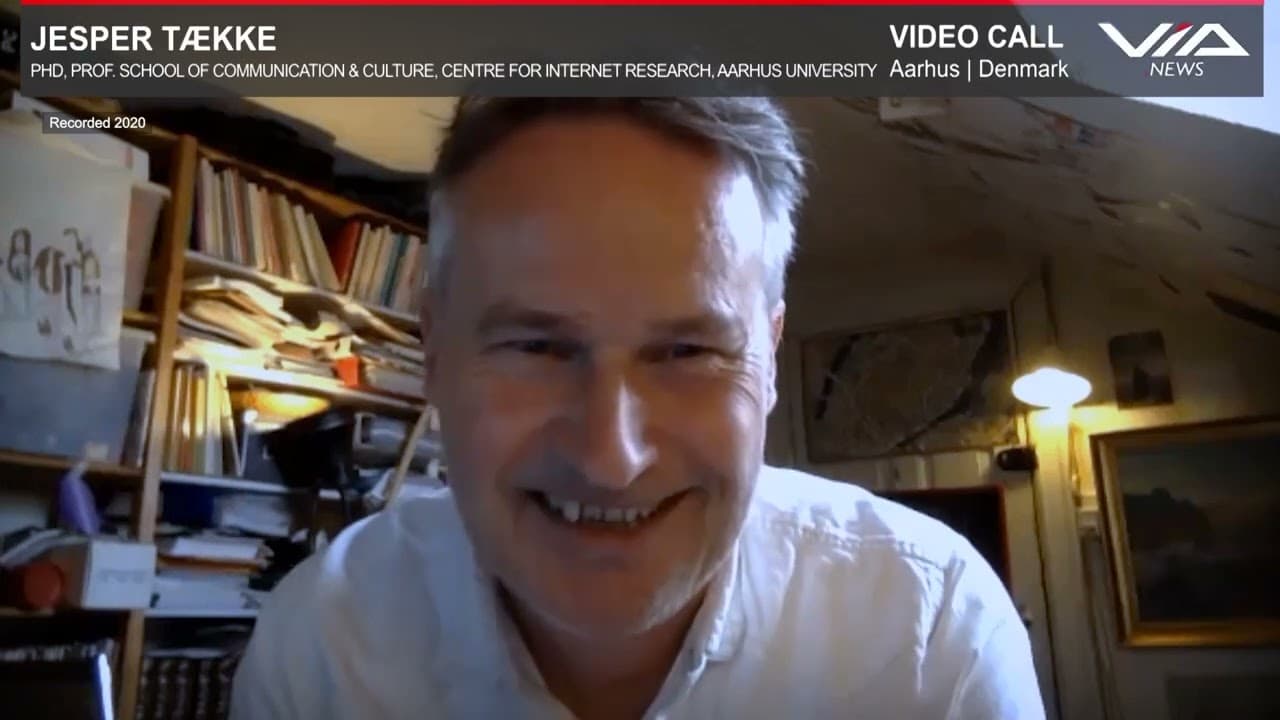
This interview was recorded about 2020.
Jesper Taekke, a professor at the School of Communication & Culture for Internet Research at Aarhus University in Denmark, says large American technology companies are using the pandemic to move into the education market, and that Europe should resist handing teaching over to data-driven machines. He told Via News that the commercial push is already under way.
"Google and other of the big actors from from the US and Silicon Valley based companies are also using this corona situation to to get the market for teaching and and they think that they can do it just well but I think it's not going to happen." He described the Anglo-American direction as one built on big data and the profiling of students, with artificial intelligence deciding how questions should be framed to them.
Three models for the future of teaching
Asked about the prospects for investment in online education tools, Taekke set out what he sees as three competing models. The first is the Anglo-American one, with big data and large companies running the show. The second is a state model such as China, where the state and its artificial intelligence run the teaching. The third is a European tradition of building, a concept he said exists in German and in Danish and which treats education as preparing citizens to decide for themselves.
On that basis he is wary of automated teaching. "we would not like to be profiled and to just have an artificial intelligence as our teacher but maybe they can can help us doing good teaching", he said. Technology could assist, but not lead. "we would like a teacher a human being there with the students", he said.
He added that his group is preparing an article on the three models and that he would share it once published.
Pandemic as shock therapy
Taekke finished his doctoral dissertation in 2006 and has since worked on how the digital media revolution affects schools, leading three larger research projects. He said the pandemic had a dramatic effect on the sector. "I think the coronavirus pandemic has transformed the education sector." He called it a shock therapy, because face-to-face teaching was cancelled in most countries, and said many teachers had not wanted to use digital media and knew little about tools such as Zoom.
He stressed that researchers never intended teaching to move entirely online. "I will also say that it was never meant for us who are researchers in the field that the teaching should only be online that was never the idea." He said the emergency may at least have given some teachers training that makes them better with digital media.
Online-only teaching, in his view, has clear costs. He pointed to the lack of commitment that comes from a teacher being physically present, and to the loss of the feedback a teacher gets from seeing whether students understand. In Denmark, he said, the youngest children and the students who are least strong at school have been hit hardest. "i guess it's very clear to everybody now that a clear clean online model of teaching will not do".
Integrate rather than ban
Taekke drew on the social media education project, which began when an upper secondary school in Denmark found students distracted by their own and others' use of digital media. He said schools tended to respond by forbidding media or ignoring the problem, and that neither helps new norms to develop. In the project the rule was the reverse. "we prohibited the teachers to prohibit the use of any media at all but also to ignore any media use", and teachers were asked to start discussions with students about good use.
Teachers also used Twitter, wikis and shared documents in lessons. Researchers scraped 30,000 tweets from one class over its three years of upper secondary school. Students used Twitter as a written channel alongside spoken discussion, for example asking each other questions about a film as they watched it and keeping the tweets as notes for later writing. He contrasted that with other classes where students played games, shopped online or slept during films. Teachers also offered homework help on Twitter for one hour, five days a week, at night.
He said this takes time and effort from teachers. "it takes time to develop this new didactics and therefore it is very important not to prohibit or ignore the use of for example social media but to integrate them in the teaching." He argued that teachers need training both in the technology and in how to teach with it, and should run small experiments with their classes every day.
His view of ordinary classrooms is critical. "we have this strange problem in these years that to walk into a typical classroom it's like going 20 years back in time where you do not use the new media for creating knowledge for sharing knowledge for learning". Asked whether online education will become permanent, he said it would become absolutely normal, like printed books, if schools keep experimenting.
For students learning online, he advised taking their own initiative, such as forming reading and discussion groups and using written chat during a lecture so that a group can interrupt when something is unclear.
Watch the full interview
Interview by LM Salvado (Miguel Salvado) for Via News.