

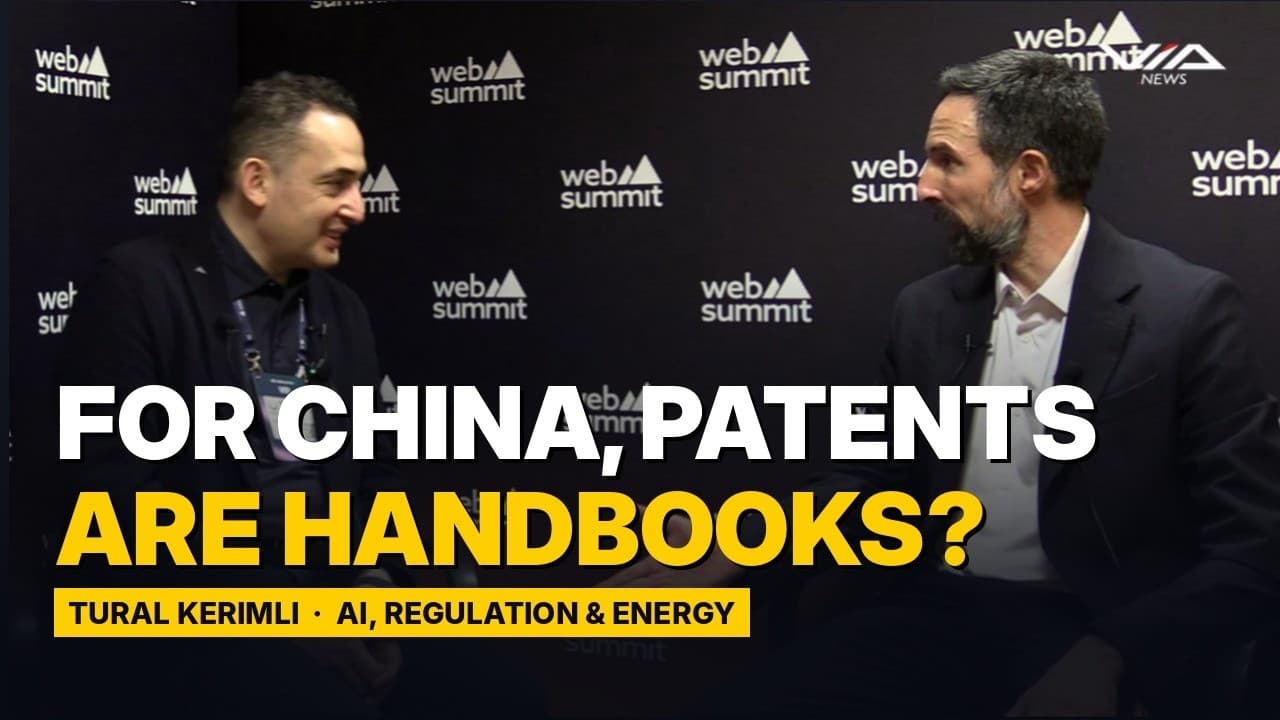
Tural Kerimli, the CEO and founder of AlemX, believes European regulation is lagging behind the AI industry and that regulators will eventually have to give way. Speaking to Via News at the Web Summit, he said the pace of development, the cost of energy and the pull of American investment are putting pressure on the continent's rule-makers. The interview was published by Via News on 16 November 2026.
Regulation and the pull of the United States
Kerimli said Europe is particularly sensitive when it comes to AI rules, and that this is one of the biggest challenges facing its regulators. His view is that the industry will not wait. "That's why the industry will disrupt the regulators. And they have to, from my perspective, they have to liberate the regulation a bit for the players."
He pointed to a drift of companies out of Europe as evidence. "Because what I see right now, many AI companies, even from Europe, they move to the U.S., because of the availability of the funds for AI startups, the investment hype, what goes there." In his assessment, Europe is a little behind the industry, and regulation is the reason, because the continent is highly institutionalised.
Asked whether that is an advantage or a disadvantage, he said it depends on the time horizon. Over the long term he sees it as an advantage, and in the short term a disadvantage. If AI starts to affect some industries negatively elsewhere, he argued, Europe's approach will protect its small and medium businesses.
Energy and chips decide the race
On the competition between the United States, Europe and China over large language models, Kerimli said the contest comes down to energy, microchips, computing power and data centres. He expects the winner to be the country that has all of these at the best prices.
Europe, he said, is exposed on energy. Many European countries switched off nuclear stations and moved to green power, while AI is driving demand sharply higher. "Data centers consume a tremendous amount of electricity." He added that the production of chips is the other main constraint. "Main challenge will be the electricity. So Europe will face a very serious challenge."
Attention, consolidation and the future of work
AlemX describes itself as an attention marketplace and a super app combining messenger, social media and a wallet. Its central idea is to pay users for their attention, including when they watch advertising. Kerimli said the company came to the idea because AI has made content and products easy to produce, which makes attention scarce. The product itself uses AI moderation, an AI assistant and an AI module that chooses which advertisements a user sees based on financial behaviour.
He argued that the economics of building a company have flipped. "It's easy to build the product, but it's not easy to onboard the users." AI agents may soon hold phone numbers, email and wallets and make calls and payments on a person's behalf, he said, but he is sure they cannot replace a person's attention and the decisions that follow from it.
Looking ahead to 2027, Kerimli expects three processes. The first is optimisation, with AI replacing humans in many companies and adoption becoming as obligatory as internet access is today. The second is new business models, as AI changes how markets work. The third is consolidation. "Layer one will be the big companies that will consolidate all the small businesses under their solution." He compared this to electricity, where one or two producers supply resellers and operators in different cities, and said the winner will be the company closest to customers.
On jobs, he was sceptical of big technology companies' message that AI will make everyone wealthy. He said he met developers at the Web Summit who told him they had lost work to AI coding tools and now had to find another profession. He is not sure AI will make everyone wealthy, he said, but he is confident it will make people more powerful, because it helps them find solutions to their problems.
For next year, he expects business models and consumer behaviour that have not been seen before, and a change in who starts companies. "Let's say 10 years ago, it was very unrealistic to see the solo founders, because from investment perspective, VCs, they like when you have many founders, you have a big team, but now we have a new reality, we have an age of the solo founders." He expects AI founders to follow.
Watch the full interview
Interview by L. Miguel Salvado for Via News.