
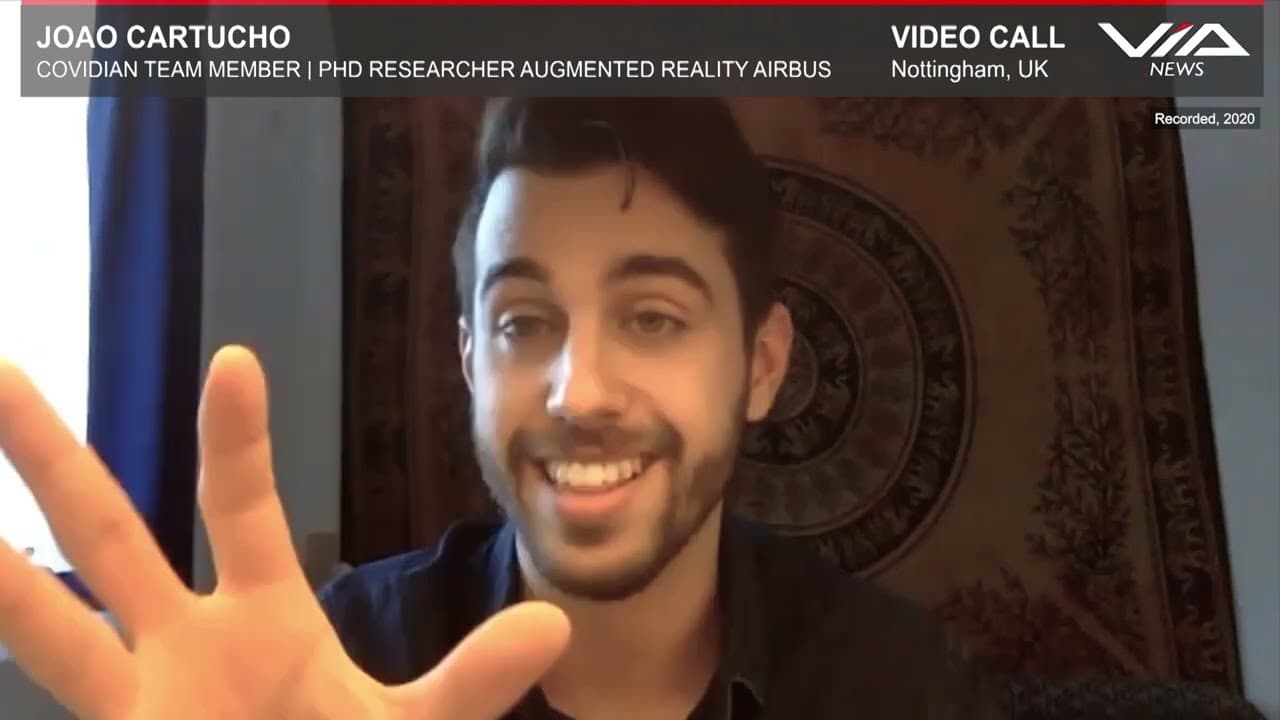
Joao Cartucho, a member of the Covidian team and described as a PhD researcher in augmented reality at Airbus, says the developers of a Covid-19 contact tracing app deliberately gave up the chance to hand governments richer data, in order to win public trust. Speaking to Via News, he said the choice was a hard one, but that an app people refuse to install has no value to anyone.
Cartucho described a spectrum of tracing apps. At one end are those that preserve maximum privacy and security for users, and at the other are those that preserve maximum information for governments and health authorities. The two goals, he said, pull against each other. "We obviously wish to support the government but we chose to prioritize user safety so that people will actually use the application and hence sort of stall the development of the pandemic."
What the app collects, and what it does not
The app uses Bluetooth Low Energy and a randomly generated code that carries no information about the user or the device. Cartucho said the code changes every 15 minutes so it cannot be traced back to a person. He said all data on the phone and all connections to the server are encrypted, and that data is deleted when it is no longer relevant. Users who have had a risky exposure are alerted, he said, even if the person they met had no symptoms, so that they can self-isolate and get tested sooner.
On what is gathered, he was categorical. "The most important thing is that we do not track your location nor your movements. So we don't touch GPS location, we don't track your identity, your name, your date of birth, we don't track the identity of the people you come into contact with, we don't take your telephone number and we don't have your email address."
Asked how the app differs from those in China, Cartucho placed it at the opposite end of the spectrum. He said that approach gives the state a great deal of information but destroys user privacy and respect, adding that "in China there's an element of being forced to use these applications, whereas we believe in people feeling comfortable so that they can make the choice to use these applications."
Adoption as the central business problem
Cartucho said adoption is the main weakness of every tracing app. "The biggest obstacle in all of the COVID-19 tracing applications is adoption. Which is to say people need to download the application in order for it to be effective." He cited research indicating that between 30 and 60 percent of a country's population must download an app before pandemic numbers fall.
His team's answer is to integrate with the second phase of the Apple and Google API, which he said would be released quite soon. Phones would receive an automatic update and ask the owner in the morning whether to enable contact tracing, removing the need to find and install an app, a step he said is especially hard for elderly people. He called this by far the most practical plan for improving effectiveness.
The app is free. "It's completely free. We and hopefully many people don't believe in profiting from pandemic." Cartucho said the first version of the app had been downloaded more than 100,000 times in its first few days in Slovakia, a country of 5.5 million people.
Expansion and regulation
Cartucho said the app is currently available in Slovakia, where he described the results as a great success, and that the team is in talks with Portugal, Mauritius, Madagascar and Brazil. He said there had been multiple calls with representatives of the Portuguese health ministry, with next steps under discussion, and that in Brazil the team has spoken with health representatives from Panama and Sao Paulo. Contacts in Mauritius and Madagascar came through a Dubai connection, he said. The team is connected with BetaE, which he described as Portugal's largest collaborative innovation consultancy, and its chief executive has already launched two companies.
He argued that regulation matters most for apps that collect heavily. An application built to protect privacy from the start needs fewer rules, he said, whereas those that track much more data put the user at risk and should face strong regulation to prevent harm.
We believe that technology is like fire, which is to say fire can burn down a house or it can cook for an entire family.
He said technology companies have a poor record on privacy, citing the Facebook Cambridge Analytica scandal, largely because there is normally no profit incentive to respect users. His team wants to show otherwise. "We do wish to go against that Silicon Valley trend of sucking up as much data as possible, because we believe that trust with users is the most important thing. Because if they don't trust the app, they won't download the app."
Watch the full interview
Interview by LM Salvado (Miguel Salvado) for Via News.