
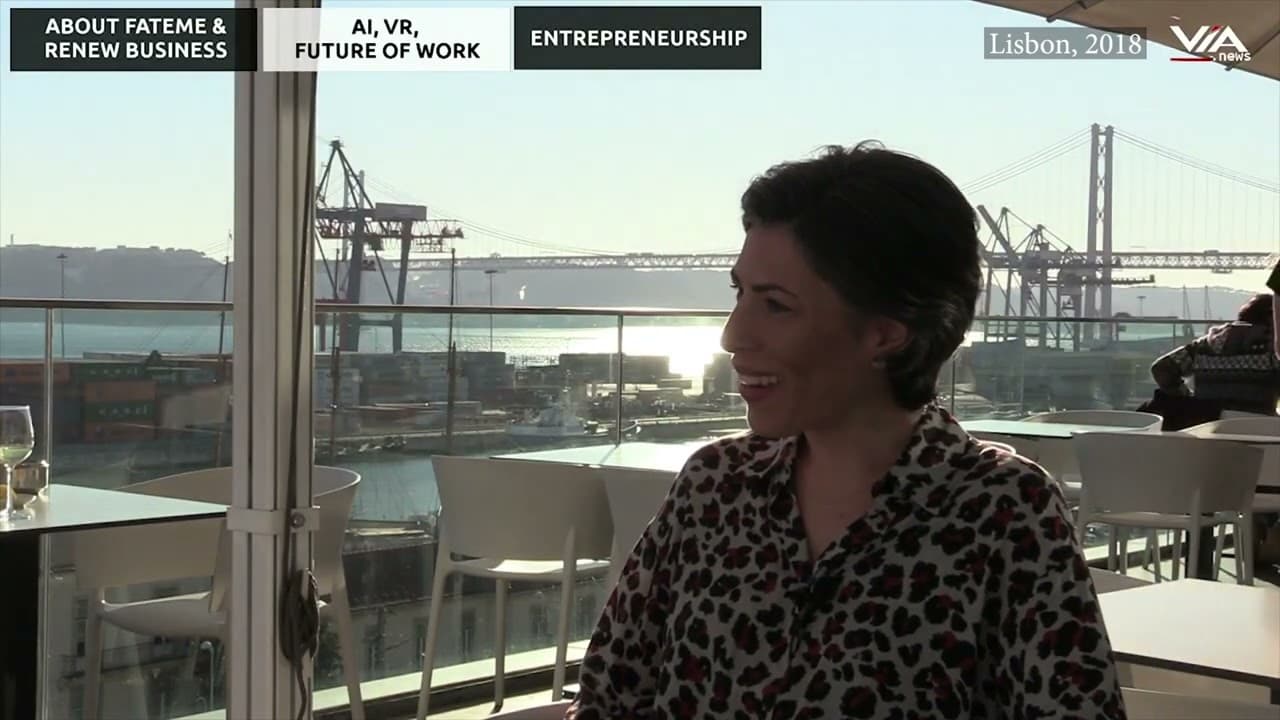
Companies that do not make work a human experience will find it hard to attract and keep the talent they need, according to Fateme Banishoeib, founder of Renew Business. She told Via News, in an interview published on 28 November 2023, that innovation, the thing businesses say they want most, depends on first bringing people back to the centre of the organisation.
Banishoeib holds a master's degree in pharmaceutical chemistry from the University of Rome and a PhD in organic chemistry from Belgium. She worked in a pharmaceutical company, moving from research into quality, distribution, manufacturing and finally strategy, before founding Renew Business in 2017. She is also the author of a self-help journal, Freevolution, and uses poetry in her work with leaders and teams.
Technology should free people, not replace them
Banishoeib said the spread of AI and virtual reality makes the question of humanity more urgent, not less. In her view the technology can take on labour people no longer need to do, which leaves room to reconnect with human skills.
So we need to bring back that human aspect, human factors, human skills that robots, VR, AI cannot reproduce and will not and should not reproduce so that we can finally use the technology we have available for us, for our betterment, for the development of humankind, not for the enslavement of humankind.
She said she hears a great deal of fear and misunderstanding about what the technologies can do. Jobs can indeed be lost, she acknowledged, but she put the weight on what companies do with the gains. "How are we reinvesting back the money that new technology will bring? How are we freeing many labor and giving them the opportunity to grow themselves as a human being?" she asked. The answer, she said, depends on a conscious commitment to humanity, otherwise firms can hide behind an algorithm that does everything for them.
Talent and the next decade
Looking five to ten years ahead, Banishoeib pointed to the expectations of millennials in the workplace, citing studies by major companies such as PwC and McKinsey. "It is very clear that paycheck rewards are no longer enough to not only attract talents, but really to maintain these talents." Businesses that fail to humanise, she said, will find the innovation they crave sitting outside their walls, and the shift away from an assembly-line mindset will happen whether companies want it or not.
She said the same logic applies to leadership. Data on the skills leaders will need, she said, show that "creativity and imagination are rated as the top five skills of the leader of the future." Inclusion, she added, is the one trait she considers essential, both of the parts of ourselves we prefer to show and of the people around us. She also stressed that leadership starts with leading oneself, then a team, and only then an organisation.
Her own programmes for individual leaders, teams and whole organisations follow a fixed order. "So the pillars of Renew Business are integrity, inclusion, and innovation." Integrity comes first, she explained, meaning the reconnection of elements that have been excluded. Inclusion follows, creating an environment where those people, skills and emotions can grow, and innovation is the outcome. She delivers this through one-to-one mentoring and coaching, workshops and retreats. She said her ambition for the company is not conventional growth but to be remembered as the organisation that brought the human back into business.
Women in business and advice to founders
On the role of women, Banishoeib said that after often being the only woman or one of very few in her corporate roles, she sees no real change in the past 50 years, only more women in certain positions. She argued that this reflects a misunderstanding of diversity and inclusion: placing a number of women in senior roles does not by itself mean their views are represented. She called for a shift in the model to bring a feminine point of view into whole processes. "it's not about how many women I have. But do I hear their voices or not." The same test, she said, applies to anyone else.
For young entrepreneurs, her advice was to believe in their dreams, avoid copying what everyone else does, and fall in love with the customer's problem. She said empathy with customers is what allows a founder to find a workable solution. "I don't think and I don't believe anymore in the so-called massive solutions, those solutions that apply to everyone." She added that customers increasingly want something customised to them.
On adversity, she was blunt about what the path involves. "if somebody doesn't like adversity or risk or tough times, should not enter this world." Hard times, she said, do not stop founders but make them stronger, help validate an idea and prompt them to reshape it.
Watch the full interview
Interview by L. Miguel Salvado for Via News.