
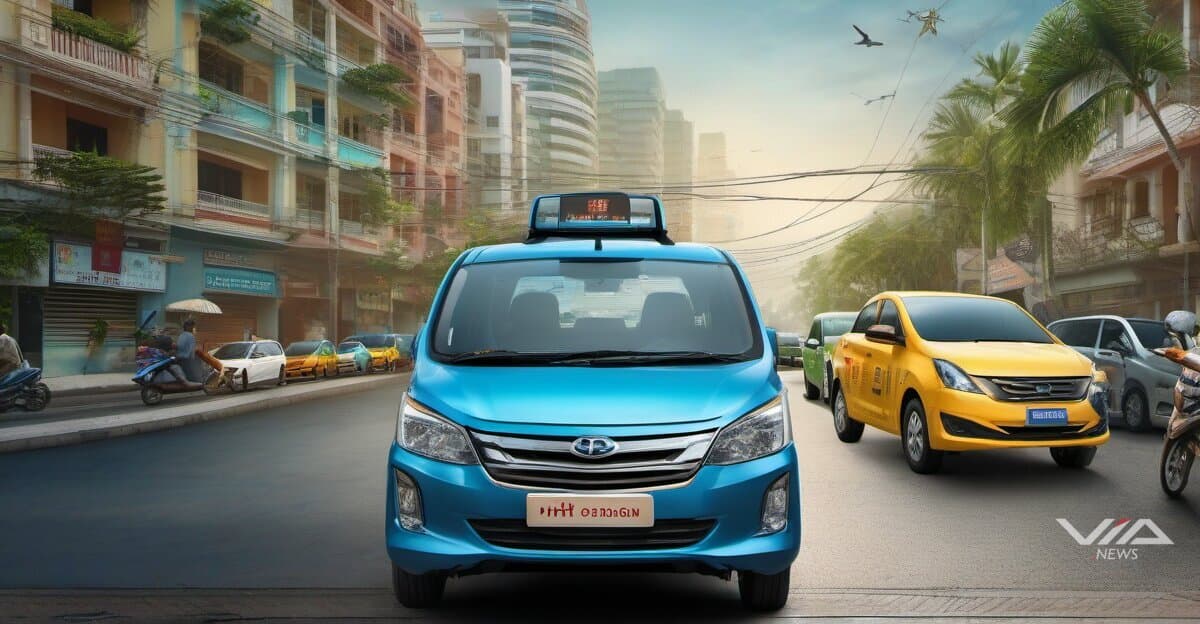
When Ho Chi Minh City announced that every ride-hailing vehicle operating within its boundaries must be electric by January 1, 2030, it joined a growing club of megacities willing to use regulatory hard stops — not incentives alone — to force the pace of transport decarbonisation. The move positions Vietnam alongside London, Amsterdam, and Shenzhen as jurisdictions that have chosen deadline-driven policy over gradualism, and it is already reshaping investment flows across Southeast Asia.
The scale of the task is formidable. An estimated 200,000 to 300,000 ride-hailing vehicles — from motorbike taxis to passenger cars — currently ply the city's streets. That figure makes Ho Chi Minh City's transition one of the largest single-market EV fleet mandates attempted anywhere in the world, comparable in ambition if not yet in state subsidy firepower to China's earlier electrification push in its tier-one cities.
A Global Policy Playbook, Local Economics
The directive follows a template that regulators from Jakarta to Nairobi are studying closely: set a non-negotiable end date, create a financing corridor for operators, and rely on market competition to fill the infrastructure gap. London's Ultra Low Emission Zone, which progressively tightened until petrol and diesel taxis faced existential economics, demonstrated that hard deadlines — rather than subsidy nudges — produce faster fleet turnover. Ho Chi Minh City's planners have drawn the same conclusion.
Yet the economics here are structurally different from those in Western markets. The platforms most exposed — Grab, Gojek, and a constellation of domestic Vietnamese competitors — do not own their vehicles. Drivers are independent contractors who self-finance their motorbikes and cars. That gig-economy ownership model, dominant across Southeast Asia, South Asia, and Sub-Saharan Africa, means the capital burden of electrification falls on individuals with limited access to formal credit, not on balance-sheet-rich corporations.
Bridging that gap is now the central problem for regional banks and development finance institutions. Green vehicle micro-loan products are proliferating, structured to pool the risk of tens of thousands of individual borrowers into instruments palatable to institutional asset managers seeking exposure to Southeast Asian green finance. The World Bank's International Finance Corporation and several Asian Development Bank facilities have signalled interest in this segment, recognising that the gig-driver financing model in Ho Chi Minh City could become a replicable blueprint for similar mandates elsewhere in the developing world.
Battery Swapping: Asia's Answer to the Charging Bottleneck
For infrastructure investors, the most consequential — and most constrained — opportunity is not the vehicles themselves but the energy network behind them. Ho Chi Minh City's hyper-dense street grid, where motorbikes vastly outnumber cars and pavement space is chronically contested, makes the conventional Western model of fixed plug-in charging stations difficult to scale at mandate speed.
Battery swapping is emerging as the structural alternative. The model — in which a driver pulls into a kiosk, exchanges a depleted battery for a charged one in under two minutes, and pays per swap — eliminates the dwell time that makes plug-in charging incompatible with a gig worker's revenue model. Taiwan-headquartered Gogoro pioneered the approach and has expanded aggressively across Asian markets, reporting continued network growth in its Q4 2025 earnings and pointing to institutional appetite for replicating the model in Southeast Asian urban centres.
The Gogoro playbook is asset-light by design: network operators own and maintain battery stations; riders bear no upfront battery cost. That separation of vehicle ownership from energy infrastructure mirrors the concession model familiar to airport and toll-road investors, and it is attracting similar classes of long-duration institutional capital. Comparable swap networks are gaining traction in India, where Bounce Infinity and Sun Mobility are competing for urban two-wheeler dominance, and in several Chinese cities where NIO's Power Swap stations have become a selling point for premium EV buyers.
Regulatory Risk in Emerging Market Context
The 2030 deadline is simultaneously the policy's greatest strength and its most significant investment risk. Hard regulatory timelines in emerging markets carry a documented history of slippage: enforcement mechanisms weaken under lobbying pressure, subsidy frameworks undershoot projections, and grid capacity upgrades fall behind schedule. Investors who committed to similar mandates in Southeast Asian markets in previous years — including early EV bus concessions in Thailand and the Philippines — found that regulatory certainty on paper did not always translate into operational certainty on the ground.
Vietnam's grid itself presents a structural constraint that no ride-hailing mandate can resolve independently. The country remains heavily dependent on coal-fired generation, meaning an accelerated EV transition risks substituting tailpipe emissions for smokestack emissions unless renewable capacity expands in parallel. That concern is not unique to Vietnam: critics of rapid EV mandates in India, Indonesia, and South Africa have raised identical questions about grid carbon intensity. The answer, increasingly, lies in pairing mobility mandates with renewable energy procurement targets — a linkage that Ho Chi Minh City's framework has yet to fully address.
What the World Is Watching For
Regardless of execution risk, the Ho Chi Minh City mandate matters beyond Vietnam's borders for two reasons. First, it represents one of the most ambitious electrification targets ever imposed on a predominantly two-wheeler urban mobility market — a category that accounts for a significant share of transport emissions across the Global South but has received far less policy attention than passenger cars. Second, the financing structures being developed to serve gig-economy drivers in this context — micro-green-loans, battery-as-a-service subscriptions, pooled risk securitisation — are innovations that could unlock EV transitions in dozens of cities from Lagos to Dhaka where the same ownership dynamics apply.
Analysts at several Asia-focused infrastructure funds describe Ho Chi Minh City not merely as a local compliance deadline, but as a live experiment in whether emerging-market cities can leapfrog the incremental EV adoption curve that slowed transitions in wealthier economies. The results, whatever they prove, will be studied in capital allocation committees well beyond Southeast Asia.