
Friday, October 23, 2026

American Express anchors 2 World Trade Center with 2031 lease in $1.5 trillion global office market shift

American Express will occupy 2 World Trade Center starting January 2031, joining a growing pattern of multinational financial firms consolidating into premium office space rather than downsizing. The commitment comes as global cities from New York to Singapore see widening divergence between aging towers and new construction in post-pandemic office markets.

Source Trace Score1 source document1 with a live linkVerifiability: Basic
American Express anchors 2 World Trade Center with 2031 lease in $1.5 trillion global office market shift
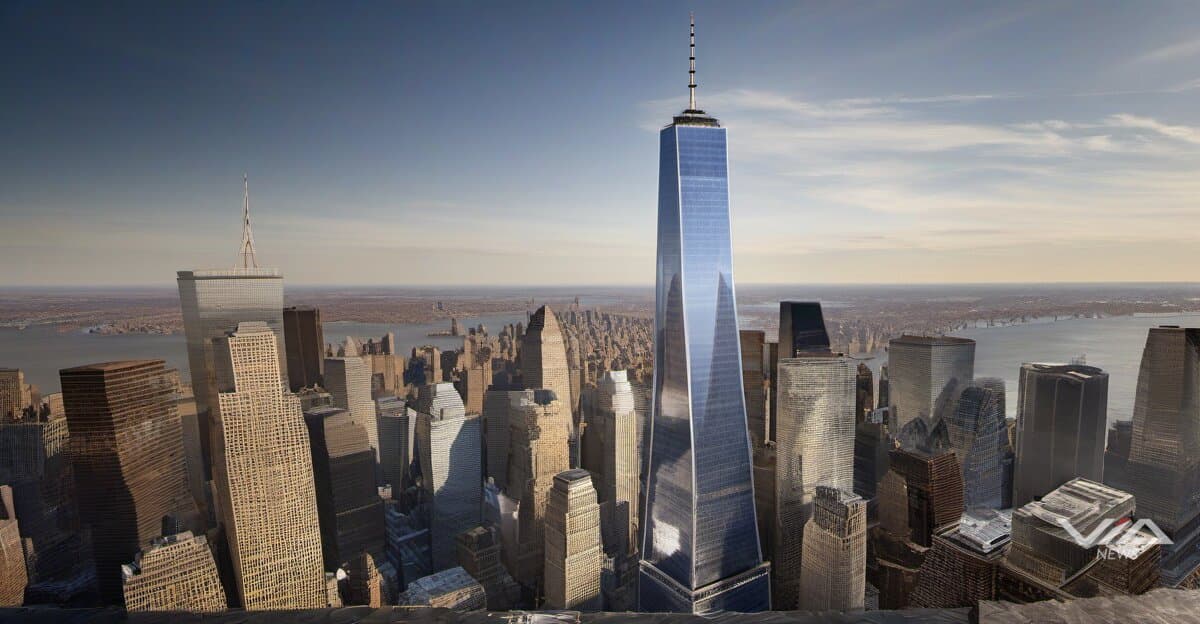
Image generated by AI for illustrative purposes. Not actual footage or photography from the reported events.

American Express will occupy 2 World Trade Center beginning January 2031, making it the anchor tenant for the final tower at New York's rebuilt World Trade Center complex and joining financial services firms worldwide that are consolidating into premium office space rather than abandoning urban centers.

The commitment mirrors moves by HSBC in London, Deutsche Bank in Frankfurt, and UBS in Zurich, where major financial institutions are downsizing total square footage while upgrading to modern buildings with enhanced amenities and sustainability features.

Developer Silverstein Properties had sought a major tenant to justify completing construction on the site, which has faced delays since the 2001 attacks. Large pre-lease agreements like American Express's typically trigger vertical construction on speculative office towers across global financial hubs.

The move reflects a broader pattern in office markets from Manhattan to Hong Kong, where newer buildings command premium rents while older properties struggle. Singapore's Marina Bay district and London's Canary Wharf show similar divergence, with trophy assets maintaining occupancy above 90% while aging inventory sits vacant.

Financial services companies have led return-to-office requirements more aggressively than technology firms globally. JPMorgan, Goldman Sachs, and Citigroup in New York maintain policies similar to counterparts like Barclays in London and Nomura in Tokyo, requiring in-person attendance multiple days weekly.

American Express currently operates across multiple New York locations. The 2 World Trade Center consolidation would centralize employees in a single facility, following a strategy employed by BNP Paribas in Paris and Standard Chartered in Singapore.

Lower Manhattan's World Trade Center complex offers direct subway access to 11 transit lines, outdoor plazas, and building systems designed for post-pandemic workplace standards. Similar transit-oriented developments anchor financial districts in cities including Toronto's Financial District and Sydney's Barangaroo.

The seven-year timeline until 2031 occupancy gives American Express extended planning runway for workplace design and allows phased construction without compressed schedules, a approach increasingly common in major global office developments where tenant customization drives final design specifications.

Source documents

Via News is a conduit. We point to the source documents behind this report — we don't replace them. Trace any claim to its source and decide what to trust. How we source

Source Trace Score1 source document1 with a live linkVerifiability: Basic
  1. [1]News articleYahoo Finance· February 25, 2026
    American Express to Build New State-of-the-Art Global Headquarters at 2 World Trade Center, Deepening Commitment to Lower Manhattan

In this story · Knowledge Files

What we know · the intelligence behind this page
Live from the substrate
What we're seeing
Enterprise Software Races to Govern and Consolidate Around Agentic AI
Enterprise software vendors are repositioning around autonomous AI agents. Salesforce is acquiring Braze, ServiceNow is launching agent governance tools (AI Passport, Super Intelligence Control Tower), SAP is pushing its 'Autonomous Enterprise', and Zeta is launching AthenaOS and its own inference model. Palantir is embedding itself in banking, aviation and sovereign AI infrastructure through partnerships with Customers Bank, Surf Air, Ondas and Armada. Governance, data sovereignty and enforced policy are emerging as preconditions for regulated sectors like finance. Investors such as Norwest see room to disrupt ERP and finance software, and they caution that AI should not be trusted with financial calculations. Consolidation and shareholder disputes (Salesforce/Braze, Tiny/Oso Cloud, ZenaTech/Boardwalktech) show the market reshaping.
Our read on the data ›
Signals we're tracking
EPKINLY Regulatory-Clinical Success Cascade
High probability of expanded label indications, additional combination approvals, and competitive positioning strength in follicular lymphoma market. Predicts positive commercial uptake and potential accelerated review for related indications.
Patterns we're watching ›
Where sources disagree
ING Group
Both facts record the same metric (shares_outstanding) for ING Group at the identical observation date (2025-12-31). FACT A states 2,902,437,688 shares; FACT B states 2,902 million shares (2,902,000,000). The difference is 437,688 shares (~0.015%). This is a genuine value conflict, though the discrepancy appears to result from FACT B rounding to the nearest million while FACT A provides the precise count.
We flag conflicts openly ›
Recently verified
✓ Checked against the original source
4,994
facts traced to their source — and we flag the ones that don't hold up.
101 entities tracked4,994 facts checked against source5,475 source documents archived
Query this data → isubstrate.com