
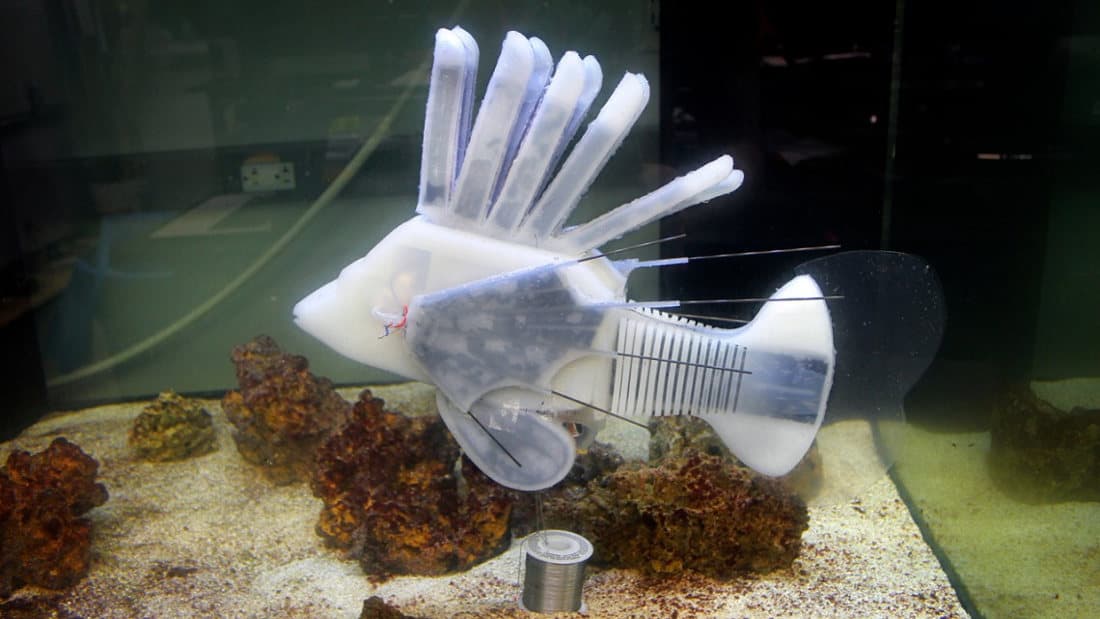
For the longest time, robots have been essential, even as developers tried to make them more human in the way they operate. Fast forward researchers at Cornell University have demystified this thought by going a notch higher and coming up with a robotic fish that tries to mimic how spiders initiate movements.
Robotic Fish
A hydraulic robot that operates using the same principle of a spider is the latest development taking the world by storm. The robot in question leverages the power of pressurized fluids to move from one place to another. The robot underscores how researchers are increasingly trying to empower future robots to have more features as animals.
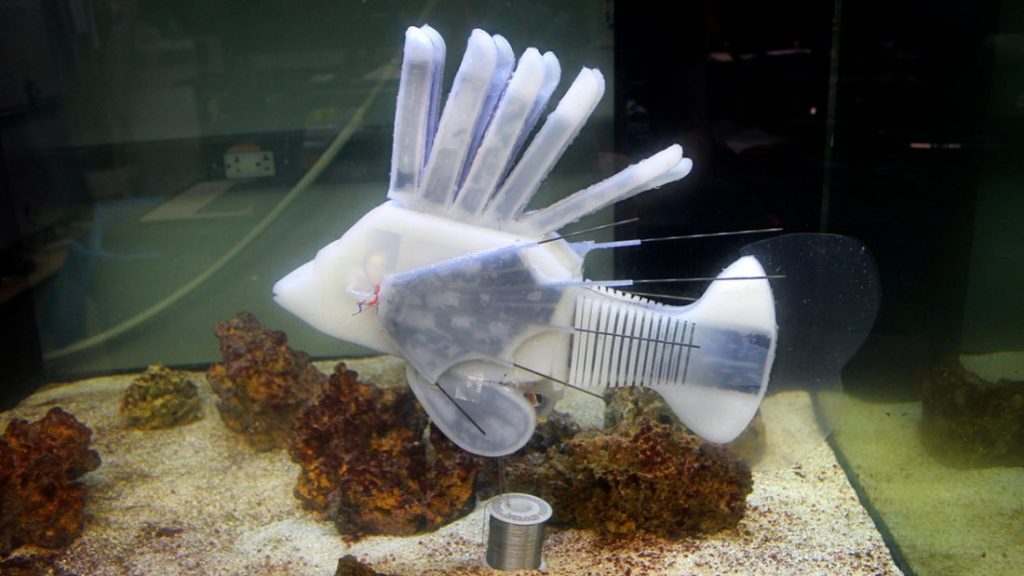
In a research paper, Cornell University researchers have detailed a robotic fish capable of using synthetic blood to perform a wide array of functions. According to the researchers, the robotic fish comes with 0.12 liter of synthetic blood that provides the hydraulic power for movements.
While a significant development in science, the researchers still have a long way to go given that spiders not only use their blood as hydraulic fluids to initiate movements. Instead, their blood performs other roles key among them being the transportation of nutrients as well as oxygen as is the case in other organisms.
The blood moves through an artificial vascular system designed to resemble a healthy heart. The artificial vascular system primary role is to pump energy-dense liquid that generates energy and transmit force.
The pumping of the synthetic blood provides the much-needed hydraulic power, thus allowing the robotic fish to move from one point to another. The use of synthetic blood to drive hydraulic actuators is more efficient as compared to conventional batteries.
The artificial blood, in this case, is a trioxide cathode that serves as a redox flow battery. Oxidation of the zinc results in the production of electrons that power underlying microcontrollers and pumps, consequently initiating movements.
Besides, the robotic fish comes with two separate pumps, both of which pump synthetic blood from a reservoir. One of the pumps pushes blood from the dorsal spines, thus pushing fins outward while the other pump pushes blood from one side of the tail. Coordination of tab two pumps results in a swimming motion of the robot fish
“In nature, we see how long organisms can operate while doing sophisticated tasks. Robots can't perform similar feats for very long," said associate professor at Cornell Rob Shepherd. "Our bio-inspired approach can dramatically increase the system's energy density while allowing soft robots to remain mobile for far longer."
Researchers have since detailed a system that combined hydraulic force transmission and energy storage capability. The integrations increase energy density, thus allowing the robot to operate for long hours.
Operating times of up to 36 hours on a single charge in water is a milestone achievement for the robotic fish. The researchers are currently working on plenty of optimization that they expect to lead to improvements in efficiency as well as performance.
Autonomous Robots Push
The robotic fish underscores research and exploration possibilities as the race of autonomous robots roaming the oceans heats up. A focus on underwater robots is mostly fuelled by the fact that aquatic robots don’t need an exoskeleton, as is the case with others. The long-term plan is to have most of these robots sent to conduct reconnaissance missions underwater.
While there are already robotic, devices that rely on hydraulic power for movements, researchers are working on coming up with softer and more sophisticated robots able to perform various functions.