
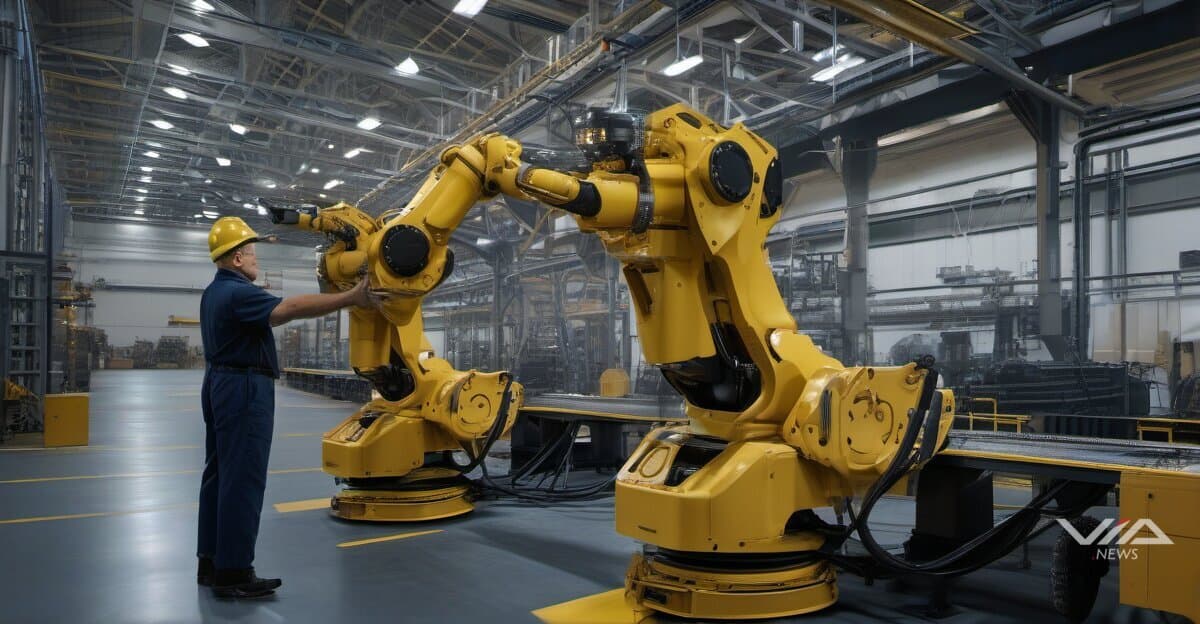
For years, the promise of physical AI — robots capable of perceiving, reasoning, and acting in unstructured real-world environments — was measured in controlled demonstrations and cautious pilot programs. That era is ending. Across naval shipyards, aerospace factories, and ground support operations on multiple continents, autonomous systems are being embedded into the critical infrastructure of defense manufacturing at a scale that would have been unthinkable just a few years ago.
The clearest signal of this shift is a partnership between HII, one of America's largest naval shipbuilders, and Path Robotics, an AI-driven welding company. Together, they are deploying autonomous welding systems directly into naval vessel production lines — not as a proof-of-concept, but as a core component of live manufacturing operations. Welding is among the most technically demanding tasks in shipbuilding, requiring precise judgment about material properties, joint geometry, and environmental conditions. That an AI system can now perform this work reliably enough for defense-grade vessels represents a meaningful industrial threshold — one being watched closely by rival shipbuilding nations.
The broader context makes the timing unsurprising. The United States Congress recently passed an $839 billion defense spending bill, injecting unprecedented capital into the defense industrial base. But Washington is far from alone. NATO members have been racing to meet — and in many cases exceed — the alliance's 2% of GDP defense spending target following Russia's invasion of Ukraine. Germany, Poland, and the Nordic states have all announced multi-year military investment programmes of historic scale. Meanwhile, Japan has doubled its defense budget in a landmark shift away from post-war pacifist doctrine, and Australia is channelling billions into its AUKUS submarine partnership with the United States and United Kingdom.
When procurement budgets reach this scale across so many economies simultaneously, defense contractors face enormous pressure to expand production capacity faster than traditional labor markets can supply. Autonomous robotics offers the most direct solution: systems that can operate continuously, maintain consistent quality tolerances, and be replicated without the decade-long training pipeline that skilled welders and machinists require. Labor shortages in advanced manufacturing are not a uniquely American problem — they are acute across Germany's industrial heartland, South Korea's shipbuilding clusters, and the United Kingdom's aerospace supply chain.
The aerospace sector tells a parallel story. Howmet Aerospace, a major global supplier of structural components for aircraft and defense platforms, recently reported record performance metrics — a sign that advanced manufacturing output is under genuine demand pressure worldwide. European aerospace consortiums, including those supplying the Eurofighter and FCAS next-generation fighter programmes, are confronting similar bottlenecks. Automation is no longer being pursued merely to reduce costs; it is being deployed to fulfil delivery commitments that human-staffed lines cannot meet at current volumes.
Beyond the factory floor, the autonomous transition is visible in adjacent domains. Driverless ground support vehicles are being integrated into airfield and depot operations across NATO installations, reducing the logistical friction of moving equipment and materials across large industrial facilities. These systems represent a distinct category of physical AI — less about precision manufacturing and more about reliable, scalable logistics automation in complex outdoor environments. Similar systems are being trialled at military bases in South Korea, Australia, and several Gulf states investing heavily in defence modernisation.
What distinguishes the current moment from previous waves of industrial automation is the role of machine learning in making these systems genuinely adaptive. Earlier industrial robots required exhaustive pre-programming for every task variation. Contemporary physical AI systems learn from their environment, adjust to material inconsistencies, and improve with accumulated operational data — capabilities that make them viable in the inherently variable conditions of large-scale manufacturing and field logistics.
The geopolitical dimension cannot be separated from the industrial one. China has made autonomous manufacturing a central pillar of its Made in China 2025 and subsequent industrial strategy documents, investing aggressively in robotics, AI-driven production systems, and the shipbuilding capacity to support a rapidly expanding naval fleet. The integration of physical AI into Western defense manufacturing is, in part, a direct response to this competitive pressure — an attempt to sustain qualitative advantages in production speed, precision, and volume as the global balance of industrial capability shifts.
For the countries and companies at the frontier of this transition, the strategic stakes are clear: the next era of defense industrial power will belong not simply to those with the largest workforces or the deepest raw material reserves, but to those who can most effectively merge artificial intelligence with physical production. The shipyard is becoming a proving ground for that proposition.