
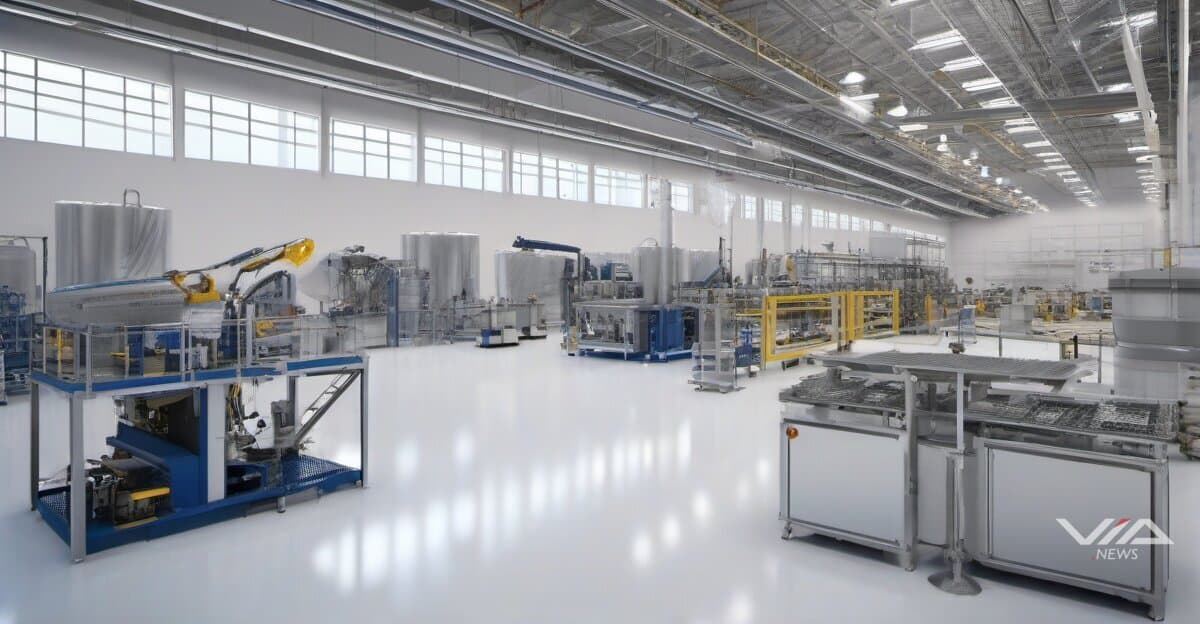
For decades, the geography of the global semiconductor industry has followed a familiar pattern: chips designed in the United States and Europe, fabricated in Taiwan or South Korea, and packaged — assembled into the finished components that actually power devices — almost exclusively in East Asia. Amkor Technology's new mega-campus in Peoria, Arizona is a deliberate challenge to that arrangement.
When the facility begins production in 2028, it will bring approximately 750,000 square feet of cleanroom space online on American soil — making it one of the largest advanced semiconductor packaging sites in the Western Hemisphere, and a direct competitor to the concentrated packaging hubs of Taiwan, South Korea, Malaysia, and China that have long defined the industry's final mile.
The Hidden Chokepoint in Global AI Hardware
Advanced chip packaging has emerged as one of the most consequential and least-discussed battlegrounds in the global technology race. While years of political and investment attention focused on wafer fabrication — who can build the fabs to manufacture chips at the leading edge — packaging quietly became equally critical to delivering the performance that artificial intelligence workloads demand.
Techniques such as fan-out wafer-level packaging, 2.5D interposers, and chip-on-wafer-on-substrate (CoWoS) are now essential for bonding high-bandwidth memory stacks directly alongside compute dies. NVIDIA's H100 and B200 GPUs — the workhorses of data centres from Frankfurt to Singapore — rely on these processes to function. Without advanced packaging capacity in the West, chips fabricated in Arizona or the Netherlands still require a journey to Asia before they can be deployed in a server rack.
That dependency has drawn increasing scrutiny from governments in Washington, Brussels, and Tokyo alike, all of whom have watched the concentration of packaging expertise in Asia with growing unease — particularly after supply chain disruptions during the COVID-19 pandemic exposed the fragility of just-in-time semiconductor logistics.
Asia's Dominance — and the Challenge to It
The packaging industry has historically been dominated by a handful of Asian players. Taiwan's ASE Technology Holding and Japan's Ibiden are among the world's leading suppliers of advanced packaging services, while Taiwan Semiconductor Manufacturing Company (TSMC) has aggressively expanded its own integrated packaging capabilities through its InFO and CoWoS platforms. Malaysia and China have also cultivated significant packaging capacity, with the latter investing heavily in domestic champions as part of its broader semiconductor self-sufficiency drive.
Amkor itself is a deeply international operation — founded by a Korean-American family, headquartered in the United States but with major manufacturing facilities in South Korea, Japan, Vietnam, Portugal, and Malaysia. Its Arizona investment represents a strategic pivot: applying global expertise to serve the onshoring imperative that US industrial policy now demands.
The CHIPS Act as Catalyst
The facility is a direct product of the industrial policy wave set in motion by America's CHIPS and Science Act, which allocated tens of billions of dollars to rebuild domestic semiconductor capacity across the value chain — from raw materials and fabrication to packaging and testing. Similar legislative efforts have followed in the European Union's Chips Act, Japan's partnership with TSMC and Samsung to onshore advanced fabrication, and South Korea's own national semiconductor strategy.
What distinguishes the Amkor project is the depth of its anchor customer relationships. Apple — one of Amkor's largest customers globally — has publicly committed to sourcing advanced packaging services from the Arizona plant. That kind of offtake commitment de-risks a capital-intensive infrastructure investment in ways that government subsidies alone cannot, and it signals that American technology companies are prepared to pay a premium for supply chain resilience over pure cost efficiency.
Market Momentum and the Race for Scale
The broader market backdrop supports the investment case. The global wafer dicing and packaging services market is projected to exceed $932.9 million by 2035, according to analysis from Astute Analytica, driven by surging demand for miniaturised, high-performance components across AI infrastructure, automotive electronics, and next-generation consumer devices. Domestic capacity expansions like Amkor's are positioned to capture a meaningful share of that growth — though they will compete against deeply entrenched, cost-competitive Asian rivals with decades of process expertise.
The competitive pressure runs in both directions. South Korean and Taiwanese packaging firms are watching American onshoring with a mix of concern and pragmatism, with some — including TSMC through its own Arizona fab expansion — choosing to participate in the US market rather than cede it. The result is a global packaging industry in structural transition, with capacity migrating westward even as Asian incumbents invest to defend their technological lead.
What It Means for the Global AI Ecosystem
For hyperscalers and AI hardware developers worldwide — from Amazon and Google in the United States to Alibaba and ByteDance in China, and emerging AI infrastructure builders in the Gulf and Southeast Asia — a maturing Western packaging ecosystem changes the calculus of supply chain risk. Shorter supply chains and faster iteration cycles become available to those building in or near the United States. For others, the bifurcation of the global semiconductor supply chain into increasingly distinct Western and Chinese ecosystems becomes more pronounced.
Geopolitically, the Amkor campus is one data point in a larger reconfiguration. The era of a single, seamlessly integrated global semiconductor supply chain — optimised for cost above all else — is giving way to a more fragmented, redundant, and politically shaped architecture. Whether that transition delivers genuine resilience, or simply higher costs distributed across multiple blocs, will be one of the defining technology policy questions of the decade ahead.