
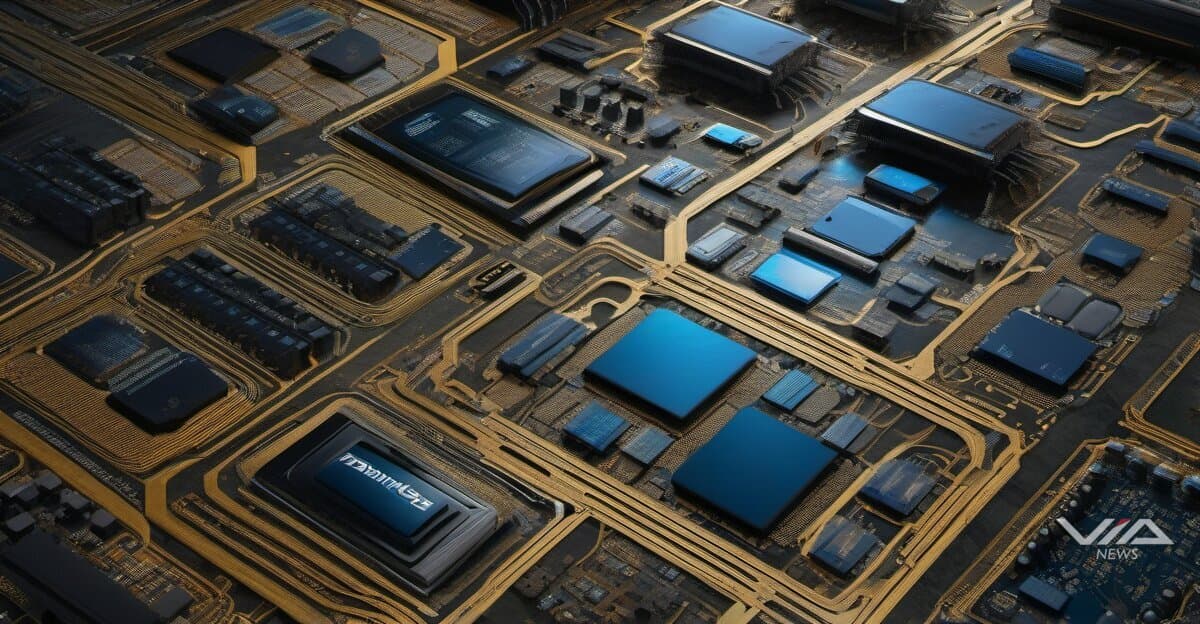
A quiet revolution in semiconductor design is reshaping the architecture of the global digital economy. Where data centers once ran on standardized, general-purpose processors sourced from a handful of dominant suppliers, the world's most powerful technology companies are now co-designing their own chips — and the geopolitical and economic implications stretch far beyond any single earnings report.
At the forefront of this transformation is Marvell Technology and its Celestial AI custom silicon program. The company projects revenue contributions beginning in the second half of fiscal 2028, scaling to a $500 million annual run rate that year before reaching $1 billion by fiscal 2029. Paired with guidance for more than 40% full-year revenue growth, Marvell has positioned itself as one of the most strategically significant companies in global AI infrastructure.
From General Purpose to Purpose-Built: A Structural Shift
For most of the past decade, artificial intelligence workloads were powered by general-purpose graphics processing units — flexible, widely available, and dominated by a single American supplier. But as the computational demands of large language models, real-time inference, and planetary-scale data processing have intensified, hyperscalers across the United States, Europe, and Asia are discovering that off-the-shelf chips carry embedded inefficiencies that compound at scale.
Custom application-specific integrated circuits, or ASICs, offer an alternative: chips engineered precisely for a given workload, delivering dramatic improvements in performance-per-watt and total cost of ownership. This is not merely a technical preference — it is becoming a strategic imperative for any organisation seeking to compete in the AI era without surrendering its infrastructure economics to chip suppliers.
Marvell's Celestial platform is designed for exactly this market. Developed in close partnership with major cloud customers — understood to include leading US hyperscalers — Celestial chips are purpose-built for next-generation AI data centers. Broadcom is pursuing the same strategy, with a 5% single-day stock gain following strong AI-related guidance signalling that investors worldwide regard this shift as structural rather than speculative.
A Global Infrastructure Race with Concentrated Suppliers
The emergence of custom silicon as the backbone of AI infrastructure is unfolding against a backdrop of intensifying geopolitical competition over semiconductor capability. The United States, European Union, China, South Korea, Japan, and Taiwan are each investing heavily in domestic chip production capacity — a response to the supply chain vulnerabilities exposed by the COVID-19 pandemic and the strategic significance assigned to semiconductors by governments on every continent.
Yet even as nations race to build sovereign chip industries, the design and intellectual property layer remains highly concentrated. Marvell and Broadcom — both headquartered in the United States — are emerging as the primary infrastructure partners for the hyperscalers driving global AI investment. Their custom silicon programs effectively embed them into the long-term capital expenditure plans of companies like Amazon, Google, Microsoft, and Meta, insulating them from the volatility of consumer electronics cycles that are buffeting less-specialised chipmakers.
This bifurcation is stark. Chipmakers exposed to smartphones, personal computers, and automotive markets are navigating considerably weaker demand environments, while AI infrastructure specialists project sustained, accelerating growth. The divergence reflects a structural reallocation of global capital — not a cyclical fluctuation — that analysts expect to persist well into the next decade.
Asia's Role: Manufacturing Power, Design Ambition
No account of the custom silicon wave is complete without acknowledging Asia's central role. Taiwan Semiconductor Manufacturing Company remains the indispensable fabrication partner for virtually every advanced custom chip in production today, including those at the heart of Marvell's Celestial program. TSMC's fabs in Taiwan — and its nascent facilities in Arizona, Japan, and Germany — are the physical foundation on which the AI infrastructure build-out rests.
Meanwhile, Chinese technology giants including Alibaba, Baidu, and Huawei have been developing their own custom AI chips for years, partly in response to US export controls that have restricted their access to leading-edge processors from American suppliers. This parallel development track is accelerating, with Chinese hyperscalers increasingly viewing domestic custom silicon as both a competitive necessity and a hedge against geopolitical risk. The result is a bifurcated global market: US-aligned hyperscalers partnering with Marvell, Broadcom, and NVIDIA, while Chinese cloud providers invest heavily in indigenous chip design ecosystems.
The Infrastructure Economics That Are Driving the Transition
Behind the headline revenue projections lies a set of infrastructure economics that are compelling for any hyperscaler, regardless of geography. Power efficiency has become a critical constraint: AI data centers consume electricity at a scale that is straining grids from Northern Virginia to Singapore, and every improvement in performance-per-watt directly reduces operating costs and carbon exposure. Interconnect bandwidth and memory architecture — two areas where custom chips can be optimised far beyond general-purpose designs — are similarly decisive for the latency and throughput requirements of frontier AI models.
These pressures are universal. Whether a data center operator is headquartered in Seattle, London, Tokyo, or Riyadh, the economics of running large-scale AI inference on general-purpose hardware are increasingly difficult to justify. The sovereign AI programs being announced by governments from France to the UAE to India will face the same hardware constraints — and the same incentive to pursue custom silicon solutions — as their private-sector counterparts.
What This Means for the Global Technology Order
The rise of custom AI silicon is not simply a story about semiconductor stocks. It represents a deepening integration between the world's largest technology platforms and their chip suppliers — a vertical consolidation of the AI stack that has profound implications for competition, sovereignty, and the distribution of value in the digital economy.
Nations and companies that can participate in the design and manufacture of custom AI chips will occupy a structurally advantaged position in the AI era. Those that cannot will face growing dependency on a small number of foreign suppliers for the hardware that increasingly underpins economic productivity, national security, and scientific capability.
Marvell's Celestial program, and Broadcom's equivalent ambitions, are symptoms of a transition that is already well underway. The data center of the future will not run on off-the-shelf hardware — and the race to define what it does run on is one of the defining technological contests of this decade.