
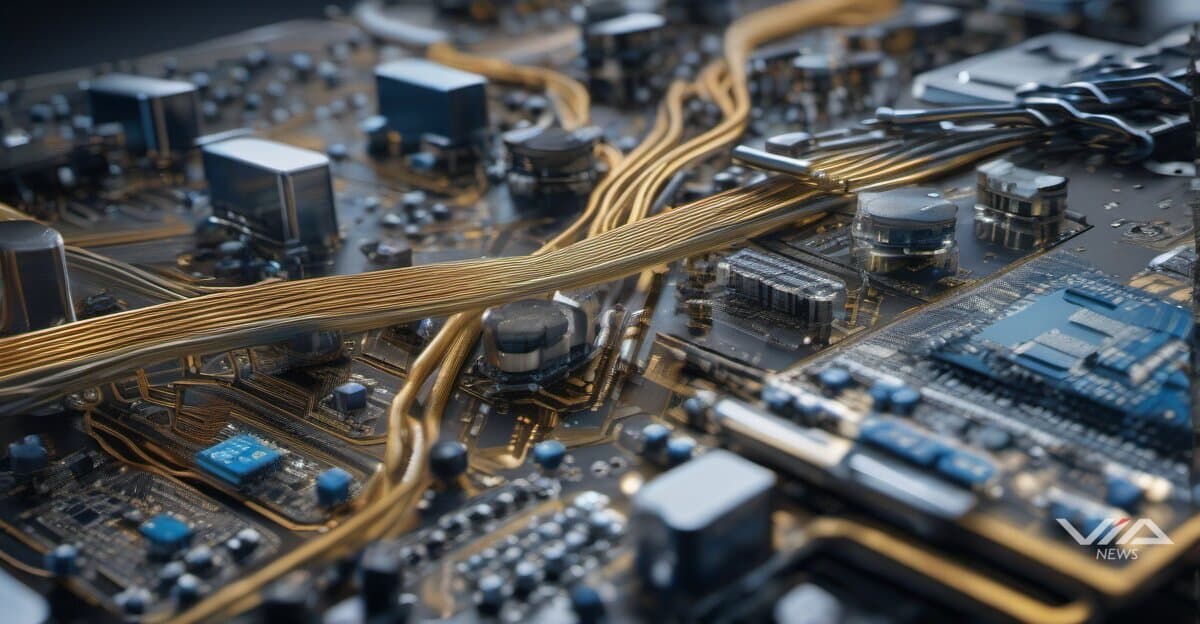
The race to build AI infrastructure is no longer just a story about processors. Beneath the headline-grabbing chip announcements lies a sprawling, increasingly strained global supply chain — one that every major player, from outsourced packaging houses in Taiwan and South Korea to precision timing specialists in California and Europe, is now scrambling to reinforce.
The semiconductor industry entered 2026 navigating a delicate dual reality: a lingering post-COVID inventory correction on one hand, and an accelerating wave of AI-driven capital expenditure on the other. The stakes are geopolitical as much as commercial. Governments from Washington to Brussels to Beijing are treating semiconductor supply chain resilience as a matter of national security, pouring billions into industrial policy designed to reduce dependence on single-country production nodes.
Packaging Becomes the New Bottleneck — and a New Geopolitical Front
As chip architectures grow more complex — with AI accelerators increasingly relying on chiplet designs, high-bandwidth memory stacking, and heterogeneous integration — advanced packaging has emerged as a critical constraint. Historically, advanced packaging has been concentrated in East Asia, particularly Taiwan and South Korea, where TSMC and Samsung Foundry have dominated. Now, U.S.-headquartered Amkor Technology is positioning itself as a Western-aligned alternative, investing heavily in advanced packaging infrastructure across its facilities in Arizona, Portugal, and Vietnam to service hyperscalers and AI hardware vendors who require capabilities well beyond traditional wire bonding.
The geographic diversification is deliberate. Following the disruptions of the COVID-19 pandemic and rising U.S.-China tensions over semiconductor access, major technology companies are actively seeking supply chains that span multiple jurisdictions. Advanced packaging techniques — fan-out wafer-level packaging, 2.5D interposer integration, and system-in-package (SiP) configurations — are now essential for delivering the memory bandwidth and power efficiency that AI workloads require. Capacity in this segment remains tight globally, and firms like Amkor are locking in long-term design wins to secure their position in an increasingly competitive market.
Consolidation at the Component Level: A Global Timing Play
Further up the stack, precision timing specialist SiTime is making an aggressive move to capture AI infrastructure tailwinds with the acquisition of Renesas's timing business. The deal — with Japanese semiconductor giant Renesas as the seller — underscores how deeply interconnected the global supply chain has become, and how consolidation is accelerating across national boundaries. Timing components, once dismissed as commodity parts, are now mission-critical in AI data centers, where synchronization across thousands of interconnected chips directly impacts system performance and reliability.
The transaction reflects a broader trend: as AI systems scale globally, the tolerance for timing jitter and clock instability narrows sharply, raising the strategic value of precision timing intellectual property and manufacturing expertise. For Japan's Renesas, divesting the unit represents a strategic refocus on automotive and industrial semiconductors — a reminder that different regions are placing different bets on where the next decade of chip demand will concentrate.
Networking Silicon: Open Standards as a Global Imperative
The supply chain transformation extends to networking silicon. Cisco's recently announced Silicon One G300 reflects a growing global industry consensus that AI at scale demands open, standards-based networking infrastructure — a principle that is especially resonant in markets outside the United States, where dependence on proprietary ecosystems from a handful of American vendors has long been a source of concern. As Cisco's Yousuf Khan noted, customers require solutions they can "deploy with confidence across diverse environments" — a formulation that speaks directly to enterprises and government bodies worldwide seeking interoperability and supply chain optionality.
European and Asian cloud providers, increasingly building out their own AI infrastructure to compete with U.S. hyperscalers, stand to benefit most from the emergence of open networking standards. The ability to source silicon from multiple vendors without being locked into a single architecture is not merely a technical preference — in an era of export controls and technology nationalism, it is a strategic necessity.
The Strategic Takeaway: Who Controls the Backbone Controls the Future
The common thread running through advanced packaging, precision timing, and networking silicon is scarcity — and the recognition by every major economy that controlling these layers of the AI supply chain confers lasting strategic advantage. The United States has moved aggressively through the CHIPS Act and allied export control regimes to shape who can access the most advanced nodes. China is investing at scale to build indigenous alternatives. Europe is funding its own semiconductor sovereignty agenda. And the smaller but critical players — Taiwan, South Korea, Japan, the Netherlands — find themselves at the center of a technology cold war they did not choose.
For investors and policymakers alike, the message is the same: the AI era will be won or lost not just in the data center, but in the packaging lines, timing chip fabs, and networking silicon design houses that most people have never heard of. The arms race is global, it is already underway, and the spoils will go to those who understood its true dimensions earliest.