
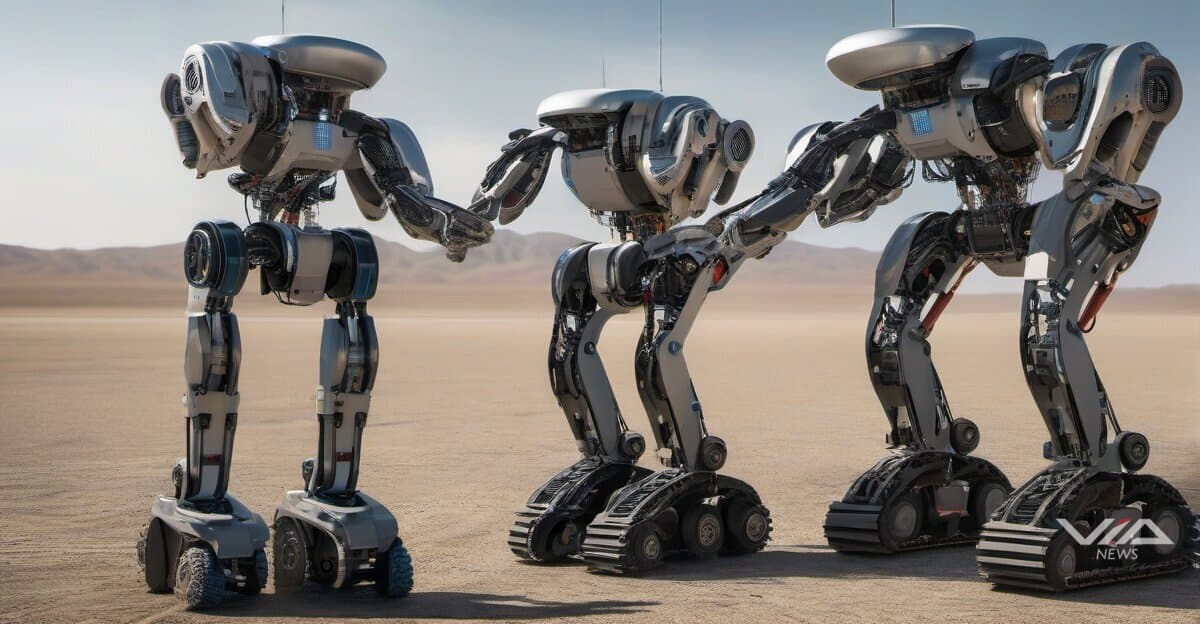
For decades, the promise of autonomous machines doing physical work sat just beyond the horizon of economic viability. The technology existed in fragments; what was missing was the combination of affordable hardware, regulatory clarity, and AI capable of operating reliably in an uncontrolled world. In 2025 and into 2026, those three conditions are converging — not in one country, but across a widening band of markets from East Asia to the Arabian Peninsula to North America.
The clearest signal comes from the autonomous vehicle sector. WeRide (NASDAQ: WRD), a Chinese-founded AV operator that has deliberately built a multi-jurisdiction footprint, reported robotaxi revenue growth of 761% year-over-year in Q3 2025, reaching RMB 35.3 million (approximately $5 million USD). Total quarterly revenue hit $24 million — up 144.3% annually — while gross margins expanded from 6.5% to 32.9%. Those margin numbers matter enormously: they signal that the unit economics of driverless transport are finally working, not just in a single favourable test market, but across a network spanning 30+ cities in 11 countries.
WeRide's geographic strategy is itself a case study in how Physical AI companies are approaching global expansion. Rather than dominating one domestic market before internationalising — the traditional playbook — WeRide has pursued regulatory licences in parallel across jurisdictions as different as the UAE, Singapore, and the United States. Its landmark driverless robotaxi commercial permit in the UAE, and a public passenger service in Singapore slated for early 2026, reflect a broader regulatory opening that would have been unthinkable five years ago. Governments that once viewed autonomous vehicles with deep scepticism are now competing, in some cases, to attract the investment and infrastructure that comes with early adoption.
This regulatory shift is not uniform. In Europe, a cautious legislative culture and fragmented national frameworks have slowed AV deployment compared to Gulf states and parts of Asia. In the United States, a patchwork of state-level rules has created an uneven landscape — though federal momentum is building. The contrast is instructive: countries and regions that move quickly on licensing infrastructure stand to become the early beneficiaries of autonomous transport networks, attracting capital, expertise, and the data-driven advantages that accrue to first movers.
On the humanoid robotics front, the most significant recent development is Mobileye's acquisition of Israel-based Mentee Robotics. The deal is notable not for its scale but for its logic. Prof. Lior Wolf, a principal architect of Mentee's technology, described the acquisition as providing "access to unparalleled AI infrastructure and commercialization expertise" — language that frames the move squarely around market entry rather than further research. Mobileye brings to the table a perception and decision-making stack refined over years of advanced driver-assistance systems (ADAS) deployment in hundreds of millions of vehicles worldwide. Adapting that stack for bipedal robots is a meaningful shortcut, compressing development timelines that would otherwise take years to replicate.
The humanoid sector is drawing investment globally. In China, companies including Unitree and Fourier Intelligence are scaling production of bipedal robots for industrial applications, backed by state industrial policy that views humanoid robotics as a strategic priority. In the United States, Figure AI and Agility Robotics are in commercial pilots with major logistics operators. Boston Dynamics, now Japanese-owned under Hyundai, straddles both markets. The result is a genuinely international competitive field — with implications for labour markets from the assembly lines of Southeast Asia to the logistics warehouses of Western Europe.
Hardware economics are the often-overlooked engine driving all of this. Hesai Technology, a Shanghai-based LiDAR manufacturer, is targeting sub-$200 price points for its next-generation ATX sensors. Context: high-quality LiDAR units cost tens of thousands of dollars as recently as a decade ago. The automotive LiDAR market is projected to reach $25.75 billion by 2035, according to Astute Analytica, and that growth is predicated almost entirely on continued commoditisation. When a sensor drops below $200, it ceases to be a capital expenditure and becomes an operational line item — fundamentally transforming the business case for deploying autonomous systems at scale.
The same dynamic is playing out across the broader sensor, compute, and actuator supply chains. Costs that once confined robotics to high-margin industries like automotive or semiconductor fabrication are falling fast enough to make automation viable in lower-margin sectors: food processing, logistics, construction, elder care. The last of these carries particular weight for ageing societies in Japan, South Korea, Germany, and Italy, where demographic pressure is already straining public services and labour supply.
Industrial robotics deployments are accelerating on a parallel track. Path Robotics and Amazon Robotics are among the operators pushing automated systems deeper into manufacturing and logistics workflows in North America, with 2026–2028 widely cited as the window for broad commercial rollout. Warehouse automation, autonomous shipbuilding — South Korea's Hyundai Heavy Industries is an active player here — and public transit applications are all entering commercial phases near-simultaneously.
The cumulative picture is of an industry crossing a threshold, not gradually but in a compressed burst across multiple geographies at once. The nations and companies that move decisively in this window will shape the physical AI landscape for a generation. Those that wait for the technology to mature further, or for regulatory frameworks to settle without their input, may find the architecture already built around someone else's standards.