
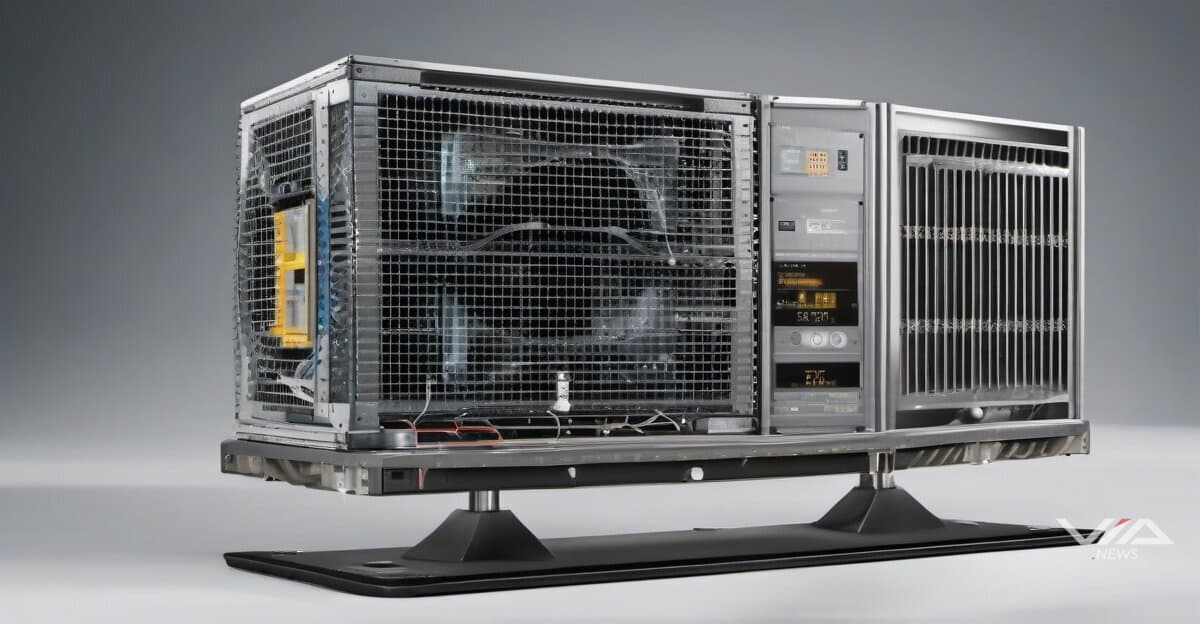
In competitive markets from California to South Korea, the fastest path to an acquisition premium is often the most dangerous one: bet everything on a single breakthrough product. QuantumSpeed, an AI acceleration firm recently absorbed by VisionWave Holdings at a valuation of $99.6 million, has followed exactly that playbook — with its entire market identity, revenue base, and strategic value concentrated in one flagship offering: qSpeed.
Risk assessments reviewed by Via News classify QuantumSpeed's single-product concentration as a catastrophic-severity technological risk, though analysts assign a low probability of near-term materialisation. The structural concern is straightforward: when brand, revenue, and market position are fused into a single named product, any acute failure — a zero-day vulnerability, a manufacturing defect at scale, or a rival architecture that renders the design obsolete — becomes existential rather than manageable.
A Global Pattern in AI Hardware
QuantumSpeed's situation is not unique. It reflects a tension playing out simultaneously across the world's major AI hardware ecosystems. In the United States, a generation of semiconductor startups rode single-architecture bets to billion-dollar valuations — and several subsequently collapsed when Nvidia's CUDA ecosystem or shifting inference workloads undercut their core proposition. In China, domestic AI chip firms backed by state capital have faced analogous pressure, with companies like Cambricon and Horizon Robotics navigating the treacherous gap between benchmark performance and production-scale adoption.
In Europe, where AI hardware investment remains more modest but growing, policymakers have begun flagging single-supplier dependencies as a systemic vulnerability — not merely a corporate risk, but a matter of strategic autonomy. The European Chips Act, partly motivated by the supply chain shocks of 2021–2022, reflects a continental-scale reckoning with what happens when critical technology concentrates in too few products or too few hands.
The transition from training-optimised to inference-optimised silicon has wrong-footed well-funded startups on multiple continents. Firms that dominated cloud training workloads found themselves outmanoeuvred as the market pivoted toward edge deployment and energy-efficient inference — a shift that rewarded architectural flexibility over raw throughput. QuantumSpeed, operating across AI acceleration, computing, and defence technology simultaneously, faces this same dynamic with additional exposure.
Defence Contracts Add a Layer of Geopolitical Risk
QuantumSpeed's involvement in defence technology amplifies the stakes considerably. Military and government procurement cycles are long, relationship-driven, and geographically bounded — contracts won in one country rarely transfer to another. But they are also unforgiving in failure: a security vulnerability discovered in hardware deployed in sensitive national security applications can trigger contract cancellations, regulatory investigations, and reputational damage that no engineering fix can quickly repair.
This dynamic has precedent globally. Israeli, British, and American defence-adjacent tech firms have all navigated moments where hardware or software vulnerabilities in classified-adjacent deployments produced cascading institutional consequences — consequences that outlasted the technical remediation by years. For a company whose entire product portfolio is a single item, such an event would carry no cushion.
What the $99.6 Million Valuation Captures — and What It Misses
VisionWave Holdings' decision to integrate QuantumSpeed at a $99.6 million valuation reflects confidence in qSpeed's current market traction. Acquisition valuations, however, are snapshots of momentum — not assessments of resilience. A $99.6 million company with one product occupies a fundamentally different risk category than a $99.6 million company with a diversified technology portfolio, even if their balance sheets look similar at the moment of deal closure.
Risk analysts assign a confidence score of 0.70 to their catastrophic-severity assessment — indicating the structural vulnerability is considered well-established, even as the probability of a triggering event in the near term remains low. It is precisely that gap between severity and likelihood where strategic planning must operate.
Globally, acquirers in the AI hardware space are beginning to price product concentration risk more explicitly. Investors in Tokyo, Tel Aviv, and Toronto have watched enough single-product AI firms cycle through hype and collapse to treat portfolio breadth as a due-diligence criterion rather than an afterthought. Whether VisionWave Holdings applied that lens rigorously before closing the QuantumSpeed deal remains an open question.
The Innovation Imperative
The path forward for QuantumSpeed — and for any AI hardware firm in its position — runs through product diversification. That is easier prescribed than executed. Expanding a hardware roadmap requires capital, engineering talent, and time: three resources that post-acquisition integration phases tend to compress rather than expand. The pressure to justify the acquisition price through qSpeed's near-term performance may actively crowd out the long-cycle investment needed to build a second product line.
That tension is not unique to QuantumSpeed. It is a structural feature of how the global AI hardware industry has developed — rewarding concentration at the startup stage, then penalising it at scale. As sovereign AI strategies in the United States, European Union, China, India, and beyond accelerate demand for domestic AI infrastructure, the firms that survive will likely be those that treated their founding product as a foundation rather than a ceiling.
For QuantumSpeed, the clock on that transition is running — and the margin for error, by the analysts' own assessment, is categorically thin.
Sources:
1 Globe Newswire, "The $15 Billion Signal From the Pentagon" (March 11, 2026)
2 Globe Newswire, "VisionWave Announces Execution of Definitive Agreement to Acquire a 51% Controlling Stake in Certifi" (February 24, 2026)
3 Globe Newswire, "$9.8 Billion in Autonomy Spending Hits the AI-Boosted Defense Supply Chain" (February 13, 2026)
4 Globe Newswire, "THE SOVEREIGN MANDATE: 5 Stocks Securing the 2026 Choke Points" (January 14, 2026)