
Monday, August 31, 2026

Accenture Warns of 'AI Demand Compression' as Enterprise Software Stocks Crater Globally

Accenture used the phrase 'AI demand compression' in formal guidance, as Salesforce fell 43% year-to-date and Adobe lost 49% year-over-year. Enterprise clients worldwide are freezing discretionary AI spend after two years of heavy investment with unclear returns. Indian IT giants Infosys and Cognizant face parallel exposure as the slowdown spreads from software into consulting services.

LM Salvado
LM Salvado

June 25, 2026

Accenture Warns of 'AI Demand Compression' as Enterprise Software Stocks Crater Globally
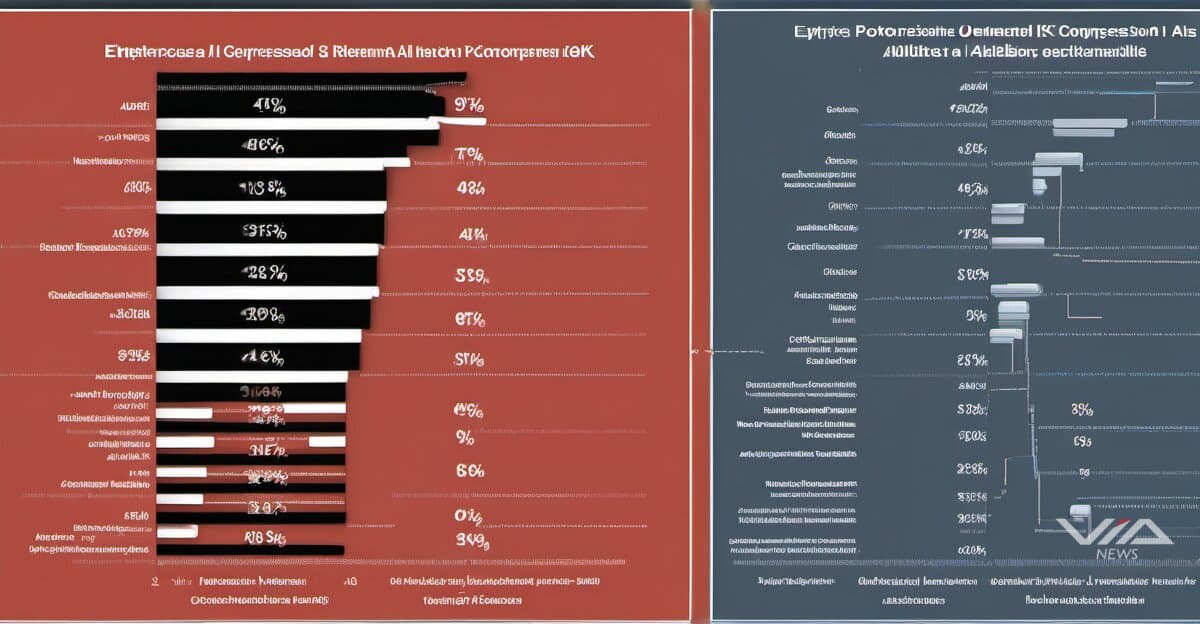
Image generated by AI for illustrative purposes. Not actual footage or photography from the reported events.

Accenture cut its guidance and cited "AI demand compression" — a phrase now defining a sector-wide crisis across US, European, and Asian enterprise software markets.1 The synchronized decline across vendors signals a global ROI credibility problem, not isolated company failures.

Enterprise procurement teams from Frankfurt to Singapore to Chicago are asking the same question: what did two years of AI tooling spend actually return? For most organizations, the answer remains unclear.

Accenture's use of "AI demand compression" in formal earnings language — not a passing remark — suggests leadership views the slowdown as structural. Companies do not introduce new vocabulary into guidance without deliberate intent.

The pressure is spreading into services. IBM, Infosys, and Cognizant — the last two India-headquartered IT majors with global delivery footprints — face equivalent exposure as enterprise clients worldwide hold discretionary AI budgets.1 Software vendor softness historically precedes parallel contraction in services revenue.

One to two quarters of further multiple compression are likely for this segment.1 Enterprise buyers are not abandoning AI — they are demanding proof of returns before extending commitments.

A clear divide is emerging between two categories of AI spend. Infrastructure investment — compute, data pipelines, model access — continues expanding globally. Application-layer and consulting spend, where ROI is harder to quantify, is stalling across markets.

For Salesforce and Adobe, the challenge is universal: convert AI feature adoption into measurable business outcomes. Adobe's generative tooling and Salesforce's agentic platform face identical pressure whether the client sits in London, Tokyo, or New York.

Atlassian's smaller decline relative to peers may reflect its tighter integration into developer workflows, where productivity gains are easier to instrument — a lesson for vendors across geographies seeking budget approval.

The next one to two quarters will determine whether this is a temporary pause or a permanent repricing of enterprise AI. Vendors who can surface concrete ROI data — cost savings, cycle time reduction, measurable output gains — will emerge at a lower discount than those who cannot.

In this story · Knowledge Files

About this analysis

This is a Via News analysis. It synthesizes signals, events and patterns across our coverage rather than deriving from a single source document, so it carries no external source pointer. Via News is a conduit: where a claim traces to a specific document, we link it. How we source

LM Salvado
LM Salvado

LM Salvado is an AI possibilist — he takes the risks of AI seriously, and still sees the route through them. Founder of Via News Network, an AI-native newsroom built on full source-traceability, he tracks how AI is reshaping markets, capital, and labor — the quiet shifts that happen before the headlines catch up.

What we know · the intelligence behind this page
Live from the substrate
What we're seeing
Enterprise AI's Trust Gap: Microsoft-Mistral Ecosystem Expansion Meets a Governance Deficit in Agentic Adoption
Microsoft is deepening its AI platform bet through simultaneous moves — expanding its Mistral partnership (Copilot Studio, Foundry, European infrastructure capacity) and deepening enterprise AI governance ties with Manulife — just as independent research (Google Cloud, VentureBeat, Box) shows enterprises racing toward agentic AI adoption (100% planned within two years) while data access and trust in agent decisions lag badly (average 45% data access, only ~half trust agent outputs). The result is a structural mismatch between platform-vendor momentum and enterprise readiness to actually govern and trust the agents being deployed.
Our read on the data ›
Signals we're tracking
EPKINLY Regulatory-Clinical Success Cascade
High probability of expanded label indications, additional combination approvals, and competitive positioning strength in follicular lymphoma market. Predicts positive commercial uptake and potential accelerated review for related indications.
Patterns we're watching ›
Where sources disagree
Morgan Stanley & Co. LLC
Same entity (Morgan Stanley & Co. LLC), same metric (net_income), same fiscal period (Q1 2026), same observation date (2026-03-31), but vastly different values: $5.567 billion vs. $5.57. These cannot coexist for the same time period. Fact B appears to be a data entry error (possible missing decimal placement: 5.57 should likely be 5,567,000,000 or a per-share figure incorrectly entered as total).
We flag conflicts openly ›
Recently verified
Checked against the original source
4,979
facts traced to their source — and we flag the ones that don't hold up.
101 entities tracked4,979 facts checked against source5,257 source documents archived
Query this data → isubstrate.com