
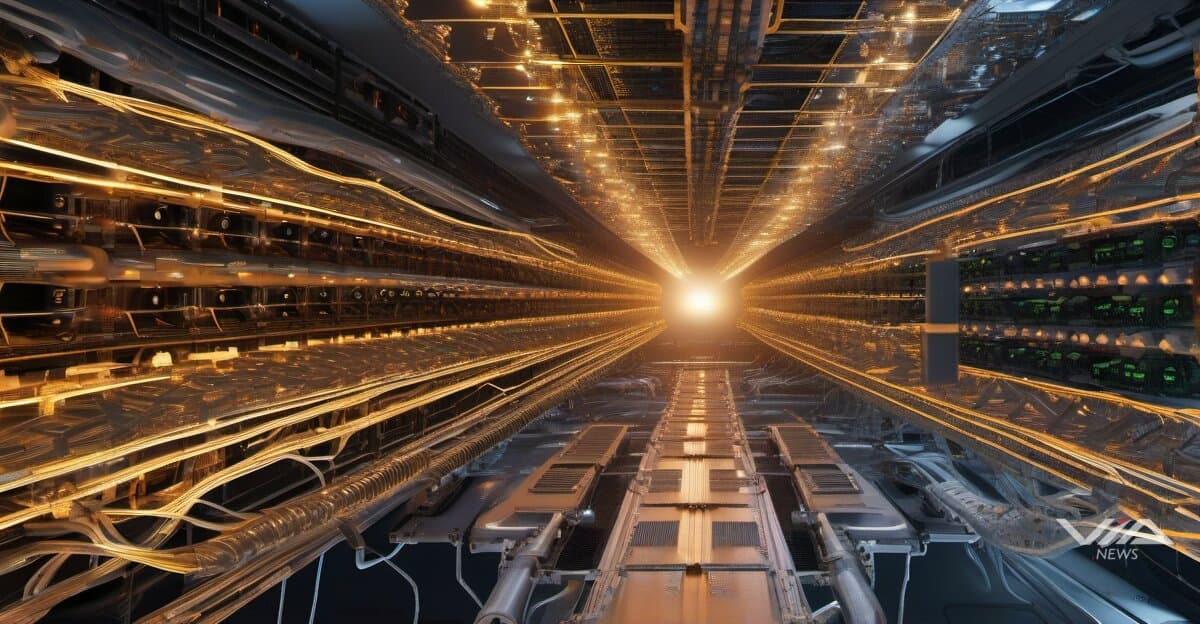
AI training racks draw 40-100 kilowatts per unit, up to 10x the power of traditional servers, forcing data center operators globally to replace air cooling with liquid thermal management systems. Single AI clusters now require 50-150 megawatts—equivalent to powering 50,000 homes—making grid capacity the primary factor in site selection over network connectivity or real estate.
Supermicro expanded Red Hat AI Factory certification for liquid-cooled systems integrating NVIDIA accelerators with purpose-built thermal management. The systems target enterprise AI deployments requiring predictable scaling across hybrid cloud environments under sustained high-power operation.
Underwater data centers are emerging as testbeds for extreme cooling solutions, using seawater for direct thermal exchange while eliminating freshwater consumption. "The marine environment is pretty brutal to engineer around because there's increased salinity, debris, and various kinds of corrosion of metal piping," said Daniel King, highlighting challenges versus land-based systems deployed across North America, Europe, and Asia.
Network infrastructure faces parallel strain. Nokia is deploying AI-RAN (AI Radio Access Network) to distribute AI workloads across network layers, enabling real-time coordination between edge devices and centralized compute. "Physical AI requires an intelligent network underpinned by AI-RAN so operators can fully harness distributed intelligence," said executive Ronnie Vasishta.
Semiconductor manufacturers are shipping 224G retimers and optical interconnects that move data between GPUs 2-3x faster than current 112G standards—critical for models trained across thousands of accelerators in facilities spanning continents.
Edge security requirements are evolving rapidly. Veea Inc. open-sourced its Lobster Trap scanning system, which validates AI agents in under one millisecond. The company's TerraFabric platform enables autonomous updates at distributed edge sites while maintaining stability across global deployments.
Industry analysts estimate AI-native infrastructure buildout will exceed $50 billion through 2027 as hyperscalers and enterprises retrofit existing facilities and construct greenfield sites designed for AI workloads. Grid constraints now determine data center geography more than traditional factors, reshaping the global distribution of compute capacity.