
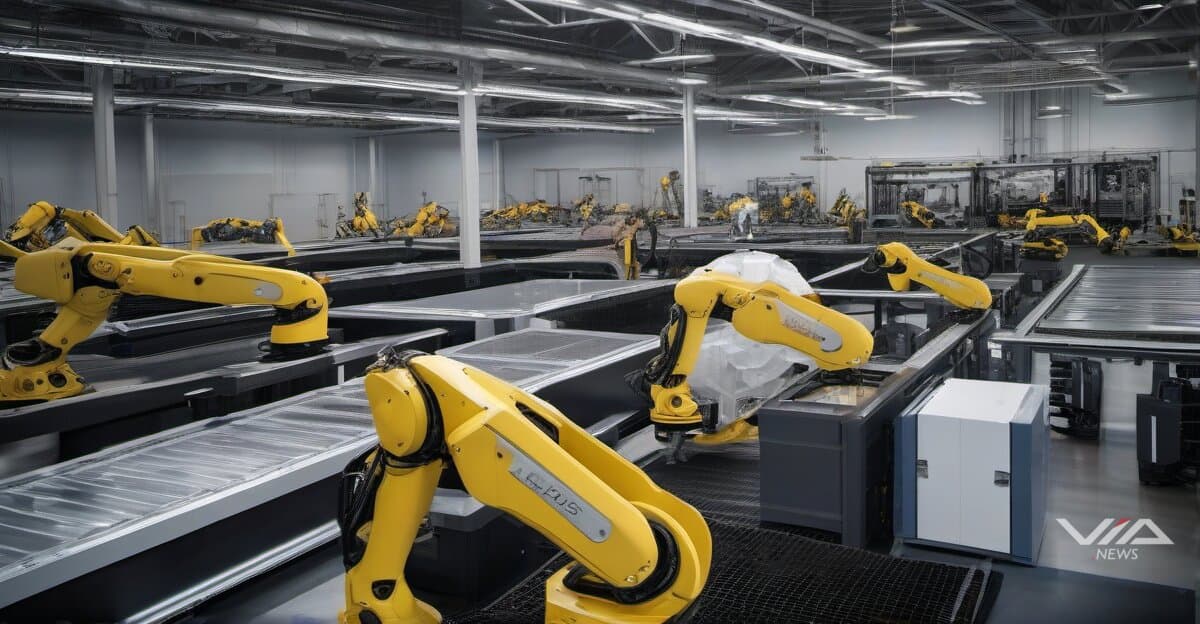
AI-powered warehouse robotics have achieved 98% accuracy rates as autonomous vehicle manufacturers across North America, Europe, and Asia confirm 2026-2027 production targets for commercial rollout.
Warehouse automation leads global deployment maturity. Computer vision and machine learning systems now handle inventory management, order fulfillment, and quality control with minimal human oversight. These systems match or exceed human performance in repetitive tasks while operating continuously.
Autonomous vehicle production relies on convergent AI and AI-RAN 5G telecom infrastructure. Real-time processing capabilities support navigation and object recognition systems required for mass manufacturing timelines announced by automakers in multiple markets.
Defense contractors and industrial manufacturers have formed international partnerships to deploy physical AI in production facilities. Integrated sensor systems, actuators, and decision algorithms perform complex assembly tasks previously requiring human dexterity across automotive plants in Germany, electronics facilities in East Asia, and food processing operations in North America.
Regulatory agencies in the US, EU, and Asia-Pacific markets have expanded approvals for assistive robotics in healthcare and service industries. Cleared applications include patient mobility assistance, surgical support, and rehabilitation therapy following safety validation studies.
Manufacturing automation benefits from adaptive robots that adjust to production line changes without extensive reprogramming. Machine learning models learn assembly patterns from human demonstrations, then optimize processes through repetition. Factories report 30-40% efficiency gains after full integration.
Five sectors dominate current deployments worldwide: logistics fulfillment centers, automotive manufacturing, warehouse inventory management, food processing facilities, and electronics assembly plants. Each has progressed from proof-of-concept to multi-site implementations with documented ROI.
Standardized component availability—vision systems, manipulator arms, mobility platforms—enables companies to integrate custom AI models trained on industry-specific datasets. This modular approach reduces deployment costs and accelerates timelines across international markets.