
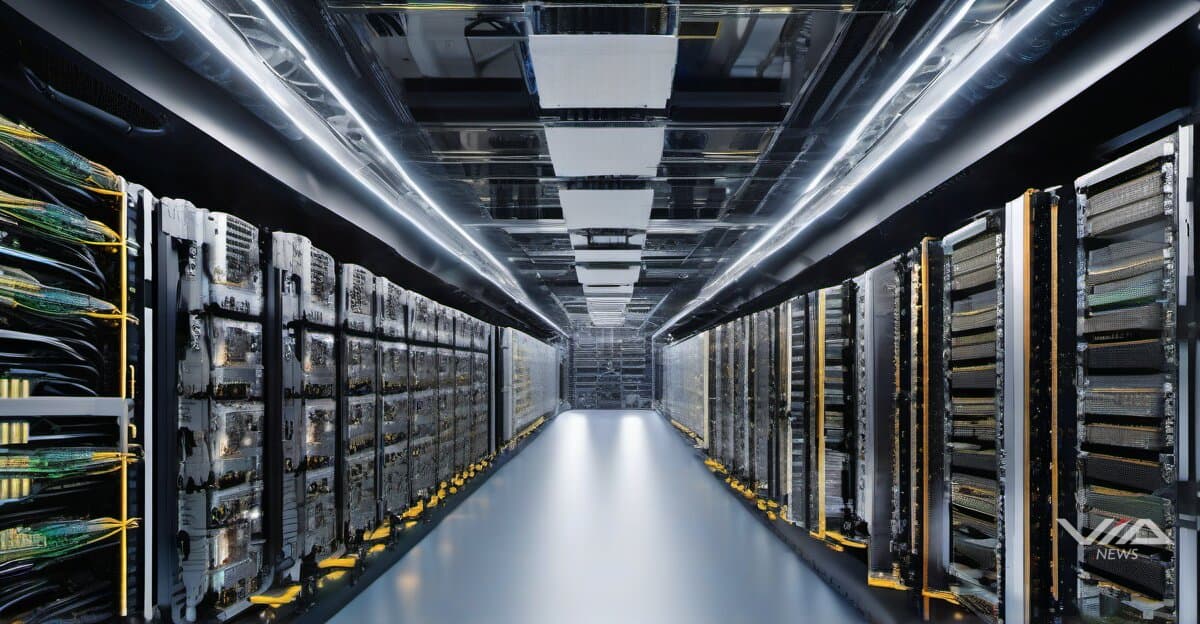
The global infrastructure backbone supporting artificial intelligence systems is undergoing a fundamental transformation as semiconductor manufacturers, testing equipment providers, and connectivity specialists across North America, Asia, and Europe scramble to meet unprecedented demand from cloud computing giants and enterprise AI deployments.
The worldwide AI processor market is projected to surge from $43.7 billion to over $323 billion, driving sustained investment across multiple continents and layers of the hardware stack—from advanced semiconductors and high-bandwidth memory to data center connectivity and edge computing capabilities. This growth trajectory is fueling aggressive capacity expansion from California to Taiwan, signaling a shift from concentrated supply chains to geographically distributed production networks.
The competitive dynamics are evolving beyond traditional US-centric narratives as hyperscalers worldwide—from American cloud providers to European and Asian technology platforms—increasingly invest in proprietary accelerator designs optimized for their specific AI workloads. This strategic diversification is fragmenting what was once a more concentrated market dominated by a handful of US semiconductor designers.
Credo Technology Group, a California-based provider of high-speed connectivity solutions for AI data centers, is projecting GAAP gross margins between 63.8% and 65.8% for Q3 FY2026, reflecting the premium economics of specialized infrastructure components as data centers globally race to eliminate bottlenecks in chip-to-chip and rack-to-rack communication.
Meanwhile, Aehr Test Systems has reported receiving "very large forecasts" from its lead production customer, with shipments expected to commence in Q1 FY2027. The company is forecasting $60 million to $80 million in bookings for the second half of FY2026, primarily driven by AI wafer-level and packaged-part burn-in systems—critical infrastructure as chip complexity increases worldwide.
The company's Silicon Valley test lab has received multiple orders for new high-power configurations capable of handling up to 2,000 watts per device, reflecting the escalating power requirements of cutting-edge AI accelerators being deployed from North American hyperscale facilities to European research centers and Asian cloud platforms.
Significantly, Aehr has expanded its partnership with ASE, the world's leading outsourced semiconductor assembly and test platform based in Taiwan, to provide wafer-level and packaged-part testing services for top-tier semiconductor customers in high-performance computing and AI applications. This transatlantic-transpacific collaboration underscores how the AI infrastructure supply chain is becoming increasingly interdependent across continents.
The competitive landscape now features custom silicon strategies from Google in the United States, potential European sovereignty initiatives in AI hardware, and established Asian semiconductor manufacturing prowess—presenting a multipolar challenge to any single vendor's market dominance. Governments from Washington to Brussels to Beijing are viewing AI infrastructure capacity as a strategic imperative, with implications for technology sovereignty and economic competitiveness.
Industry analysts worldwide point to the "memory wall"—the bandwidth bottleneck between processors and memory—and advanced packaging technology as the next critical competitive frontiers. High-bandwidth memory (HBM) supply constraints, concentrated in South Korean and Taiwanese production facilities, and 3D packaging capabilities are emerging as key differentiators in the global race to deliver performance improvements for large language models and other compute-intensive AI applications.
The sustained infrastructure investment reflects a fundamental recalibration of global technology supply chains, with implications extending from semiconductor fabrication facilities in East Asia to data center construction across North America and Europe, as nations and corporations alike position themselves for what many view as a defining technological transition of the 21st century.