
Sunday, September 13, 2026

KLA Lifts 2026 Chip Equipment Forecast to $150 Billion on Global AI Demand

KLA raised its 2026 wafer fabrication equipment forecast to the low-$150 billion range, citing AI chip demand. The California-based supplier also lifted quarterly revenue guidance to $4 billion and its advanced packaging target to $1.1 billion, alongside a 10-for-1 stock split.

LM Salvado
LM Salvado

August 3, 2026

KLA Lifts 2026 Chip Equipment Forecast to $150 Billion on Global AI Demand
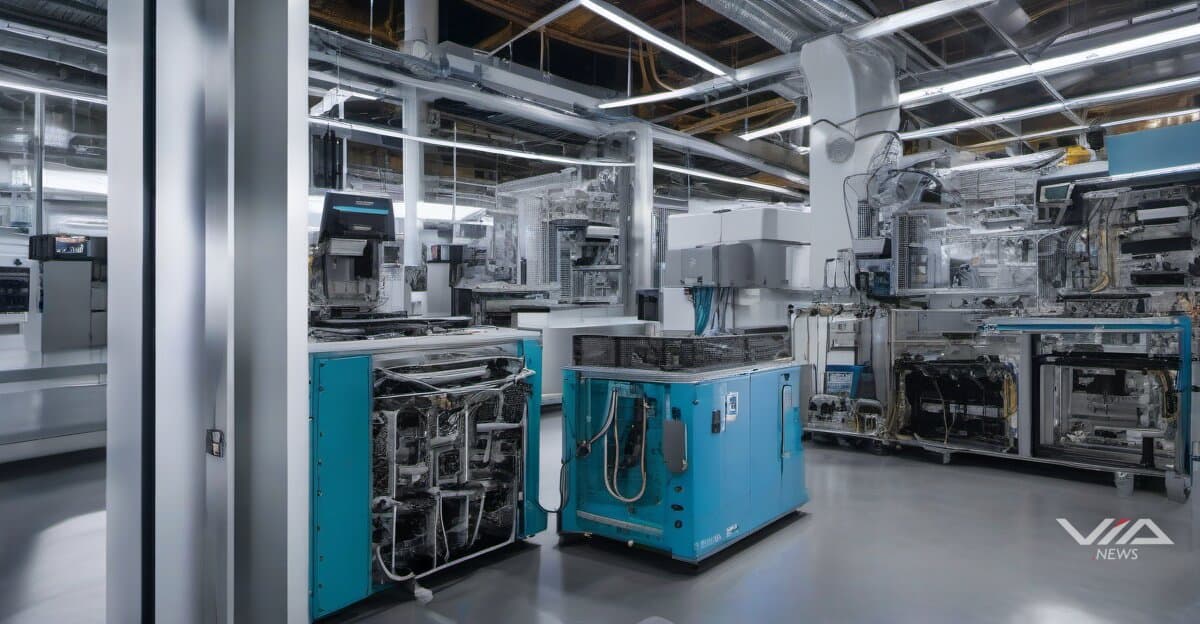
Image generated by AI for illustrative purposes. Not actual footage or photography from the reported events.

KLA raised its September-quarter revenue guidance to $4 billion, citing surging global demand for AI chip manufacturing equipment.1 The California-based supplier lifted its 2026 wafer fabrication equipment market forecast to the low-billions range.1

KLA also raised its advanced packaging process control revenue target to billions.1 These tools inspect the multi-chip assemblies used in AI accelerators and high-bandwidth memory, components sourced through supply chains spanning the US, Taiwan, South Korea and Japan.1 All three revisions came within one reporting cycle, alongside a 10-for-1 stock split.1

The guidance increase signals equipment makers are booking orders tied directly to AI accelerator fabrication capacity worldwide.1 Wafer equipment spending funds tools that produce the logic and memory chips powering AI data centers from Virginia to Singapore.1 A billions 2026 market outlook would extend a run of capital-spending growth across the international chip supply chain.1

The increases point to sustained order strength for semiconductor capital equipment over the next one to two quarters.1 Rising AI chip fabrication demand is the stated driver.1 Peer equipment makers, including US-based Applied Materials and Lam Research and the Netherlands' ASML, could report similar guidance increases as the same demand flows through their order books.1

Advanced packaging is a bottleneck step in AI chip production, connecting processors to HBM stacks largely manufactured by South Korean and Taiwanese memory makers.1 KLA's billions target signals equipment makers expect packaging capacity, not just wafer fabrication, to expand alongside AI accelerator output.1 Combined with the wider forecast, this suggests capacity expansion is underway across multiple production stages simultaneously.1

The 10-for-1 stock split does not change KLA's underlying business but typically follows sustained share price gains.1 Together, the guidance raises signal equipment suppliers worldwide are positioning for continued AI-driven capital expenditure into next year.1

In this story · Knowledge Files

About this analysis

This is a Via News analysis. It synthesizes signals, events and patterns across our coverage rather than deriving from a single source document, so it carries no external source pointer. Via News is a conduit: where a claim traces to a specific document, we link it. How we source

LM Salvado
LM Salvado

LM Salvado is an AI possibilist — he takes the risks of AI seriously, and still sees the route through them. Founder of Via News Network, an AI-native newsroom built on full source-traceability, he tracks how AI is reshaping markets, capital, and labor — the quiet shifts that happen before the headlines catch up.

What we know · the intelligence behind this page
Live from the substrate
What we're seeing
AI Chip Boom Lifts Semiconductors as Export-Control Gaps Persist
AI infrastructure demand is fueling a broad semiconductor rally — Broadcom's AI chip revenue and Q4 guidance, Amazon's custom silicon crossing a $25B annual run rate, and bullish analyst calls on Micron and Sandisk tied to a memory chip boom underestimated even by bulls — with ASML rallying on sympathy. That momentum runs alongside unresolved US-China tech tensions: Belgium's arrest of a suspect for stealing chip technology for China and a blacklisted Chinese firm still acquiring Nvidia's top AI chips show export-control enforcement lagging the pace of AI chip demand.
Our read on the data ›
Signals we're tracking
EPKINLY Regulatory-Clinical Success Cascade
High probability of expanded label indications, additional combination approvals, and competitive positioning strength in follicular lymphoma market. Predicts positive commercial uptake and potential accelerated review for related indications.
Patterns we're watching ›
Where sources disagree
ING Group
Both facts record the same metric (shares_outstanding) for ING Group at the identical observation date (2025-12-31). FACT A states 2,902,437,688 shares; FACT B states 2,902 million shares (2,902,000,000). The difference is 437,688 shares (~0.015%). This is a genuine value conflict, though the discrepancy appears to result from FACT B rounding to the nearest million while FACT A provides the precise count.
We flag conflicts openly ›
Recently verified
Checked against the original source
4,981
facts traced to their source — and we flag the ones that don't hold up.
101 entities tracked4,981 facts checked against source5,280 source documents archived
Query this data → isubstrate.com