
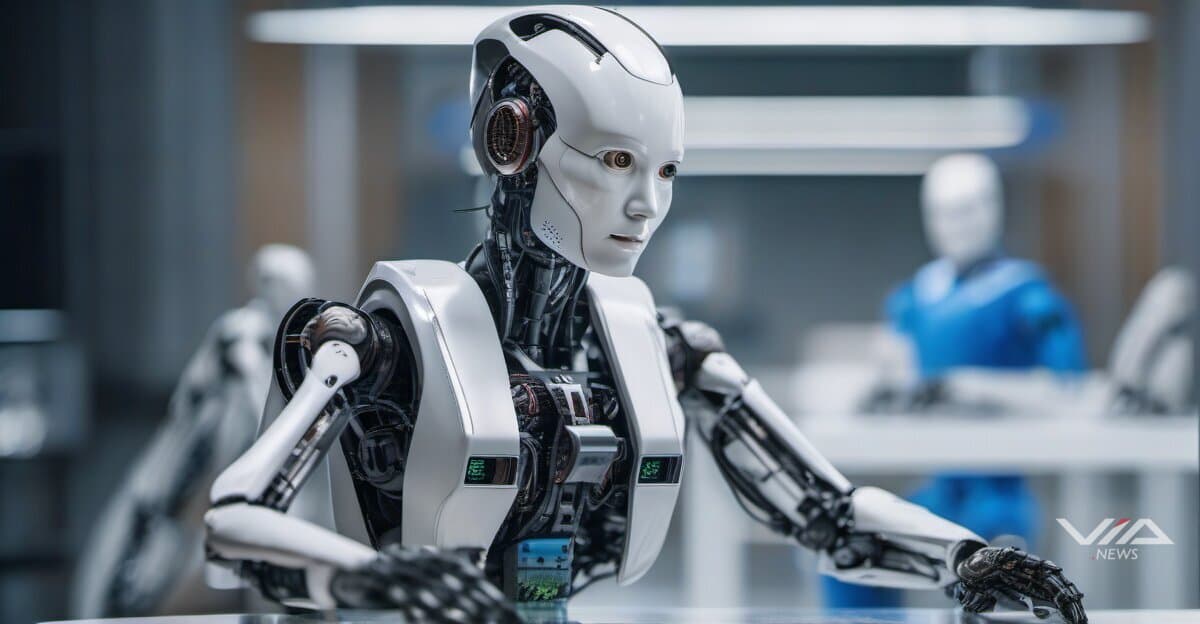
A humanoid robotics startup born in Tel Aviv is about to become one of the more unexpected entrants in the global race to put walking, working robots on factory floors — and its most significant competitive advantage may have been built on motorways, not in robotics labs.
Mentee Robotics, founded by engineers who designed the core machine-vision systems behind Mobileye's driver-assistance technology, is moving toward series production of its humanoid robot platform. Mobileye — the autonomous driving subsidiary of Intel and one of the world's most influential perception-technology companies — is simultaneously moving to acquire Mentee outright, folding the startup into an organisation whose sensor-fusion software has been refined across hundreds of millions of kilometres of real-world driving data across four continents.
The timing is deliberate. The humanoid robotics industry has entered what investors and analysts describe as its first genuine commercialisation phase, with competing programmes in the United States, China, Germany, and Japan all making production commitments within the past two years. Tesla's Optimus programme, Figure AI, and Amazon-backed Agility Robotics represent the American push. China's Unitree and Fourier Intelligence have moved aggressively on both price and volume, targeting export markets. European industrial groups, including several tied to Germany's automotive supply chain, have begun quietly evaluating humanoid integration for assembly lines where demographic pressures are shrinking the available human workforce.
Against that backdrop, Mentee's proposition is rooted less in headline-grabbing demonstrations and more in engineering fundamentals. Its humanoid platform has been designed with industrial deployment in mind from the outset — built to survive the physical demands of logistics handling and light manufacturing, the two sectors where a human-form factor offers the most immediate ergonomic advantages over conventional robotic arms or autonomous mobile platforms. Where many research-oriented humanoid projects optimise for laboratory performance, Mentee has oriented its hardware toward the messy, unstructured conditions of real warehouses and production facilities.
The Mobileye connection matters globally because perception remains the unsolved bottleneck across the entire humanoid field. A robot that can walk is no longer remarkable; a robot that can reliably interpret a dynamic shared environment — identifying objects, people, hazards, and tasks in real time — remains genuinely hard. Mobileye's EyeQ chip architecture and its associated computer-vision stack represent some of the most production-hardened perception technology in existence, stress-tested not in controlled conditions but in the chaos of urban traffic across diverse geographies. Applying that heritage to embodied AI could compress development timelines that have stalled better-funded competitors.
The broader geopolitical dimension should not be overlooked. Israel has emerged as a disproportionately significant node in the global deep-tech ecosystem, punching well above its population weight in semiconductors, cybersecurity, and autonomous systems. Mentee's lineage — drawing directly from the engineering culture that made Mobileye one of Intel's most valuable acquisitions — reflects a pattern in which Israeli R&D capability is increasingly absorbed into multinational industrial conglomerates seeking to close technological gaps. Whether that dynamic ultimately concentrates humanoid robotics capability within a handful of large Western technology platforms, or whether it accelerates diffusion of the technology more broadly, will partly depend on how Mobileye integrates Mentee's team and intellectual property.
Commercialisation, all participants in this race acknowledge, is considerably harder than engineering. Producing a humanoid robot that performs reliably on an assembly line requires not only technical readiness but supply chain maturity, unit economics that make business cases viable for enterprise buyers, and regulatory frameworks that are still being written in most jurisdictions. Labour market politics add another layer of complexity: in economies where manufacturing employment remains politically sensitive — including the United States, Germany, South Korea, and parts of Southeast Asia — the introduction of humanoid robots at scale will face scrutiny that goes well beyond engineering certification.
Industry projections suggest the humanoid robotics market could reach tens of billions of dollars annually by the early 2030s, though forecasters have consistently noted that actual deployment has lagged the ambitions expressed in funding announcements. Mentee's series production push, backed by Mobileye's perception expertise and Intel's industrial resources, represents one of the more technically credible bets that the gap between promise and reality is finally beginning to close.