
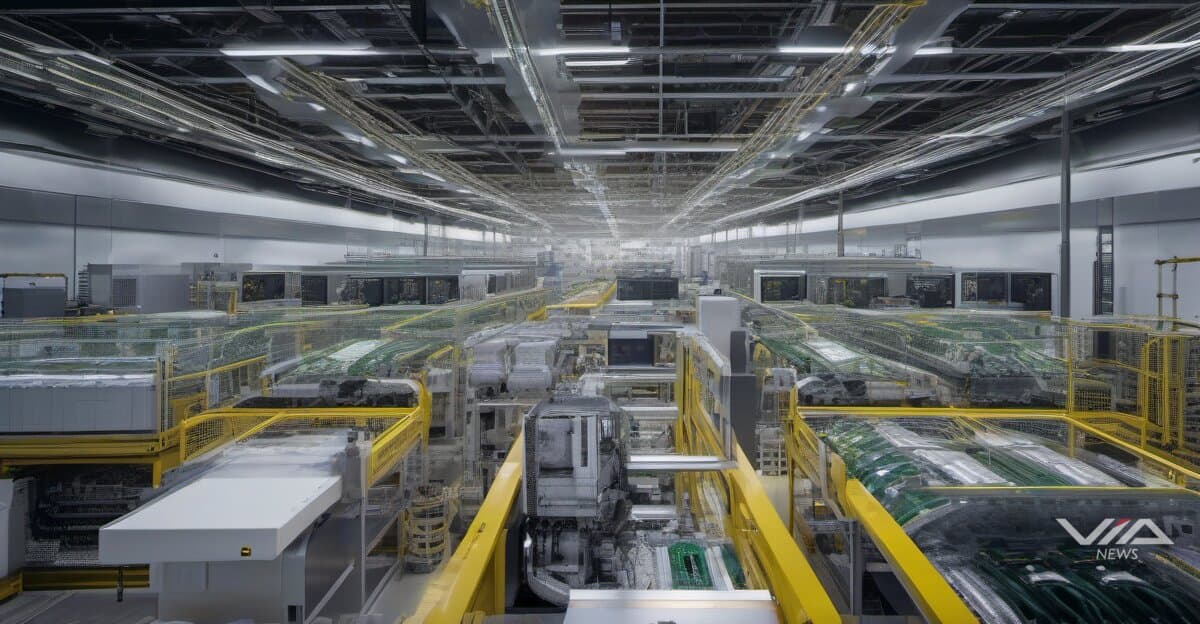
Nvidia committed $4 billion to silicon photonics partnerships with Coherent and Lumentum, targeting interconnect bandwidth bottlenecks that constrain AI model training from California to China. The investment marks a structural shift as electrical connections reach physical limits for GPU-to-GPU communication in data centers globally.
Silicon photonics replaces copper wires with light-based transmission, enabling speeds up to 1.6 terabits per second over longer distances with lower power consumption. Training clusters for frontier AI models now require thousands of GPUs exchanging gradient updates simultaneously—a workload that exposes electrical interconnect constraints at scale across North American, European, and Asian facilities.
Hyperscalers including Meta, Microsoft, Google, and Chinese cloud providers are planning 100,000+ GPU clusters for 2026-2027 deployment. A 10% reduction in communication overhead can save weeks on multi-month training runs, translating to competitive advantage in the global AI race.
Coherent manufactures indium phosphide laser components while Lumentum specializes in optical modulators and transceivers. Nvidia's investment secures dedicated manufacturing capacity as chip makers face competing demand from telecom operators in Europe, enterprise networks in Asia, and 5G infrastructure worldwide.
Analog Devices cited strong data center and industrial customer demand spanning multiple continents in recent guidance. Lattice Semiconductor forecast Q1 revenue between $158 million and $172 million, reflecting sustained global orders for specialty chips used in data center management and connectivity.
Advanced packaging technologies are emerging as a parallel solution. SiTime's acquisition of Renesas' timing business—expected to be earnings-accretive in year one—reflects consolidation around precision components needed for chiplet-based designs. These multi-die packages reduce interconnect distances but require sub-picosecond clock synchronization.
Industry analysts note silicon photonics won't replace electrical connections entirely but will handle long-reach, high-bandwidth links between racks and clusters. Hybrid architectures combining copper for chip-to-chip, electrical for rack-internal, and photonics for rack-to-rack connections are becoming standard in 2026 data center designs worldwide.