
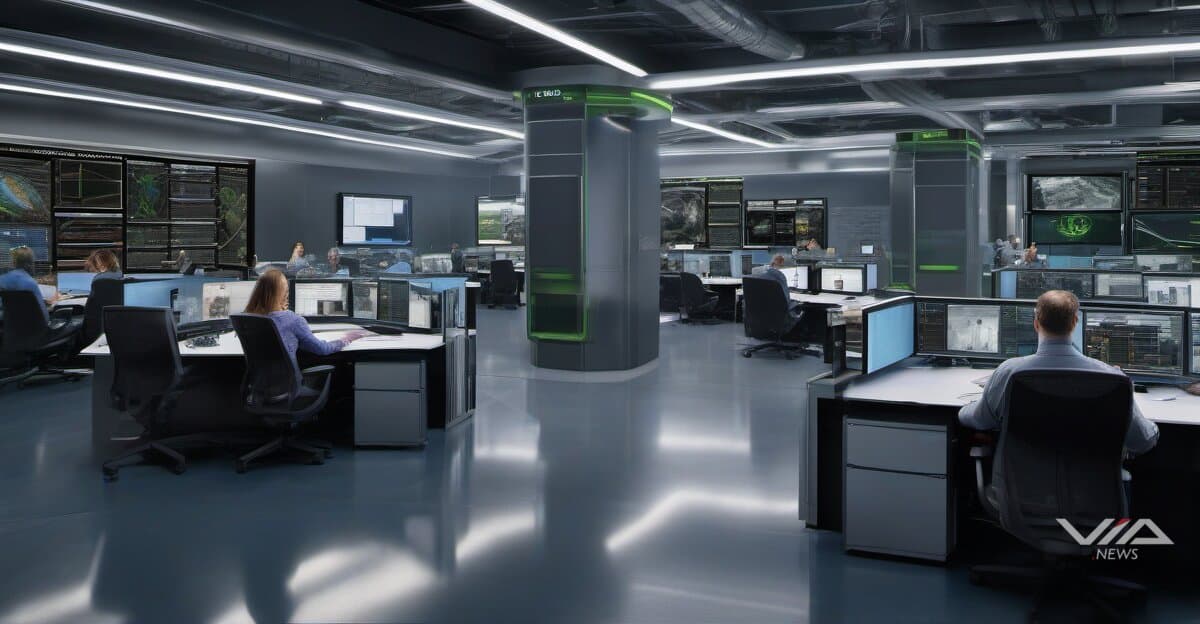
NVIDIA's Hopper and Blackwell GPU architectures are powering an 82% enterprise AI adoption surge as companies worldwide move deep learning into production systems.
Global deployments span multiple sectors. Burger King launched Patty AI for restaurant operations. Perplexity deployed its Computer agent for enterprise workflows. Rad AI rolled out data transformation tools converting unstructured data into actionable insights with measurable ROI across international markets.
Hardware advances enable AI agents to handle real-world complexity at scale. Stanford research demonstrates that training on human video datasets improves robot performance by 20%+ on unseen tasks, showing deep learning now tackles diverse scenarios beyond controlled lab environments.
Neural networks are evolving toward explainability. Stanford researchers developed DVD (Domain-Agnostic Video Discriminator), which learns from mixed robot and human video to predict task completion. The system achieved 66% success rates on language-specified commands using Visual Model-Predictive Control.
"Explanations can be delivered via audio, visualization, text, or vibration, and people may choose different modes depending on their technical knowledge, cognitive abilities, and age," said Shahin Atakishiyev on autonomous vehicle AI systems, highlighting global accessibility requirements.
Commercial momentum faces ethical constraints. Anthropic refused Pentagon contracts, highlighting tensions between rapid deployment and responsible AI principles. This contrasts with competitors pursuing defense applications, reflecting diverging approaches in the global AI industry.
Market research confirms deep learning expansion into autonomous systems and robotics worldwide. The technology enables post-incident analysis of decision-making errors, helping engineers build safer autonomous vehicles across international markets.
GPU advances removed previous bottlenecks. Hopper's transformer engine and Blackwell's second-generation architecture handle trillion-parameter models that were impractical 18 months ago. Enterprise buyers globally now access compute power previously limited to research institutions.
Companies worldwide report moving from pilot programs to production systems, driven by hardware making complex deep learning economically viable at scale. The 82% market confidence reflects improving sentiment as deployment cases multiply across industries and regions.