
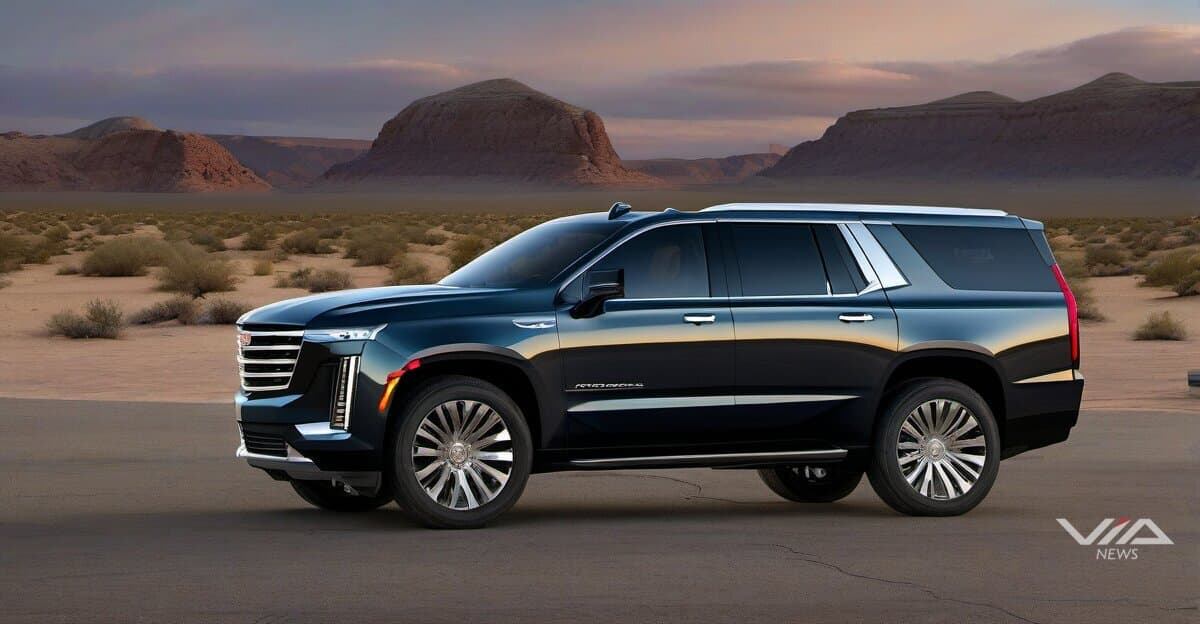
When General Motors buried a pivotal announcement inside the financial tables of its Q4 2025 earnings call, industry watchers on three continents took note. The company's second-generation software-defined vehicle platform — SDV 2.0 — is set to debut in the Cadillac Escalade I in 2028, and the specifications represent a fundamental rethinking of how a car's nervous system is built.
The headline figures: 1,000 times more in-vehicle bandwidth and 10 times the over-the-air (OTA) update capacity versus GM's first-generation platform, all channelled through a single centralized compute core. In practical terms, GM is replacing the patchwork of 50 to 150 individual electronic control units (ECUs) that govern everything from braking to climate control in a modern vehicle — with one powerful onboard AI server that does it all.
The move is significant not merely for what it means for GM, but for what it confirms about the direction of a global industry in the midst of its most profound transformation since the invention of the internal combustion engine.
A Global Architectural Consensus Emerges
The centralized compute philosophy was not invented in Detroit. Tesla pioneered it with its Full Self-Driving computer, and Nvidia's DRIVE platform — now embedded in vehicles from Mercedes-Benz, BYD, and Li Auto — has proselytized the same approach across markets from California to Chengdu.
In China, the world's largest car market and the most aggressive adopter of electric and autonomous vehicles, the shift is already well underway. Huawei's intelligent driving division supplies a centralized computing stack to Seres, Chery, and BAIC. SAIC's own software-defined vehicle programme targets a similar architectural consolidation. Crucially, Chinese regulators have actively encouraged the rollout of Level 2+ and Level 3 autonomy on public roads at a pace that has outstripped Western markets, creating a vast real-world testing ground that generates the training data centralized AI systems depend upon.
In Europe, Volkswagen Group — the continent's largest automaker and one of the world's biggest — has staked its future on its E3 electrical architecture, a centralized platform underpinning everything from the Volkswagen ID. range to Audi's electric lineup. The project suffered well-publicised delays and cost overruns, but the strategic commitment remains intact. Stellantis, BMW, and Renault are pursuing parallel paths, while the EU's regulatory framework increasingly rewards OTA-capable vehicles through its approval processes for automated driving systems.
South Korea's Hyundai-Kia, meanwhile, has partnered with Nvidia to deploy centralized domain controllers across its next generation of Genesis, Hyundai, and Kia models. Japan's Toyota — historically cautious about software-first paradigms — has accelerated its Arene OS initiative following pressure from domestic rivals Honda and the fast-growing threat of Chinese imports.
GM's SDV 2.0 announcement, then, is less a lone invention and more the final confirmation that the world's legacy automakers have reached a consensus: the distributed ECU era is over.
Bandwidth as the Limiting Factor for True Autonomy
The 1,000x bandwidth claim deserves scrutiny. Current automotive ethernet backbones typically operate between 100 Megabits and 1 Gigabit per second. A thousand-fold increase pushes throughput into the terabit range — the order of magnitude required to handle uncompressed, simultaneous sensor streams from a full autonomous suite of cameras, lidar, radar, and ultrasonic arrays.
This is not an abstract engineering preference. Perception systems degrade when sensor data is compressed or sampled before reaching the inference engine. Richer, higher-fidelity data directly improves the quality of decisions made at speed — the difference, in urban environments from Lagos to London to Los Angeles, between a system that works in predictable conditions and one that handles the chaotic edge cases of real-world traffic.
The bandwidth race also has geopolitical dimensions. The supply of high-bandwidth automotive-grade semiconductors — the chips that make such architectures possible — is concentrated among a small number of producers: Nvidia and Qualcomm in the United States, NXP in the Netherlands, Renesas in Japan, and an increasingly ambitious cohort of Chinese fabless designers such as Horizon Robotics and Black Sesame Technologies. Western export controls have complicated Chinese automakers' access to leading-edge Nvidia silicon, accelerating domestic chip development in ways that may reshape the competitive landscape within this decade.
OTA Updates: The New Competitive Moat
GM's 10x expansion in over-the-air update capacity addresses a dimension of the SDV race that is often underappreciated outside the industry: the ability to improve a vehicle after it has left the factory.
Tesla normalized this expectation years ago, pushing autonomous capability improvements, range optimizations, and new features to millions of vehicles overnight. The practice has since become a baseline expectation among consumers in the United States, Europe, and particularly China, where software feature parity with smartphones is an explicit purchase criterion for younger buyers.
Greater OTA bandwidth means GM can deploy larger AI model updates, new autonomous features, and safety patches far more rapidly than its current generation allows. This matters for regulatory compliance as much as consumer experience: jurisdictions from California to Germany to South Korea are developing type-approval frameworks that tie safety certifications to demonstrable, auditable OTA update histories.
The vehicle, in this model, ceases to be a product sold at point of purchase and becomes a continuously evolving service — one that generates recurring software revenue long after the initial transaction. It is a model that has proven transformative for consumer electronics, and its application to the automotive sector will reshape the economics of an industry that has historically relied on hardware replacement cycles measured in years and decades.
The Broader Stakes
The competition playing out across GM's announcement, China's SDV programmes, and Europe's centralized architectures is not merely commercial. Autonomous vehicles represent a platform — one that will eventually govern the movement of goods, people, and emergency services across cities, and that will generate extraordinary quantities of geographically specific mobility data.
Who controls the compute layer of that platform, and under what regulatory frameworks, is a question being actively contested by governments from Washington to Brussels to Beijing. GM's SDV 2.0 is, among other things, a statement that the United States intends to compete for that position from the highest levels of the automotive supply chain.
The Cadillac Escalade I arrives in 2028. The race, however, is already well underway.