
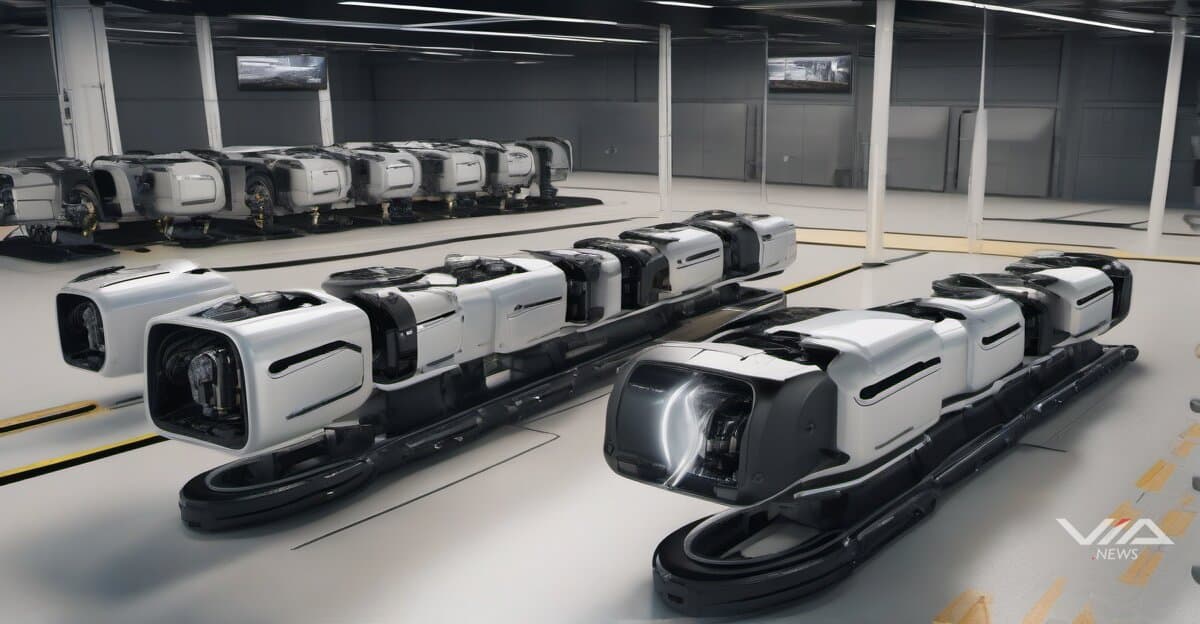
Waymo will reach 1 million autonomous rides per week by December 2026, the company announced, marking a tenfold increase from early 2025 levels. The expansion follows similar scaling efforts by China's Baidu Apollo and GM's Cruise across urban markets in the U.S., Europe, and Asia.
Boston Dynamics is completing final testing on Atlas, its humanoid robot platform, before commercial launch. The system targets logistics and industrial tasks where full-body autonomy provides advantages over fixed automation used in European and Asian warehouses. Atlas follows years of research demonstrations showing parkour and navigation capabilities.
MAVLab released SkyDreamer, the first end-to-end vision-based autonomous drone racing policy. The system maps camera input directly to flight controls, enabling operation in GPS-denied environments—a capability relevant to search-and-rescue operations and infrastructure inspection globally.
Polish startup Nomagic developed the Shoebox Picker for warehouse automation, handling over 98% of shoebox form factors on the market. Founder Kacper Nowicki said the goal is embedding physical AI in warehouse operations at scale, competing with systems deployed across Amazon and DHL facilities worldwide.
The pattern spans multiple robotics segments: Boston Dynamics transitioning Atlas from research to commerce, Waymo scaling toward profitability, and specialized systems like Shoebox Picker solving high-volume niche tasks. Commercial viability depends on reliability thresholds—Nomagic's 98% success rate works because edge cases route to human workers, while Waymo's volume growth indicates the company cleared safety and cost hurdles for urban deployment across multiple continents.
The shift from research budgets to revenue targets will determine which systems achieve market scale in 2026-2027, with implications for manufacturing and logistics operations from North America to Southeast Asia.
Sources:
1 Nasdaq, "Tesla's New Robotic Rival Has a Strangely Familiar Face" (March 20, 2026)
2 Nasdaq, "1 Artificial Intelligence (AI) Stock With Generational Wealth Potential" (March 20, 2026)
3 Globe Newswire, "Zalando to install up to 50 AI-powered Nomagic robots in its European fulfilment centres" (March 19, 2026)
4 Yahoo Finance, "Prediction: This Artificial Intelligence (AI) Stock Will Be Worth $5 Trillion by the End of 2026" (March 22, 2026)
5 Yahoo Finance, "Rivian's $1.25 Billion Uber Robotaxi Deal Looks Like A Big Win—But Some Analysts Say It's Actually A" (March 22, 2026)