
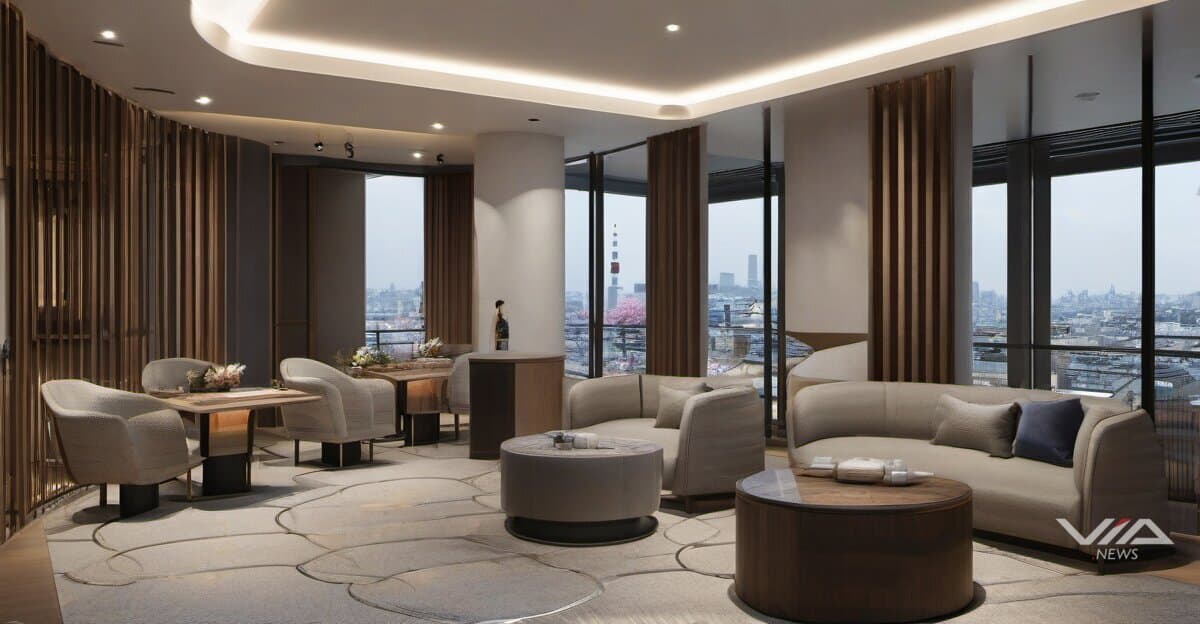
As global hospitality investors race to position capital ahead of Asia's next demand wave, Tokyo-listed developer LogProstyle is executing a strategy increasingly familiar to observers of European boutique hotel markets: concentrate, don't scatter. The company has confirmed a second hotel in Tokyo's Asakusa district, due to open in October 2028, bringing its total operated portfolio to five properties — all anchored in Japan's highest-traffic tourism corridors.
The decision to double down on Asakusa rather than plant a flag in a new city echoes a model refined by operators in cities like Barcelona, Lisbon, and Amsterdam, where clustering multiple properties around a single cultural magnet — a cathedral district, a historic waterfront — allows operators to extract yield management efficiencies that a solitary flagship simply cannot deliver. Shared back-office infrastructure, consolidated supplier contracts, and cross-selling between properties during peak demand periods reduce the marginal cost of each additional room while compounding brand recognition in a single high-value micro-market.
Asakusa is a compelling anchor for that model. The district sits at the heart of Tokyo's Shitamachi cultural corridor, drawing millions of visitors annually to Senso-ji Temple and the iconic Nakamise-dori shopping street. It is, by any global measure, a Tier 1 cultural destination — comparable in visitor density and emotional resonance to Rome's Trastevere or Kyoto's Gion. Japan's National Tourism Agency recorded inbound visitor spending surpassing ¥8 trillion (approximately $53 billion) in 2024, with Tokyo consistently absorbing the largest share of overnight stays in the country.
That macro backdrop is not incidental to LogProstyle's timing. Japan is in the early stages of what analysts describe as a structural inbound tourism supercycle — a sustained, multi-year surge in foreign arrivals driven by a confluence of factors unlikely to reverse quickly. The yen's prolonged weakness against the dollar and euro has made Japan one of the most cost-competitive major destinations in the world for Western travelers, while Asia-Pacific's expanding middle class has simultaneously deepened the pool of regional visitors. For hospitality developers with construction pipelines already in motion, the commercial logic of front-loading capacity additions ahead of projected demand peaks is hard to dispute.
LogProstyle's five-property footprint, spanning what the company characterises as Japan's leading tourism markets, is deliberately architected to capture demand across multiple visitor segments — without the occupancy volatility that tends to afflict secondary cities when inbound flows soften. It is a portfolio designed for resilience as much as growth, mirroring the asset-light discipline that characterised the most successful European boutique operators during the post-pandemic recovery.
The company disclosed the expansion as part of its first-half fiscal results, signalling that the Asakusa project remains on schedule and within previously communicated financial parameters. Full capital expenditure figures for the new property were not separately itemised in available disclosures — a common feature of development-stage hotel announcements — but the timing of the disclosure alongside earnings results suggests investor-relations alignment rather than speculative positioning.
For international investors tracking Asian hospitality exposure, LogProstyle's strategy offers a case study in disciplined geographic concentration at a moment when Japan's tourism fundamentals are arguably the strongest they have been in a generation. The question, as with any clustering strategy, is whether the bet on a single district's structural durability proves prescient — or whether diversification foregone becomes a liability when visitor patterns eventually shift. For now, the data, the demographics, and the exchange rate are all pointing the same direction.