
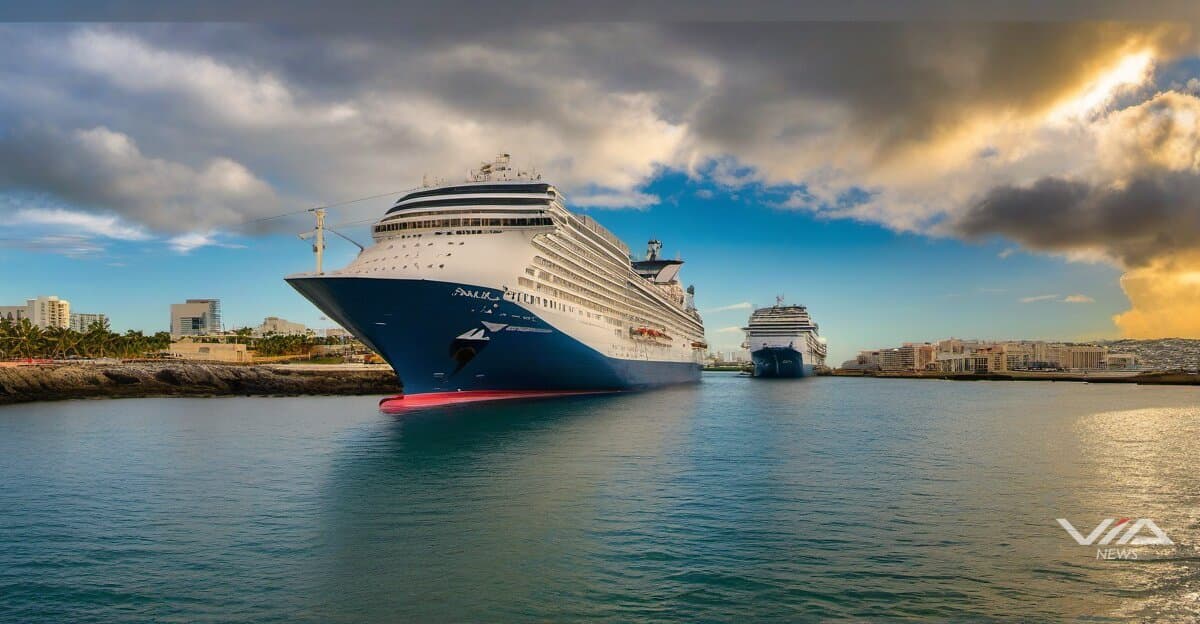
In a move without precedent in its 60-year history, Norwegian Cruise Line Holdings (NCLH) has announced that both Norwegian Prima and Norwegian Viva — the twin flagships of its Prima Class fleet — will homeport simultaneously in San Juan, Puerto Rico for the winter 2027/28 season. The decision marks one of the most significant capital-allocation signals in the global cruise industry this decade.
The Caribbean remains the world's dominant cruise destination, accounting for roughly 40 percent of global cruise capacity according to industry estimates — far ahead of the Mediterranean, Asia-Pacific, and Northern Europe combined. Within that market, San Juan has historically functioned as the region's most strategically valuable homeport, offering direct access to both Eastern and Southern Caribbean itineraries without the transit-day costs associated with Florida-based embarkations, the traditional nerve centre of the American cruise industry.
A Strategic Bet on the Caribbean's Premium Tier
For international observers, NCL's move reflects a trend visible across the global cruise sector: the shift from volume-based capacity expansion toward yield-optimised deployment of premium hardware. European operators such as MSC Cruises and Costa Cruises have pursued similar strategies in the Mediterranean, concentrating newer, higher-specification vessels in ports with stronger fly-cruise catchment areas. NCL's San Juan gambit follows the same logic, transplanted to the Western Hemisphere.
The Prima Class ships each accommodate approximately 3,215 guests at double occupancy, featuring expanded suite categories, proprietary restaurant concepts, and onboard amenities calibrated to attract higher-spending travellers. Combined, the two vessels represent roughly 6,430 double-occupancy berths departing San Juan weekly throughout the winter season — a substantial inventory commitment that would place NCL among the largest single-homeport operators in the Caribbean during that period.
San Juan's appeal is partly geographic and partly demographic. Puerto Rico's status as a United States territory simplifies logistics for North American passengers while simultaneously making it accessible to the growing Latin American premium travel segment, a market that cruise operators from Miami to Barcelona have been actively courting. Fly-cruise passengers — those who fly directly to their embarkation port rather than driving — tend to book further in advance, spend more onboard, and select longer itineraries, all of which improve the net yield metrics that Wall Street analysts track most closely.
Revenue and Margin Logic
For NCLH shareholders and industry analysts, the financial rationale is straightforward. Onboard revenue — encompassing specialty dining, beverage packages, shore excursions, and casino activity — has become a structurally more important margin driver for all major cruise operators in the post-pandemic era, as ticket pricing alone has proved insufficient to absorb rising fuel, labour, and port costs. Concentrating premium hardware in a high-yield homeport is the most direct mechanism available to management for improving net yield per passenger cruise day (PCD), the industry's primary profitability metric.
The strategy mirrors moves made by luxury and ultra-luxury operators globally. Regent Seven Seas, Silversea, and Seabourn have all intensified their focus on itinerary-quality over raw capacity in recent years, a pattern now filtering down to the premium-contemporary segment where NCL competes. The Prima Class deployment in San Juan can be read as NCL's clearest statement yet that it intends to compete at the upper end of that spectrum.
Competitive Pressure From Global Rivals
The announcement does not occur in a vacuum. Royal Caribbean International — the world's largest cruise operator by capacity — and Carnival Corporation, which operates the world's largest fleet across nine distinct brands, have both expanded Caribbean capacity aggressively in recent seasons. Royal Caribbean's Icon-class ships, the largest passenger vessels ever built, have reshaped consumer expectations for onboard experience in the Caribbean market. Carnival's multi-brand presence, spanning Carnival Cruise Line, Princess Cruises, and Holland America, gives it unmatched distribution reach across North American and international source markets.
NCL's response — concentrating its most differentiated product in the highest-yield port available — is a recognisably focused counter-strategy. Rather than competing on scale with Royal Caribbean or distribution breadth with Carnival, NCL is doubling down on premium positioning in a market where geography and demographics favour its product profile.
Puerto Rico's Growing Role in Global Cruise Infrastructure
From Puerto Rico's own perspective, the dual Prima-class deployment represents a meaningful economic development. Cruise homeporting generates significantly more local economic activity than turnaround calls: passengers embark and disembark in the port city, generating hotel, restaurant, transportation, and retail spending that itinerary port calls cannot replicate at the same scale. San Juan's port authority has invested substantially in homeport infrastructure over the past decade, and NCL's commitment through 2027/28 validates that investment strategy.
The broader implication for Caribbean island economies is also worth noting. As global cruise operators concentrate premium capacity in established homeports, secondary destinations along premium itinerary routes stand to benefit from higher-spending passenger profiles. Eastern and Southern Caribbean islands that feature on Prima-class itineraries — from St. Kitts and Antigua to Barbados and Curaçao — may see measurable shifts in visitor spending patterns as a result.
NCL's historic dual deployment is, in the end, both a corporate strategy and a statement about where the global cruise industry's centre of gravity is heading: toward premium experiences, yield-focused geography, and the conviction that the Caribbean's appeal to international travellers remains as strong as ever.