
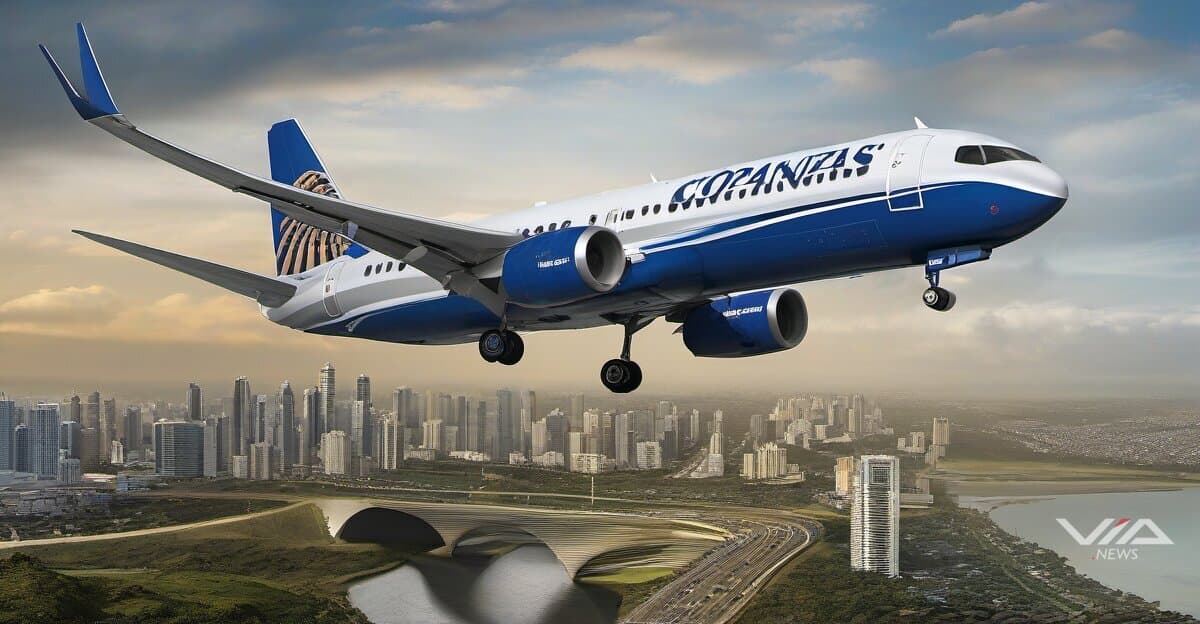
Among the world's regional carriers, few have executed a hub strategy as cleanly as Copa Airlines. Tocumen International Airport in Panama City occupies a rare geographic privilege: positioned near the narrowest point of the Americas, it sits almost precisely on the great-circle routes connecting North America, South America, and the Caribbean. The result is a connecting machine that rivals the operational efficiency of Dubai's Emirates hub model — a single node through which an entire continent's air traffic can be routed with minimal detour.
For Copa Holdings (NYSE: CPA), the parent company listed on the New York Stock Exchange, this architecture has translated into industry-leading on-time performance, enviable load factors, and margins that most Latin American carriers can only aspire to match. Wall Street has rewarded the model accordingly.
But the same logic that makes Tocumen so powerful makes it dangerous. And in an era of rising geopolitical friction — from trade wars to canal diplomacy — the risk is becoming harder to dismiss.
The Anatomy of a Single-Point Failure
In aviation, hub concentration is a known and managed risk. The world's largest carriers hedge it through geographic diversification. Delta Air Lines distributes exposure across Atlanta, New York-JFK, Minneapolis, and Los Angeles. Lufthansa operates meaningful hubs in both Frankfurt and Munich, with Brussels Airlines and Austrian adding further network resilience. Air France-KLM balances Charles de Gaulle against Amsterdam Schiphol. Even Gulf carriers, often cited as examples of extreme hub dependency, operate within sovereign environments of exceptional political stability and with state backing that functions as an implicit guarantee.
Copa has none of these buffers. As of 2025, Tocumen handles the overwhelming majority of the airline's connecting traffic across more than 80 destinations in roughly 33 countries. There is no secondary hub. There is no domestic network to fall back on. Panama is Copa's network.
This is not a concealed fact — the carrier has disclosed hub concentration risk in its filings with the U.S. Securities and Exchange Commission. What is less appreciated is what analysts describe as the correlation of failure modes. A disruption at Tocumen is categorically different from a winter storm grounding flights at Chicago O'Hare or a strike affecting Paris CDG. Those events impair one node in a multi-hub system. A disruption at Tocumen impairs Copa's ability to operate at all.
The Panama Canal Factor
What has elevated this from theoretical to pressing is the trajectory of U.S.-Panama relations. The Panama Canal — the waterway that moves approximately 5% of global maritime trade and connects the Atlantic and Pacific Oceans — has become a focal point of geopolitical tension following statements from Washington asserting influence over the canal's operation and fees. For a country whose national identity and economic sovereignty are inseparable from the canal, the diplomatic signals have been received with alarm.
For Copa, the stakes are direct and operational. The airline's commercial model depends heavily on U.S. traffic flows — American travelers transiting through Panama to South America, and codeshare agreements with U.S. carriers that feed Tocumen. Those partnerships require approval from the U.S. Department of Transportation. Overflight rights, bilateral air service agreements, and the broader Open Skies framework between the two countries are all instruments that a deteriorating diplomatic relationship could put in play.
Panama's civil aviation authority, the Aeronautica Civil, holds singular jurisdiction over Copa's operating certificates and route approvals. Unlike a multinational carrier that might appeal to multiple regulatory environments or relocate operations across borders, Copa has no domestic workaround if Panama's regulatory posture shifts — whether driven by bilateral treaty renegotiation, safety reviews, or political pressure from any direction.
Comparable Cases From Around the World
History offers instructive precedents. When U.S.-Cuba relations collapsed in the 1960s, Cubana de Aviación's international network was effectively severed overnight. The carrier never recovered its pre-revolution stature. More recently, Qatar Airways faced an existential crisis in 2017 when Saudi Arabia, the UAE, Bahrain, and Egypt imposed a blockade that closed their airspace to Qatari aircraft — forcing the carrier to reroute flights over Iran and dramatically increasing operating costs. Qatar's sovereign wealth backing and the eventual resolution of the crisis saved the airline; Copa would have neither resource in an equivalent scenario.
The case of Ethiopian Airlines offers a contrasting model worth noting: deliberately structured around a pan-African hub strategy that reduces dependence on any single bilateral relationship, it has built resilience into its network architecture even as it expanded aggressively. Copa's model, for all its elegance, has moved in the opposite direction.
What Investors Are Pricing — And What They May Not Be
Financial markets tend to misprice tail risks — low-probability, high-severity events — until they materialise. Copa Holdings currently trades at a valuation that reflects operational excellence and strong fundamentals. The geopolitical risk premium embedded in the stock remains modest relative to comparable single-hub carriers operating in politically complex regions.
For equity investors, the relevant question is not whether Copa's management is competent — it demonstrably is — but whether the market is adequately compensating holders for the asymmetric downside of a network that cannot function if its sole sovereign host becomes inhospitable.
For fixed-income investors, Copa's relatively conservative balance sheet provides some buffer against a temporary disruption. A full or extended network suspension is a different matter entirely, and one that debt covenants and liquidity ratios designed for normal operating conditions were not built to absorb.
A Global Aviation Lesson
Copa's situation is, in a broader sense, a case study in the tension between efficiency and resilience that runs through contemporary supply chain thinking worldwide. The pandemic exposed the fragility of just-in-time logistics. The Suez Canal blockage of 2021 illustrated how a single geographic chokepoint can paralyse global trade. The lesson drawn by strategists across industries has been consistent: optimised systems are brittle systems.
Copa Airlines has built perhaps the most optimised hub network in the Western Hemisphere. Whether that optimisation comes at an unacknowledged cost is a question that investors, regulators, and the airline's own strategists would be wise to examine — before geopolitics forces the answer upon them.
Sources:
1 Yahoo Finance, "BofA Lowers Copa Holdings (CPA) Target; Citi Sees Recovery Despite Fuel Headwinds" (March 19, 2026)
2 Yahoo Finance, "Copa Holdings, S.A. (CPA) Elicits Mixed Sentiments on Wall Street amid Operational Momentum" (February 23, 2026)
3 Yahoo Finance, "Copa Holdings Reports Fourth-Quarter and Full-Year 2025 Financial Results" (February 11, 2026)
4 Yahoo Finance, "Air Canada suspends Cuba flights as island set to run out of jet fuel" (February 09, 2026)