
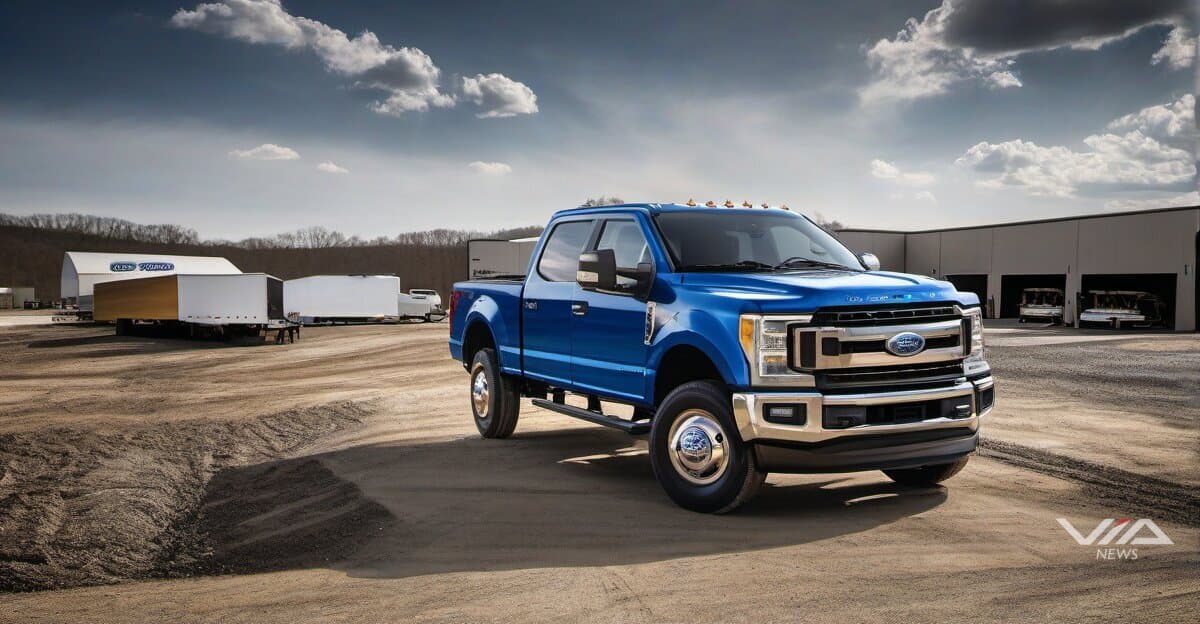
Ford Motor Company has made one of the most consequential strategic reversals in the current era of automotive transformation, announcing that BlueOval City — its sprawling Tennessee manufacturing complex originally conceived as the centrepiece of the company's electric vehicle future — will instead produce a new line of gas-powered Built Ford Tough trucks. The decision is being closely watched not only on Wall Street, but in boardrooms from Munich to Tokyo, as it reinforces a pattern of electrification hesitation that is now reshaping the global industry.
The Tennessee Truck Plant had been earmarked for a next-generation electric pickup, part of a multi-billion dollar manufacturing investment that Ford framed as its bet on the clean-energy transition. That programme has been shelved in favour of traditional internal combustion engine (ICE) vehicles — a segment where Ford's F-Series franchise has ranked as the best-selling vehicle line in the United States for more than four decades and remains one of the most profitable product lines in global automotive.
A Demand Problem Without Borders
Ford's leadership has framed the pivot as "following customers" — a phrase that carries significant weight in the broader global debate over how quickly mass-market EV adoption can realistically be achieved. The challenges cited by Ford's American buyers — range anxiety, towing limitations, sparse charging infrastructure, and persistent price premiums — are not uniquely American complaints. They echo consumer surveys from the United Kingdom, Germany, Australia, and across Southeast Asia, where mainstream EV uptake beyond early adopters has proven stubbornly slow outside of markets with heavy government subsidy regimes.
China remains the principal exception. Beijing's combination of purchase subsidies, manufacturing incentives, and urban registration restrictions has propelled domestic brands such as BYD, SAIC, and NIO to commanding positions in the world's largest auto market. BYD overtook Tesla in global EV sales volume in 2023 and has sustained that momentum into 2025. But even in China, growth rates have moderated as the subsidy-driven first wave of adoption reaches saturation in tier-one cities.
Ford Is Not Alone: A Sector-Wide Recalibration
Ford's retreat from BlueOval City's original mission is the latest in a sequence of high-profile EV target reductions across the Western automotive establishment. General Motors has trimmed production ambitions at its Ultium-platform plants. Stellantis — the multinational parent of Jeep, Fiat, Peugeot, and Opel — has delayed several electric models across European and North American markets. Volkswagen Group, once the most vocal European champion of rapid electrification, has announced factory restructuring in Germany and revised its EV volume targets downward amid weakening demand and intensifying competition from Chinese rivals.
The cumulative effect is a fundamental repricing of the electrification timeline that investors had baked into automotive sector valuations over the previous five years. Equity multiples that had rewarded aggressive EV commitments are now under pressure, while ICE-focused profit engines are being reassessed as durable rather than stranded assets.
Balance Sheet Consequences and Stranded Capital Risk
The financial implications of Ford's pivot are substantial. The company committed approximately $5.6 billion to the BlueOval City complex in partnership with South Korean battery manufacturer SK On, making it one of the largest single manufacturing investments in Ford's recent corporate history. Redirecting the facility away from EV production raises immediate questions about stranded capital, potential asset write-downs, and the future of Ford's battery supply arrangements with SK On — a company that has itself been navigating difficult negotiations with other Western automaker partners.
Ford's EV division, Model e, is widely projected to post losses exceeding $5 billion for the current fiscal year. Against that backdrop, the financial logic of pivoting BlueOval City toward high-margin ICE trucks is arithmetically straightforward, even if the long-term strategic calculus remains contested. The company's Pro commercial vehicle segment and its traditional truck business have been the profit engine sustaining Ford's overall financial performance while the EV transition burns capital.
Regulatory Headwinds — and Tailwinds — on the Global Stage
The timing of Ford's announcement intersects with a shifting regulatory environment. In the United States, the current federal administration has moved to soften EV mandates and roll back emissions standards that had effectively compelled automakers toward electrification on an accelerated schedule. In Europe, the 2035 internal combustion engine ban — enshrined in EU law — faces renewed political pressure from member states and automakers lobbying for flexibility, with Germany and Italy among the most vocal critics seeking carve-outs for synthetic fuels.
Japan, meanwhile, has consistently advocated for a technology-neutral approach through hybrid and hydrogen pathways, with Toyota's multi-technology strategy now appearing more prescient than it did when pure-EV mandates were at their political peak. For developing economies across Africa, South Asia, and Latin America, the affordability gap between ICE and electric vehicles remains a defining constraint, and the pivot by Western manufacturers may slow the trickle-down of EV technology to those markets.
What This Means for the Global Transition
Ford's BlueOval City reversal does not signal the death of electrification — but it does mark the end of the assumption that the transition would be linear, rapid, and supply-led. The revised consensus emerging across the industry is that EV adoption will be geographically uneven, segmented by vehicle class, and heavily contingent on infrastructure investment and price parity that remains years away in most markets outside China.
For investors, the practical implication is a reassessment of which companies and markets will lead the next phase of automotive competition. Pure-play EV manufacturers face a prolonged period in which legacy ICE profits fund their competitors' patience. For policymakers, the industry's recalibration is a signal that mandates alone — without coordinated investment in charging infrastructure, grid capacity, and consumer affordability — are insufficient to drive the pace of transition that climate targets demand.
BlueOval City was meant to be a monument to Ford's electric future. For now, it will build gas trucks. The world's automakers, and the governments that have staked climate commitments on their transformation, are watching closely.