
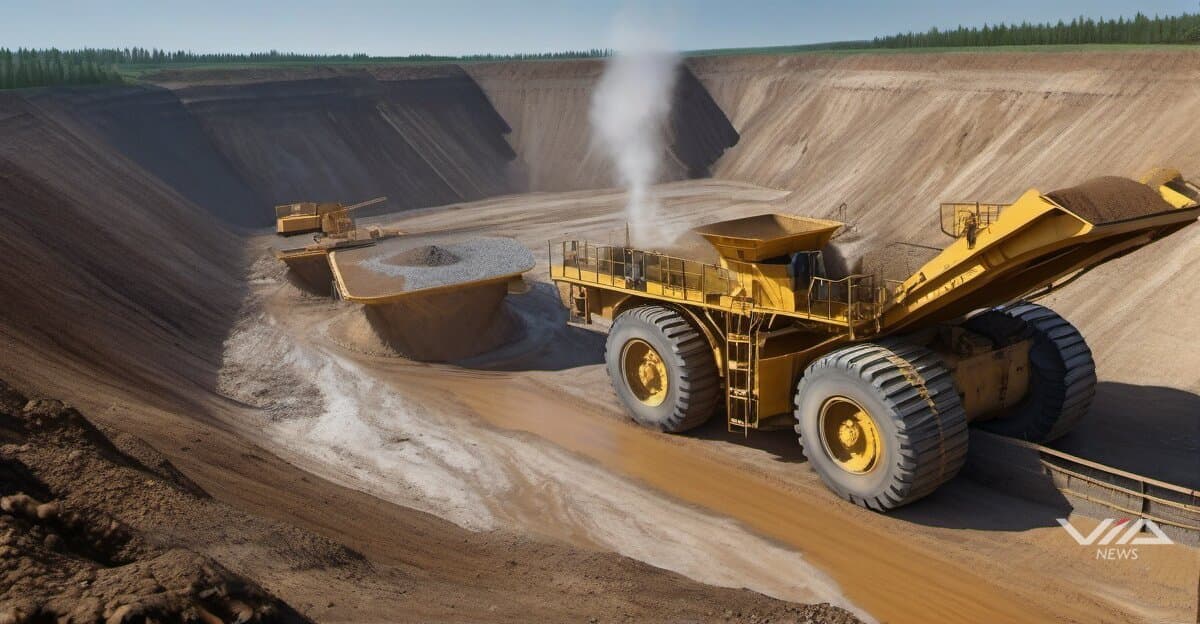
In a region where Romans once smelted copper and Ottoman engineers dug for silver, a 21st-century gold mine has just drawn its first ore to the surface. DPM Metals' Čoka Rakita project in eastern Serbia is not merely a mining milestone — it is a data point in one of the defining economic stories of this decade: Europe's race to secure its own critical mineral supply.
The underground mine, located 35 kilometres northwest of Bor in Serbia's historically resource-rich east, completed a robust feasibility study in November 2025 and has since moved directly into active extraction — a discovery-to-production timeline of under three years that would be considered fast in any jurisdiction on earth, and exceptional by European standards.
World-Class Economics in a Competitive Global Market
The project's financial profile invites comparison with the best new gold developments anywhere. At a reference gold price of $1,900 per ounce — well below current spot levels, which adds further upside — Čoka Rakita delivers an after-tax net present value of $782 million and an internal rate of return of 36%. Initial capital of $448 million is projected to be recovered within just 1.8 years of production start, a payback speed more commonly associated with high-grade operations in West Africa or Nevada than with European underground mines.
Probable reserves stand at 7.34 million tonnes grading 6.44 grams of gold per tonne, containing 1.52 million ounces — figures that represent a 10% improvement in tonnage and an 11% increase in contained ounces over the preceding pre-feasibility study. Annual throughput is planned at 850,000 tonnes, yielding an average of 148,000 ounces per year across the mine's life, with peak output of approximately 247,000 ounces forecast for 2031.
All-in sustaining costs of $644 per ounce place Čoka Rakita in the first quartile globally for cost efficiency — a metric that matters enormously in a commodity market where gold prices, though currently elevated, have historically been volatile. For context, the global industry average AISC sits above $1,300 per ounce; Čoka Rakita's cost structure gives it resilience that most producers can only aspire to.
Engineering for Depth and Recovery
Underground long-hole open stoping with cemented paste backfill is the chosen extraction method, accessed via two declines and a spiral ramp — a design well-suited to the high-grade, structurally sound ore body. Processing will combine gravity concentration and flotation to produce doré, achieving an average metallurgical recovery of 87.9%. The processing plant accounts for $63 million of initial capital, while a further $52 million has been allocated to tailings management and water treatment — a level of environmental infrastructure investment that reflects both regulatory expectations in Serbia and the reputational standards a dual-listed company must maintain.
Serbia in the Frame of European Mineral Strategy
The timing of Čoka Rakita's first production is geopolitically significant. The European Union's Critical Raw Materials Act, which entered force in 2024, sets binding targets for domestic extraction, processing, and recycling of strategic minerals. Gold itself is not on the EU's critical list, but the broader principle — reducing dependence on imports from politically unstable or geographically distant sources — applies directly to the investment thesis here.
Serbia is not yet an EU member, but it holds candidate status and has deepened economic integration with the bloc over the past decade. Large-scale, transparent mineral investment of the kind DPM Metals represents strengthens Serbia's credentials as a reliable partner in the European supply chain conversation — particularly at a moment when the bloc is actively courting mineral-rich candidate countries to diversify away from Chinese and Russian supply dependencies.
The Balkans more broadly are emerging as an underappreciated mining frontier. Serbia, North Macedonia, and Bosnia all sit on significant mineral endowments that remained largely underdeveloped through the post-Yugoslav transition period. Infrastructure improvements, regulatory modernisation, and rising commodity prices are now combining to attract the kind of tier-one capital that had previously flowed almost exclusively to Africa, Latin America, and Australia.
DPM Metals: Operational Credibility in the Region
DPM Metals — listed on both the Toronto Stock Exchange and the Australian Securities Exchange — brings direct regional experience that distinguishes it from purely speculative entrants. Its nearby Chelopech copper-gold mine in Bulgaria has been operating for years, giving the company established relationships with Balkan regulators, workforce pipelines, and logistical infrastructure. With zero debt and approximately $414 million in cash reserves as of late 2025, DPM enters the production phase from a position of unusual financial strength, insulated from the refinancing pressures that have derailed comparable projects elsewhere.
As gold prices trade at historically elevated levels and European policymakers seek to demonstrate that the continent can produce, not merely consume, strategic minerals, Čoka Rakita's first ore represents more than a corporate milestone. It is an early signal that Europe's mining renaissance — long promised, often delayed — may finally be arriving.