
Wednesday, August 19, 2026
What we know · the intelligence behind this page
Live from the substrate
What we're seeing
AI Platforms Rush to Establish Content-Authenticity Standards Amid Leadership Shakeups and Sustained Capex
Within days of each other in mid-August 2026, Google, Anthropic, and Spotify moved to formalize AI content watermarking and labeling policies, signaling an industry-wide push toward self-governed provenance standards as generative AI output floods consumer platforms. The shift coincides with executive turnover at OpenAI (Brad Lightcap's departure) and Meta's public AI manifesto, all set against continued heavy AI infrastructure capital expenditure and finance-sector moves (e.g., Wall Street paying for algorithmic edges on social signals) that underscore AI's deepening entanglement with capital markets.
Our read on the data ›
Signals we're tracking
EPKINLY Regulatory-Clinical Success Cascade
High probability of expanded label indications, additional combination approvals, and competitive positioning strength in follicular lymphoma market. Predicts positive commercial uptake and potential accelerated review for related indications.
Patterns we're watching ›
Where sources disagree
JPMorgan Chase & Co.
Both facts report JPMorgan Chase & Co.'s revenue for the same fiscal period (FY 2025) with the same observation date (2025-12-31), but with different values: $182.447 billion vs. $185 billion. The ~1.4% difference ($2.553 billion) is too large to be explained by rounding alone and represents conflicting data for the identical time period.
We flag conflicts openly ›
Recently verified
Checked against the original source
4,812
facts traced to their source — and we flag the ones that don't hold up.
101 entities tracked4,812 facts checked against source5,238 source documents archived
Work with this data → vianewsagency.com

What Muslim Community and Islamic Leaders Think About Women Wearing Hijab in Europe

Daniyal Daud

July 3, 2018
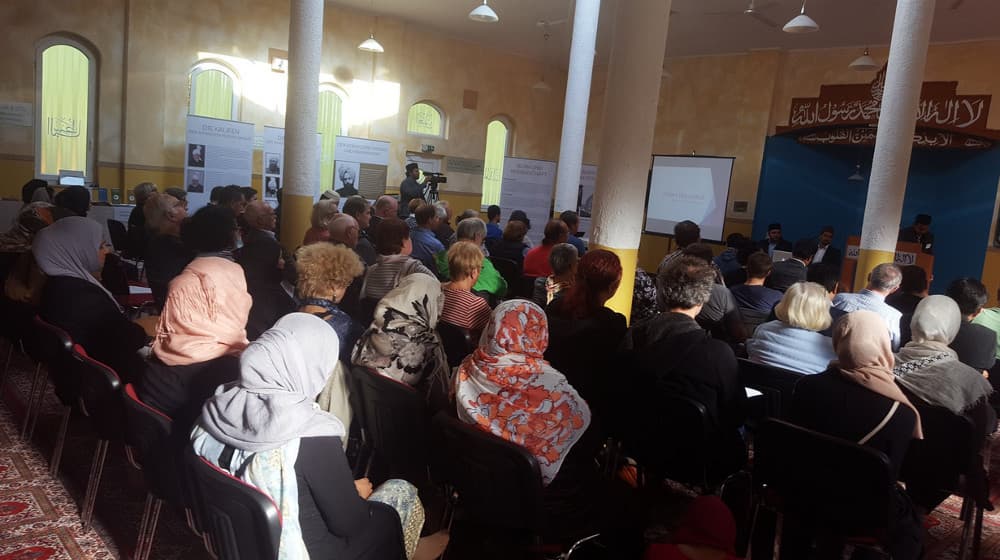
Muslim community- in koblenz, Germany. Women wearing hijab. Photo by: Tanveer
KOBLENZ, Germany (ViaNews) - I went to look for answers at the very heart of Europe, in Germany. Koblenz is a city in central Germany which I know well, so I talked to the Muslim community there so to understand its views about women wearing the hijab, the headscarf worn in public by some Muslim women. A Muslim man from an Asian country came to me and pointed out to the fact that a Muslim girl we both knew had suddenly decided to ditch her headscarf. The girl we were talking about is Farahnaz Boromand, a 17-year-old immigrant from Iran. I asked her about her decision and what she thinks about his comments. Her response was “my personal decisions should not concern anyone, Muslim men need to learn about boundaries and their religion”.

How the German Islamic leaders view the hijab

Imam Noman Khalid of the local Ahmaddiya mosque in Koblenz, Germany, told Via News that “it's their choice. Ladies should not be forced to wear hijab.” He further added that “although there is no punishment for not observing hijab, Islam commands both men and women to stay modest. This teaching is to prevent indecent behaviour in the society.” he concluded.

The opinion of another Muslim woman who wears a Hijab

Another Muslim lady Atia Bari, a 30-year-old mother, wears hijab because of her “cultural upbringing and also to abide by the religious teachings”. She said “I further understood the concept of hijab when I read about it and thence I was convinced in my heart. My personal opinion is that hijab begins within one’s heart and then you should wear a headscarf on your head.” She wishes that non-muslims understood that “hijab is not an obstacle for Muslim women”. She is well aware of the facts that some of the “European governments want Muslim woman to get rid of a piece of cloth on heads”. In a compromise, she has “stopped covering” her face because the culture allows it and she is still practising her chosen faith.

What the Islam teachings say regarding wearing the hijab

Non-Islamic cultures do not require women to wear hijab. What seems a surprise to many is the fact that Islam teachings don't also require women to wear hijab. To spell this out for Muslim men, sacred texts like the Quran are used to clear things out. One such teaching comes in the form of a sentence "Advise the Believing males that they restrain their eyes and guard their private sexual parts. This is purer for them." In the next verse, women are commanded the same. Another teaching reinforcing the same idea tells the story of the Prophet of Islam who was once riding with his companion Al Fadl ibn Abbas when a woman, described to be strikingly beautiful, approached to seek guidance in some religious matter. Al Fadl started staring at her. The prophet noticed it and he “reached his hand backwards catching Al Fadal’s chin and turning his face to the other side. So that he would not gaze at her”. Thus established that women did not need to be told or scolded for dressing in a way that revealed their body.

Society's take on using the hijab

We should make an effort to understand that these women need some space to adjust to the culture and when they decide to keep their headscarf on, we have the responsibility to encourage them and make them feel that they are part of the society. They have potential to accomplish anything either way. If we feel pride for Farahnaz’s decision to ditch her hijab we should also be accommodating to those who still wear it.