

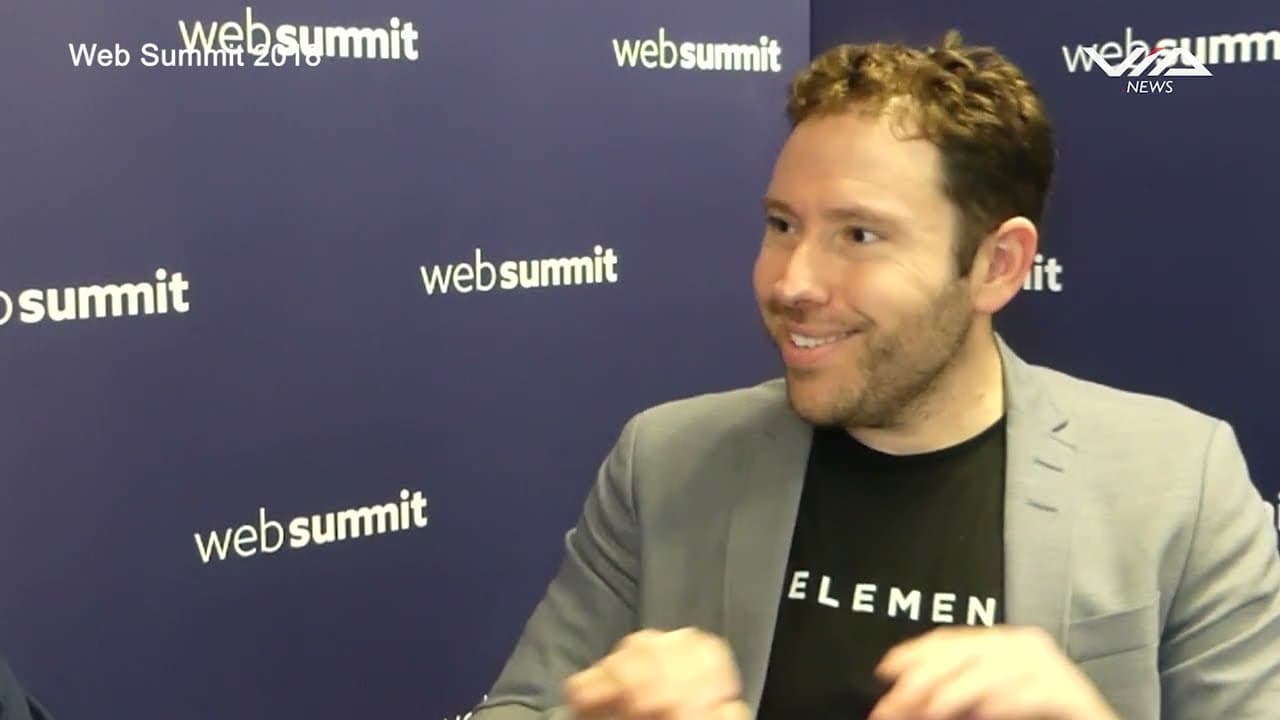
This interview was recorded about 2018.
Jean-François Gagné of Element AI says artificial intelligence will keep raising the productivity of office workers, and that each company will have to decide whether to take the gain as speed, lower cost or better quality. He also argues that society should be ready to redirect part of the resulting profits to deal with job displacement. He spoke to Via News at Web Summit, in an interview published on 17 December 2023.
From curiosity to practical use cases
Gagné said he gave four talks at the event, including three minutes on the main stage to present the company. Reaction, he said, showed that the level of maturity around the technology had improved sharply, although some curiosity remained about how to apply it in a given situation.
He described a clear change in the conversations he has had with business audiences. "Everyone is looking for practical use case. And I think that's the big contrast." Last year, he said, discussions were high level and asked what AI is and whether it could do this or that. This year, he said, people want to hear concrete examples.
Element AI's stated vision is to augment every decision, and it sells products as a service in the financial and supply chain sectors. Gagné pointed to a claims tool that lets a large insurer digest all the information around a car accident and reach an accurate decision in a matter of hours. Where the system's confidence is not high enough, a person steps in, and the system watches and learns so that it can handle the same case itself next time. The company also makes cyber security products.
He gave a second example delivered for the port of Montreal, where the company looks at the pattern of incoming vessels and orchestrates the logistics around them, including which container will be available when and which truck should arrive. Optimisation systems have existed for a long time, he said, and the new element is the ability to sense physical data such as weather, satellite information and signals from boats and trucks, and to combine it in real time.
Faster, cheaper or better
Looking ahead, Gagné said the main takeaway is that individual productivity will continue to rise. "Like productivity for all white collar jobs is going to go up and up and up and up." What companies do with that, he said, is up to the market and to the companies themselves.
He framed it as a choice between three options: shortening time to service, reducing costs by using fewer people to do much more, or personalising service at the same cost to a degree not possible before. In his words, "these are kind of the three main decision that company has when they really leverage artificial intelligence. Faster service, cheaper service, or higher quality service." He acknowledged that the cost option makes some people afraid, but said it is still a reality.
Asked about warnings from prominent entrepreneurs on the dangers of AI, he said new leverage creates new opportunity for products and services, but did not dismiss the worry about jobs. "I think that the job displacement topic is a fair one. And we need to mitigate these consequences." He said the world needs to be proactive, with the right governance in place.
We need to redirect a portion of these profits to alleviate the consequences.
Gagné said efficiency gains and the effort to ease the consequences are not well connected at present. He expects a lot of debate over the next ten years about what to do and at what speed, and believes that openness about the choices will lead to good outcomes.
Timeline and advice
On timing, he said a shift in the kind of work AI performs is likely within a defined window. "The five to 10 year time span I think is a fair one." He expects AI to take on more regular mundane tasks and even some cognitive ones, and noted that it has already taken on much of the load in programming by automating rules, patterns and processes with mathematical models rather than people writing code. The maximum impact on society, he added, will probably take a bit more time.
For a company looking to adopt AI, he said the starting point is the result it wants. "They should have a clear idea of their outcomes that they're looking for. And that's really where to start." The second step, he said, is to work out how an AI system can learn the context and signals that lead to those outcomes. Only with a clear roadmap should a company decide whether to build capabilities itself or look for a provider.
His advice to young entrepreneurs was to invest in themselves. The one outcome an entrepreneur is guaranteed, he said, is what they learn along the way, and he compared the habit of learning and adapting each day to the way Olympians train.
It has to be about your own purpose and make sure that your company is aligned with that purpose.
That purpose, he said, helps a founder rally people, get through the tough times and keep growing as a person.
Watch the full interview
Interview by LM Salvado (Miguel Salvado) for Via News.